2.5
In order to assess its ongoing compliance with the section 75 duties,
Oftel proposes that, over an initial three year period, it will evaluate
how each of the major policy areas identified conforms to the requirements
of the Act. This evaluation will be achieved by means of screening and
equality impact assessments which will be incorporated into the relevant
work area or project reviews. The process of conducting equality impact
assessments will be incorporated into Oftel's Management Plan. If it
appears, as a result of the consultation on this draft Equality Scheme,
that other policy areas should also be covered then Oftel will also
conduct equality impact assessments for those policy areas.
2.6 A review of the scheme's operation will be undertaken in compliance
with the requirements of the Act.
2.7 As Oftel does not have any employees in Northern Ireland, this route
to the promotion of good relations is not available. With regard to
the development of its own social policies, Oftel will be reliant on
the input of organisations based in Northern Ireland.
2. 8 In general,
Oftel has had some difficulties in identifying how its work can, in
any meaningful sense, contribute to the promotion of good community
relations anticipated in the Act. Oftel would welcome the views of consultees
on this subject.
2.9 Responsibility
within Oftel for taking forward Oftel's implementation of the section
75 duties will rest with Oftel's Regulatory Policy Directorate, within
which a Northern Ireland Equality team will be established. This Equality
Team will be a first point of contact for those making enquiries in
relation to Oftel's Equality Scheme and its equality impact assessments.
2.10 Oftel is committed to ensuring that the appropriate resources
(in terms of staff, time and finance) are in place to ensure that
its statutory duties under the Act are complied with, and that all
staff, including those not directly involved with implementation of
the Scheme, are aware of the requirements of the Act.
2.11 All actions proposed as a result of Oftel's Equality Scheme will
appear in Oftel's Management Plan, which is produced annually.
2.12 Oftel will submit a report each year to the Northern Ireland
Equality Commission relating to its implementation of the section
75 duties.

Chapter
3
Equality impact assessments
3.1 Oftel has assessed its existing policies in light of section
75 of the Act. Having done so, Oftel currently considers
that there is no likely impact on the promotion of equality of opportunity
for those existing policies, with the exception of those matters identified
at paragraphs 2.3 and 2.4 above. In relation to those identified matters,
Oftel will ensure, where appropriate and practicable, that these areas
are subjected to a further formal screening process which will assess
the impact of these policy areas against the categories of person
set out in section 75 of the Act. These procedures will be kept under
review.
3.2 Oftel considers that the rest of its policy and compliance work
does not need to be the subject of equality impact assessments as
Oftel considers at this stage that these areas do not raise equality
of opportunity issues. As required by the Act, Oftel will make an
assessment in relation to proposed and future policies as to whether
there is a likely impact on the promotion of equality.
3.3 As indicated above, Oftel considers that by reason of the nature
of its functions as a telecommunications regulator, the main assessments
that it will be making will be in respect of equality of opportunity
rather than in the promotion of good relations. That said, where assessments
in respect of the promotion of good relations are required they will
be made.
3.4 In conducting its equality impact assessments, Oftel will consider
the following:
- Whether there
is any evidence of higher or lower participation or uptake by different
groups;
- Whether there
is any evidence that different groups have different and addressable
needs, experiences, issues and priorities in relation to the particular
policy;
- Whether there
is any possibility of promoting increased equality of opportunity
or better community relations by altering the policy in relation
to Northern Ireland or working with others in government or in the
larger community; and
- Whether consultation
with relevant groups, organisations or individuals has indicated
that particular policies create particular problems which are specific
to them and which may need to be addressed separately.
3.5 Oftel currently consults on new policy proposals at an early stage.
In future, an initial equality impact assessment will also be undertaken
at this time and will be incorporated into the consultation process
with a view to assessing on a case by case basis whether any particular
equality issues are raised. This assessment will involve drawing upon
both quantitative and qualitative data from affected stakeholders.

Chapter
4
Timetable
4.1 Oftel will
follow the timetable set out in Annex C. The
methodology to be adopted will be that set out in the Equality Commission's
Guide to Statutory Duties: A Guide to the implementation of the
statutory duties on public authorities arising from Section 75 of
the Northern Ireland Act 1998 at pages 41- 46.
Monitoring
5.1 Oftel currently assesses the impact of its policies by means
of periodic reviews and consultations. These reviews are considered
essential to informed policy making. These reviews, insofar as they
relate to equality issues, will however be subject to a more formal
structure under the proposals for monitoring which are set out below.
5.2 Oftel will, over a period of three years, undertake formal equality
impact assessments in respect of all the areas identified in paragraph
2.3 and 2.4 above. As each equality impact assessment is undertaken,
Oftel will also evaluate its monitoring of these policies and assess
the accessibility of information already published. Oftel appreciates
that for its consultative documents to be an effective means of addressing
issues of exclusion, the format of its documents must be flexible.
It is therefore proposed that Oftel will keep under review its arrangements
for providing information in alternative formats (for example, language,
font size, Braille, etc) to ensure that information in those formats
is available in a timely fashion to those who require it. Oftel's
publications are already available in a variety of media.

Chapter
6
Publication of equality impact assessments and monitoring
6.1 Oftel will consult on the outcome of any equality impact assessment
and of any monitoring undertaken in relation to paragraphs 5.2 above.
The conclusions will be published in printed form and in alternative
formats following a request in writing. A version will also be placed
on Oftel's website: www.oftel.gov.uk.

Chapter
7
Consultation
7.1 The purpose of the consultation process will be to ensure
that the views of those likely to be affected are fed into Oftel's
policy development process. The consultations envisaged by this document
will formally commence once this scheme has been approved by the Northern
Ireland Equality Commission.
7.2 Where appropriate, Oftel will consult with the Northern
Ireland Equality Commission and the Community Relations Council on
issues relevant to the fulfilment of its section 75 obligations in
relation to the areas of Oftel's work which are identified as being
relevant to the section 75 obligations.
7.3 Oftel proposes to consult with all relevant public sector and
Non-Governmental Organisations (NGOs) on any equality impact assessments
that it carries out in relation to the areas of work identified as
being subject to the section 75 duties. Where an equality impact assessment
on new activities relates to a specific geographic area within Northern
Ireland, Oftel will consult the relevant District Council(s).
7.4 Oftel routinely consults on all of its major policy and compliance
decisions. This means that representations can still be made to Oftel
even where Oftel has decided that there does not need to be an equality
impact assessment. To assist Oftel in identifying potential equality
issues, those to be consulted (set out in Annex B) might find it useful
to subscribe to Oftel's mailing list which will automatically notify
them by e mail of all new Oftel publications.
7.5 The list of those to be consulted will be updated when Oftel is
made aware of any new bodies that should be on the list. Oftel welcomes
the input of stakeholders in ensuring that its contact lists are both
up to date and accurate.
7.6 Oftel's current guidelines generally allow a period of three months
for responses to its consultation documents on broad matters of regulatory
policy . In order to ensure that the processes set out in this consultation
are put in place as swiftly as possible, Oftel considers that it is
appropriate to depart from a period of three months in this case and
proposes consulting for a period of two months on this draft scheme
which is in accordance with the statutory requirement of the Act.
7.7 As part of its consultation process on new areas of policy, Oftel
sometimes uses public meetings, focus groups, attitude surveys and
market research. Interested parties can, if appropriate, meet with
the relevant officials to make oral representations to Oftel. Where
public meetings are convened, they will be at locations and times
considered to be the most convenient for those who are to be consulted
in order to encourage the fullest participation.
7.8 Oftel has recently issued a consultation document, which aims
to assess and update the way in which Oftel consults with stakeholders.
The consultation document of February 2001 entitled Oftel's use
of public consultation is available on Oftel's website.
7.9 The consultation
will run until 6 July 2001. A further 2 weeks will be allowed to submit
comments on comments.
7.10 Any comments
should be made in writing and sent to:
David Parsons
Regulatory Policy Directorate
Oftel
50 Ludgate Hill
London EC4M 7JJ
david.parsons@oftel.gov.uk
7.11 Written comments
will be made publicly available in Oftel's Research and Intelligence
Unit except where respondents indicate that their response, or parts
of it, are confidential.
7.12 Respondents
are asked to separate out any confidential material into a confidential
annex which is clearly identified as containing confidential material.
In the interests of transparency, respondents are requested to avoid
confidentiality markings wherever possible.
7.13 Oftel has
a free e-mail based mailing list to help people stay informed about
the work that Oftel is doing. Each time an Oftel document is published
and placed on Oftel's website subscribers to the list receive an e-mail
informing them about the document. If you would like to join please
use the electronic form on the website to add yourself to the list.
There is a link to the form from the What's new section of the site.
The consultation
criteria
Oftel considers
that this document meets the Cabinet Office code of practice on written
consultation documents. The code is reproduced below for convenience.
If you have any comments or complaints about this consultation process
please contact:
Oftel Co-ordinator
for the code of practice:
Robert Jex,
Oftel,
50 Ludgate Hill,
London EC4M 7JJ,
e-mail: rob.jex@oftel.gov.uk
tel: 020 7634
5340
fax: 020 7634 8943
1) Timing of consultation
should be built into the planning process for a policy (including
legislation) or service from the start, so that it has the best prospect
of improving the proposals concerned, and so that sufficient time
is left for it at each stage.
2) It should be
clear who is being consulted, about what questions, in what timescale
and for what purpose.
3) A consultation
document should be as simple and concise as possible. It should include
a summary, in two main pages at most, of the main questions it seeks
views on. It should make it as easy as possible for readers to respond,
make contact or complain.
4) Documents should
be made widely available, with the fullest use of electronic means
(though not to the exclusion of others), and effectively drawn to
the attention of all interested groups and individuals.
5) Sufficient
time should be allowed for considered responses from all groups with
an interest. Twelve weeks should be the standard minimum period for
consultation.
6) Responses should
be carefully and open-mindedly analysed, and the results made widely
available, with an account of the views expressed, and reasons for
decisions finally taken.
7) Departments
should monitor and evaluate consultations, designating a consultation
co-ordinator who will ensure that all the lessons are disseminated.

Chapter
8
Public access to information and services
8.1 Oftel is determined to build upon what it has already achieved
in communicating its policies to the public. For example, last year
Oftel's website received more than half a million visits. The consultation
document referred to in paragraph 7.8 is another example of how Oftel
periodically re-examines the way in which it communicates with its
stakeholders. To assist this process, further periodic reviews will
be undertaken on the way in which Oftel communicates its policies
(including those that are the subject of the section 75 duties). In
such reviews, Oftel will consider:
- the adequacy
of existing provision of information in accessible formats, for
example, Braille, large font, audio and minority ethnic languages
together with how they may be improved;
- the likely
demand for information in alternative formats in relation to Oftel's
activities which are subject to the section 75 duties;
- what information
on Oftel's functions and services needs to be communicated to all
groups or only some groups and how best this targeting can be achieved;
- the requirements
of the Data Protection Act 1998, the Disability Discrimination Act
1995 and any other relevant statutes;
- resource implications
in carrying out the section 75 duties;
- the recommendations
of the cross departmental Promoting Social Inclusion (PSI) working
group on minority ethnic groups and their access to information.
8.2 Oftel's consultation documents are all published on Oftel's website.
A press notice also accompanies many publications. In future, Oftel
proposes that it will ensure that its press notices, insofar as they
relate to its section 75 duties, will be sent to all three Belfast
daily newspapers, including the North West version of the Belfast
Telegraph. Where press notices are aimed at a particular geographical
area within Northern Ireland, Oftel will ensure that the press notice
is available to local newspapers circulating in that area. Where specialist
press exist, Oftel will endeavour to ensure that copies of the press
notice are distributed to those specialist publications.
8.3 Oftel's commitments, set out in this scheme, to ensuring equality
of opportunity in relation to access to information are not limited
to any rights to information set out in the current Code of Practice
on Open Government or the Freedom of Information Act 2000.

Chapter
9
Training and awareness raising
9.1 Oftel will seek to ensure that its staff (at all levels of
responsibility) receive appropriate awareness raising training on
the section 75 duties. For new staff it is proposed that this will
be incorporated into Oftel's general induction programme on equal
opportunities. Each member of staff will receive a copy of Oftel's
Equality Scheme. Oftel will report annually on its training programme
(insofar as it relates to equality issues and the section 75 duties)
to the Equality Commission for Northern Ireland.

Chapter
10
Complaint handling
10.1 Where a person or persons believe that they have been affected
by a failure of Oftel to comply with its section 75 duties, then they
should in the first instance direct their complaint to Oftel's Regulatory
Policy Directorate, Northern Ireland Equality Team. Following receipt
of the complaint, the Equality Team will initiate an investigation
of the complaint and will respond to the complainant(s) within one
month of receipt of the complaint. In response to the complaint, Oftel
will inform the complainant(s) of the procedure for pursuing the complaint
with the Equality Commission as described in paragraph 10 of Schedule
9 of the Act. If the Equality Commission decides to investigate any
complaint or any other matter falling within paragraph 11(1)(b) of
Schedule 9 of the Act, Oftel will respond as appropriate to any such
investigation or complaint.
10.2 Oftel recognises that some people find it difficult to
make a written complaint. In view of this, complaints can be made
by telephone (at local rate to Oftel's Consumer Representation service
on 0845-714 5000), in person or via a group representative.
Oftel's staff will be given the necessary training in order to handle
such complaints.

Chapter
11
Publication of the scheme
11.1 Following this consultation, Oftel will submit its Equality
Scheme (which will, as appropriate, reflect the comments received
on the draft during the period of consultation) to the Commission.
The scheme will be available in print form and alternative formats
on request from: Oftel, 50 Ludgate Hill, London EC4M 7JJ (tel: 020-7634
8761). Copies will also be available from Oftel's website at: www.oftel.gov.uk.
Oftel is required to consult on this scheme in accordance with any
directions given by the Equality Commission. The Equality Commission
has issued directions and this consultation is in accordance with
them.
11.2 Once the Equality Commission has approved the scheme, a further
version, revised as necessary, will be made available in the ways
identified above.

Chapter
12
Review of the scheme
12.1 The scheme will be reviewed in accordance with the requirements
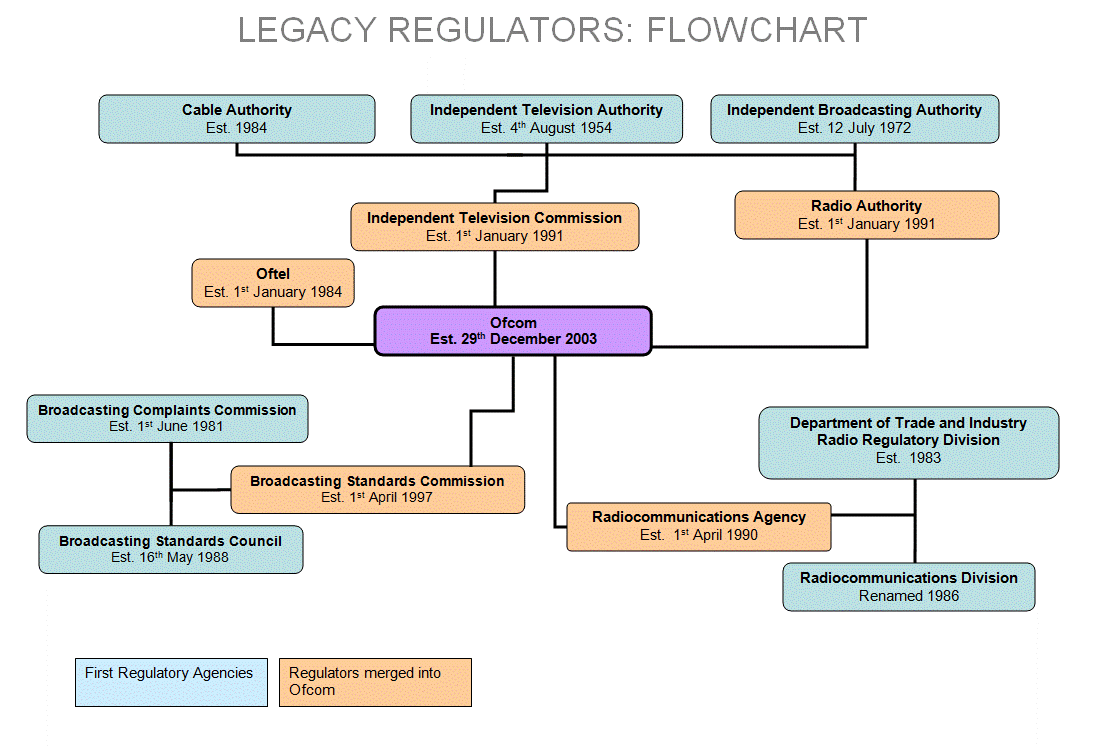
of the Act. Oftel would anticipate that Ofcom, its successor body,
would take account of Oftel's experiences in this regard.

Annex
A
Main groups identified by Oftel for the purposes of discharing its
section 75 duties
| CATEGORIES
OF PERSON IDENTIFIED IN S 75(1) (a)-(d) |
MAIN GROUPS
IDENTIFIED |
| Religious
belief |
Catholics;
Protestants and people of other recognised religious beliefs |
| Political
opinion |
Members or
supporters of Nationalism generally; Members or supporters of
Unionism generally; members or supporters of any other recognised
political party |
| Racial group |
Afro-Carribean
people; Black African people; Chinese people; Indian people; Pakistani
people; Travelling people; White people; people of mixed race
|
| Men and women
generally |
Men and women |
| Marital status |
Married people;
unmarried people; divorced or separated people; widowed people
|
| Age |
People of
school age; people of working age; people of retirement age |
| Persons with
a disability |
Those persons
(as identified in sections 1 and 2 of the Disability Discrimination
Act 1995) with a learning, a physical or sensory disability |
| Sexual orientation |
Bi-sexuals,
gays; lesbians; heterosexuals, trans-gendered people |
| People with
or without dependants |
All people
with or without dependants |

Annex
B
List of consultees
In addition to Oftel's list of industry and non-industry consultees
Oftel proposes the following which is non-exhaustive.
AIAC
Age Concern
Association of Chief Officers of Voluntary Organisations
Belfast Centre for the Unemployed
Blind Centre (NI)
NI Association for the Care and Resettlement of Offenders
Carers National Association Northern Ireland
Community Relations Council
Craigavon Standing Conference of Women's Organisations
Disability Action
East Belfast Community Development Agency
Enterprise, Trade and Investment Assembly Committee
Equality Commission for Northern Ireland
Federation of Small Businesses
Fermanagh Women's Network
Gingerbread Northern Ireland
Head of Department, Consumer Studies Department, UUJ
Health and Social Services Councils
Help the Aged
Housing Rights Service
ICTU
Law Centre Northern Ireland
Multi-cultural resource Centre
Newry & Mourne Women
NIACAB
NIACT
NICVA
NISRA
North West Community Network
North West forum of People with Disabilities
Northern Ireland Anti-Poverty Network
Northern Ireland Council for Ethnic Minorities
Northern Ireland Human Rights Commission
Northern Ireland Youth Forum
Northern Ireland Women's European Platform
Northern Ireland Political Parties
Omagh Women's Area Network
Putting Children First
Rural Community Network
Rural Development Council
West Belfast Economic Forum
Women's Forum
Women's Information Group
Women's Support Network
Youth Council for Northern Ireland

Annex
C
Proposed timetable
The following summarises the actions which Oftel proposes taking
over the three years following submission of this Scheme to the Equality
Commission.
| PERIOD |
PROPOSED
ACTIONS |
| May -June
2001 |
Consult on
draft equality scheme |
| July 2001 |
Submit scheme
to Northern Ireland Equality Commission incorporating representations
received during the consultation stage |
| Following
Equality Commission's approval |
Implement
the additional processes set out in the scheme to ensure compliance
with section 75 duties. |