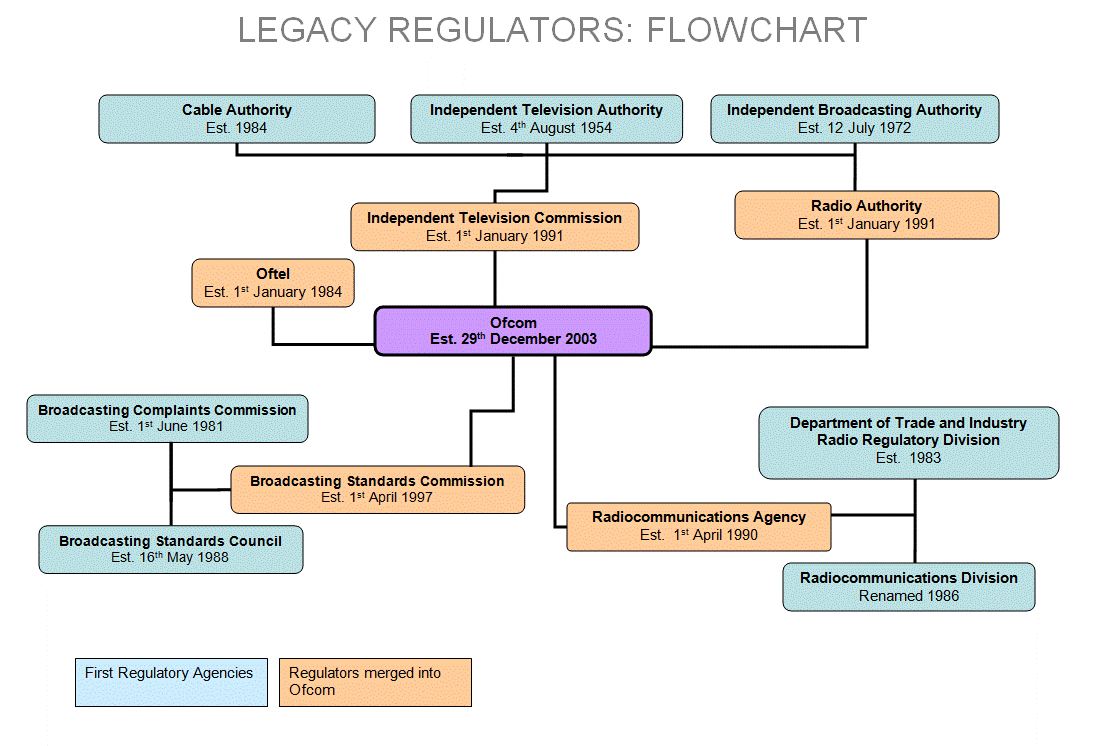
| Oftel strategy statement: Achieving the best deal for telecoms consumers | ||||||||||||||||||||||||||||||||||||||||||||||||||
|
January 2000
1. Telecommunications are critical to the development of modern economies and the participation of all in a modern society. 2. Telecommunications in the UK, as elsewhere, are undergoing rapid change. This change is being driven by increasing competition and rapid technological advances, including the convergence of telecoms, IT and broadcasting technologies, which will offer new opportunities for both suppliers and consumers. These changes are far-reaching. For example the Internet, using telecoms networks, has the potential to change radically business practices and to impact on the way in which ordinary citizens communicate, learn, shop and participate in modern society. 3. Regulation has a key part to play in this process. Until now, regulation has focussed on managing the transition from a market dominated by a former state-owned monopoly towards a competitive market. Much progress has been made, with competition growing significantly, although not all market segments are yet effectively competitive. It is now time to set a regulatory strategy which provides a coherent approach at a time of rapid change. 4. This Statement sets out Oftels strategy to achieve its goal of the best deal for consumers in terms of choice, quality and value for money. The strategy is designed to ensure that regulation is only imposed where it is justified and that it is appropriate to the level of competition in the market. Oftel must be clear where and why it needs to regulate as regulation where none is justified can distort or undermine competition. Competitive markets, which have incentives to innovate and invest, are the best way of meeting consumer needs. 5. In terms of moving forward there are two key parts to the strategy statement:
6. The Strategy retains Oftels current goal of: obtaining the best deal for the consumer in terms of quality choice and value for money. However, this is pursued through seeking to achieve four new underlying objectives of:
7. These objectives are a refocusing of Oftels current objectives but with the very important difference that they are now directed towards specific market outcomes rather than, as previously, requiring Oftel mechanically to undertake particular activities (eg promoting network competition). This change in focus will lead to a different approach in Oftels work in the future. The new objectives will be underpinned by ten principles of regulation to guide Oftel policy development and its implementation and which embody that change in approach. 8. The strategy is one of 'competition plus'. Competition is the key driver to obtain the best deal for the consumer. 'Competition plus' recognises that, given the nature of telecoms networks and the critical role of telecoms services for users, there are circumstances where some formal or informal regulatory action is needed to protect consumers' interests in addition to the achievement of effective competition. An example is the provision of universal telecommunications service. 9. The Strategy will bring a new approach to Oftels work which will mean that as competition develops further, and provided that Oftel is satisfied consumers are adequately protected, telecoms regulation will be progressively reduced. In this way the telecoms market will be governed increasingly by the same legal requirements as are placed on other industries in the economy rather than through telecoms specific regulation. This means that the case for any new regulation will be scrutinised very closely and new regulation will only be introduced if it is absolutely necessary for the promotion of competition and for the protection of consumers, and if these aims cannot be achieved in any other way. Regulation will be as light touch as possible alternatives to formal regulation such as co-regulation or self-regulation being considered wherever possible. Existing regulation will also be subject to scrutiny to see if it continues to be needed. In particular, Oftel will be looking to see if current formal regulation in licences can be removed, or replaced by self-regulation or co-regulation (eg as in the provision of Comparable Performance Indicators) if necessary to provide continuing protection or better information for customers. 10. Implementing the strategy will result in greater predictability of Oftels actions and the appropriate use of a range of less formal regulatory structures, to be able to respond quickly and effectively to a rapidly changing market. 11. In particular, the strategy means looking at what has been done to 'promote competition' in the past and to assess, in the light of developing competition, whether such promotion is still needed. 12. For Oftel implementing the strategy will mean:
13. Successful implementation of the strategy will need the commitment and involvement of Oftels key stakeholders from industry and consumer groups, particularly in self-regulatory and co-regulatory initiatives. 14. The prospect is of telecoms consumers enjoying better quality, choice and value for money with less need for regulation but without a loss of protection. 15. The strategy is designed to be a basis for coherent policy making and implementation for the next few years but recognises the market is changing rapidly. It will therefore be necessary to monitor the strategy outlined here to ensure it continues to be relevant. Introduction 1.1 Telecommunications is undergoing rapid change. Consumers are demanding and using more, new and better services from an increasing range of suppliers. As the telecommunications market is subject to sector specific regulation, all those with a stake in the successful development of telecoms - consumers, consumer groups, telecoms network companies, service providers and investors - need the regulator to clearly set out its strategy where it is going and how it intends to get there. While setting a strategy cannot give stakeholders certainty, it can give predictability. 1.2 Oftels strategy during most of the 1990s has been about promoting competition and protecting consumers, particularly where competition is not yet effective. But the telecoms market is changing. There is increasing competition in existing sectors of the telecoms market and increasing convergence between different communications technologies and markets. These changes impact on the regulatory strategy needed to ensure that it is fully applicable to a converged world. 1.3 Oftels strategy set out in this statement is designed to ensure regulation is justified and appropriate to the level of competition in the market. Oftel must be clear where and why it needs to regulate to achieve the overall goal of the best deal for the consumer in terms of choice, quality and value for money. Competition is the means to best protect consumers interests. 1.4 Competitive markets with incentives to innovate are fundamental to meeting consumer needs. Regulation must not undermine such incentives but instead should be directed towards achieving effective competition and, as necessary, protecting consumers before it is achieved or where there is a need for additional protection. This requires a more focussed regulatory approach based on competition but with the overall focus that of protecting consumers. It is likely to involve less regulation than to date but not less protection for consumers. 1.5 Regulation where none is justified can distort or undermine competition, by for example, encouraging inefficient suppliers to enter the market, thereby raising costs. Over- regulation can also be detrimental to consumers by reducing the incentive for innovation and development of services. Equally, however, a failure to regulate where it is needed could lead to consumers' interests being damaged. The regulatory tools chosen should therefore be appropriate to the circumstances: as competition increases so lighter regulatory tools become necessary. 1.6 In establishing a strategy to reflect the changes that are gathering pace, this statement sets out
Consultation process 1.7 In preparing this statement Oftel has involved a wide range of its stakeholders. Presentations were made to, and discussions held with, industry and consumer fora during the period October to December 1999. A discussion document was issued to key stakeholders and others in October and written comments on the document received from around 30 organisations. 1.8 The responses all welcomed the opportunity to comment on strategy development and welcomed Oftels transparency of approach in this area. 1.9 The views expressed in responses can be summarised as broadly falling into the following categories:
1.10. These responses have been helpful in drawing up this strategy statement, for example in clarifying the concepts of co-regulation and self-regulation. Also several respondents asked that the tests of effective competition be more explicitly set out. As can be seen from Chapter 4, Implementing the strategy, further involvement of stakeholders is planned in terms of the critical task of developing the tests of determining whether there is 'effective competition'. The need for a strategy Why telecommunications markets have been regulated 2.1 Telecommunications plays an increasingly critical role in the operation and success of both individual businesses and national economies, and in ensuring access to communications for all. It underpins the coming electronic age. 2.2 During the 1980s and 1990s, the leading economically developed countries have allowed new telecoms suppliers to enter their domestic markets, challenging the former state run monopoly telecoms suppliers which have been partly or fully privatised. To manage these processes of change, and to provide the regulatory certainty necessary to encourage investment, telecoms sector specific regulatory bodies have been established. 2.3 In the UK, the Office of Telecommunications (Oftel) is the sector specific telecoms regulator. Oftels goal is 'to enable the customer to achieve the best deal in terms of quality, choice and value for money'. This goal has been pursued to date through the following five objectives:
2.4 Oftel has pursued its goal primarily through promoting competition in telecoms as the best way to deliver the benefits to consumers of lower prices, wider choice of services and better value for money. In pursuing this approach, however, Oftel has also recognised that
Changes in telecoms markets 2.5 But the UK telecoms market is changing in two ways - more competition between telecoms suppliers and an increasing trend towards convergence of technologies and between market segments. 2.6 Competition between telecoms suppliers is developing rapidly. For example around 50% of UK households - some 12 million homes - now have a choice of direct-to-the-house fixed link telephone provider (ie use of the cable companies or BT), compared to virtually no choice some 6 to 7 years ago. Business customers in the main city centres are likely to have a choice of 3 or more directly connecting suppliers. All customers have a wide choice of suppliers to carry long distance calls (especially international), with over 50 telcos now active in this sector of the market. 2.7 In the mobile market segment, there are approaching 25 million customers. Most customers have a choice between four mobile networks compared to only two at the start of the 1990s, as well as between a number of independent service providers. 2.8 In accessing the Internet, customers have a choice of a wide range of service providers who are in turn using several different telecoms suppliers. 2.9 Convergence of technologies - for example between telecoms, broadcasting and IT, integration between mobile and fixed telecom services increasingly blurs the distinctions between existing markets, increases the scope for competition and provides greater opportunities for consumers. 2.10 More competition in existing telecoms markets and the impact of convergence enabling different delivery systems to compete with each other in terms of carrying a range of telecoms, broadcasting and interactive services means that the need for and approach to regulation requires re-assessment. 2.11 There are also changes in the legislative framework taking place and these need to be recognised in this reassessment. Changes in legislative framework 2.12 The 1984 Telecoms Act has been the basis for telecoms regulation in the UK. Recent changes have had an impact on the legislative framework. EC Directives - such as the Interconnection Directive, the Licensing Directive and the Revised Voice Telephony Directive now determine a significant proportion of a telco's licence conditions. The Data Protection Act 1998 provides a statutory underpinning of consumers' rights. 2.13 However there are a wide range of new and developing items of legislation which are and will be increasingly relevant eg:
Changes in regulation 2.14 The development of competition, the growth of convergence and substantial changes in the legislative framework outlined above require a reassessment of the present regulatory approach in terms of:
2.15 These changes imply that the present balance between the different controls on market behaviour need to be reviewed, the controls being:
2.16 A feature of increasingly competitive markets is the emergence of third parties able to provide information to consumers. The provision of such information should not be impeded by regulation or other obstacles. 2.17 The starting point for the reassessment is as follows:
2.18 The approach to developing a revised strategy is to identify clear, attainable objectives and then to set out how they can be achieved starting from where we are now. Competition had grown rapidly in the recent years and it is now necessary for Oftel to reconsider its regulatory role in competitive, or prospectively competitive, segments of the market. 2.19 This in turn indicates a need to restate Oftels existing (activities based) objectives in terms of outcomes of what further needs to be achieved over the next four to five years. These revised objectives are then supported by a set of principles designed to guide in a coherent way how Oftel regulates to meet the objectives consistent with promoting the interests of the customer whilst keeping regulation to the minimum necessary. In a world of rapid change with new products and services being developed and with fundamental changes in the underlying delivery mechanisms, there is a danger that over-regulation may reduce the incentives for investment and innovation. 2.20 The strategy therefore includes three elements as summarised in Figure 1 below and discussed in detail in chapter 3: Figure 1 - Structure of Oftel strategy:
The strategy provides the framework within which the various licence conditions, guidelines and rules currently exist and can be applied in a consistent and coherent basis. 2.21 The principles underlying the strategy are not mechanistic and cannot be as flexibility is needed in a changing environment. They require judgement in application and a more clearly focussed approach, concentrating attention on those areas where regulation can bring benefit and withdrawing where it is no longer required or is likely to have a negative impact. 2.22 To be effective, the strategy requires clarity over how it will be implemented and the mix of competition plus formal or informal regulatory mechanisms that can best achieve the overarching strategic goal. These aspects are considered in Chapter 4. A strategy for Oftel 3.1 The strategy resulting from the above analysis is set out below. Goal and objectives 3.2 The goal of achieving the best deal for consumers in terms of quality, choice and value for money is still central; the following four outcome based objectives have been set to achieve this:
Each of the outcome focused objectives is explained briefly below and related, as appropriate, to the proposed EU regulatory principles as set out in the Commission Communication Towards a new framework for Electronic Communications infrastructure and associated services (Com (1999) 539). Effective competition The outcome sought is the benefits of effective competition (ie lower prices, higher quality, more choice of services for consumers) rather than competition for its own sake. The term effective competition means that it is sustainable (ie does not depend on sector specific regulation to survive) and that consumers are able to exercise choice effectively. Effective competition is defined Chapter 4 below. Well informed consumers able to take advantage of choice To achieve this objective sufficient number of consumers must have adequate, reliable information so that they are in a position to choose the combination of services and suppliers that benefits them most. This objective is shown separately to that of effective competition although clearly well informed consumers are a necessary element of an effectively competitive market. Its separate status as an objective is to focus attention on achieving a key feature of a services market such as telecoms and one that is easily overlooked in conventional analyses of those markets. Adequately protected consumers This objective recognises
Prevention of all significant anti-competitive practices Achieving this objective will, in part, depend on achievement of the first objective (of effective competition benefiting consumers) but also on the impact of rigorous and vigilant policing of anti-competitive behaviour by Oftel and the effect of the potentially large fines under the Competition Act in discouraging anti-competitive behaviour through incentives on suppliers to ensure compliance. Overall The four objectives overall are consistent with the proposed EU regulatory principle, as set out in the Communication referred to in paragraph 3.2, which states that "regulation should be based on clearly defined policy objectives fostering economic growth and competitiveness thereby promoting employment, and ensuring objectives of general interest where they are not satisfied by market forces". Supporting principles 3.3 To ensure that the objectives are met in a coherent way with the application of a consistent approach for similar situations, a set of principles is required for each objective. The principles are set out below. Appendix 1 gives an explanatory paragraph about each principle.
3.4 Overall the principles set out above are consistent with the proposed EU regulatory principles in the Commission's Communication of
3.5 The strategy comprising Oftels goal, objectives and principles is a basis for Oftels decision making. It is recognised, however, that implementation of the strategy is not wholly unconstrained since there are existing sets of licence conditions, rules and guidelines, for example based on EC directives which have to be taken into account. As part of the process of implementing the strategy existing guidelines and licence conditions will, where feasible, be reviewed to see if they fit with the strategy. Where they do not changes to the guidelines or conditions will be sought. Implementing the strategy 4.1 Having identified a strategy, it requires a positive process of implementation, both in terms of how it is implemented and in identifying who is best placed to implement different elements of the strategy. Without positive actions on both these fronts, there is a danger of an incremental, unplanned, reactive growth of formal regulation as a 'catch-all' response to perceived problems in the telecoms market and other converging markets. This is unlikely to be either in consumers' or suppliers' interests as over-regulation could undermine incentives to innovate and invest. How to implement the strategy 4.2 To implement the strategy all stakeholders need to be clear as to the methods and the timescales for implementation. These are set out below. 4.3 Successful implementation of the strategy should enable two key questions to be answered:
4.4 These questions can best be answered through thorough periodic reviews of segments of the telecoms market that are currently regulated. The market is changing rapidly and a structured series of reviews is the most appropriate means of assessing whether regulatory action is required. The advantages of such an approach is that all of Oftels stakeholders have a clear understanding of conclusions reached as to whether regulation is needed and confidence in the regulatory process at a time of rapid change. 4.5 The focus of these reviews will be on the extent of competition and the role of consumer protection. This therefore involves two types of review, one identifying the competitiveness of market segments, and the other identifying if regulatory tools for consumer protection are consistent with the principles underlying the objective of 'consumers adequately protected'. For investors, suppliers, consumer groups and others, the timing and frequency of these reviews needs to be predictable and appropriate to the speed of change taking place. To do this means establishing two cycles of reviews - one cycle for markets and one cycle for consumer protection policies - to identify whether, and if so what, regulation is required and to take appropriate action as a result. 4.6 It is recognised that the review process set out below represents a significant new feature of regulation. Oftel will be taking forward the review process in full consultation with stakeholders. The first such workshop will be held in the first quarter of 2000. Market segment reviews 4.7 Reviews of key market segments will be carried out on the basis of a two year cycle set out in advance. This timetable will help all involved industry players, consumers and consumer groups and other government departments to be aware of the process, to be able to input to the reviews and to be prepared for changes in regulation that may take place subsequent to the review. 4.8 Figure 2 below sets out Oftels proposed market segment review cycle. This gives indicative timescales for reviews of market segments which will be firmed up through the forthcoming consultation on Oftels 2000/01 management plan and the stakeholder workshop referred to above in 4.6. 4.9 Reviews of competition in connection with controls on prices for BTs retail and interconnection services have been undertaken every four or five years, ie in line with the duration of the price caps. These periods have been judged appropriate to balance the desirability of providing BT with incentives to reduce costs over a reasonable period of time against the needs to ensure that prices do not become significantly out of line with costs (which is more likely with a longer cap) and to reflect changes in technology and market conditions in price cap reviews. Oftel intends to keep the four year period for price controls. However in other areas it believes a two year review is more appropriate given the rate of change taking place. 4.10 The two year market segment reviews proposed for non-price capped services are not linked to 'incentive regulation' of the type used in price caps. Other influences on review timescales (eg resulting from EU developments) will need to be reflected in the cycle as appropriate. The review of the access to bandwidth market will take place, as announced in Oftels recent statement, in 2005 which is an appropriate timescale given that this is a new market segment. It should be noted that the mobile market review will now start in September 2000. Figure 2: Market Reviews - proposed review cycles
4.11 The review process will involve:
4.12 The programme for reviews will be updated to ensure it meets the need for appropriate regulation with the aim of establishing whether regulation is required, if so where, and if not to identify the glide path into less regulation. Figure 3 below sets out the possible types of review outcomes and how these would be actioned
4.13 These reviews will form the context in which assessments are undertaken of individual complaints or requests for specific action eg a determination. Conversely, the outcomes of individual cases will be considered in updating the review timetable. Effective competition tests 4.14 Customers are interested in the benefits of competition rather than simply the facility for competition in particular markets. 4.15 For competition in telecom markets to be considered effective there will need to be clear evidence of:
while from the consumers perspectives it will mean:
4.16 The last of the above features rely on international benchmarking with the comparator countries chosen from other leading economies. These benchmarks could be as follows, for example:
4.17 These measures to apply to a wide range of consumers. 4.18 Appendix 2 lists Oftels proposed effective competition criteria. These will form the basis of a public consultation on effective competition criteria which will be launched in first quarter of 2000. Assessing costs and benefits of policy proposals 4.19 Given the need to be more careful in taking regulatory action, it is important that Oftel has a process for assessing whether, and if so what, regulatory action is likely to be beneficial. Such an approach is entirely consistent with the Governments desire to minimise, where feasible, regulatory action. Accordingly, Oftel will be developing a cost-benefit framework for taking decisions regarding the need for regulatory action. In some cases such an approach may not be practical but wherever feasible the aim will be to clearly identify the likely costs of regulatory action and the benefits likely to follow. If there is a net cost it will be necessary to justify regulatory action. Initially at least, the assessment may not be fully informed by availability of data but the framework afforded by the cost/benefit analysis approach should make the decision process underlying the basis of regulatory action clearer. The cost-benefit analysis will take place within the context of the various market and sectoral reviews referred to earlier. The intention is to hold a workshop with interested parties to explain the approach, within the context of the review workshop described earlier. Consumer protection policy reviews 4.20 While market reviews as outlined above will be a significant driver of Oftel activity in both policy and compliance terms, there are other aspects of regulation that will need to be reviewed. In particular, reviews will be needed of consumer protection policies that address areas other than the protection of consumers against suppliers in positions of market power. 4.21 A review of universal service was launched in July 1999 with a public consultation. Oftels intention is to publish a response to this in April 2000. Other planned consumer protection policy reviews include a review of the regulation of Premium Rate Services which is to launch in January 2000 and a review of metering and billing which will be launched with the publication of a consultation document in March 2000. 4.22 The timing and frequency of consumer protection policy reviews will be determined by a number of pressures market developments, consumer needs, government and EU developments and will not necessarily take place on the same basis as the market reviews given that factors other than market developments are relevant. To give predictability to stakeholders a cycle of reviews will be established, recognising that many of these will be influenced by a wider policy environment including EU developments. 4.23 Figure 4 below sets out the possible review outcomes and actions:
4.24 Where framework issues, such as new sector-wide legislation, is proposed, this will provide an opportunity to review relevant consumer protection rules. Who implements the strategy - using alternatives to formal regulation 4.25 If, upon undertaking these reviews, it emerges that regulation is still required, the feasibility of less formal mechanisms of regulation will be taken into consideration consistent with the aim of moving to a lighter regulatory approach as competition develops. 4.26 If the review shows that effective competition will ensure that customers can obtain the best deal, then formal regulation by Oftel may be discontinued. However, in a number of areas, the alternative to formal regulation may be co-regulation or self-regulation. Co-regulation is where the industry players work together or with others, including consumer groups and the regulator, to address issues not readily addressed by competitive market forces. In these cases the regulator usually sets the framework for the industry to work within and usually, though not always, has some reserve powers which it could use if the industry initiative fails. Self-regulation on the other hand places more responsibility directly with the industry to succeed. These voluntary approaches to regulation have the potential to be more responsive and relevant than more formal legislation based regulation and are likely to be most relevant where:
4.27 Figure 5 below is a schematic to illustrate, for a market with increasing levels of competition, the range of types of regulation, their current importance and likely future changes in balance. In practice the transition from left to right is unlikely to be as continuous as shown. Figure 5: Changes in regulatory balance
4.28 Oftel considers there is scope for development of co-regulation, moving over time towards self-regulation in the following areas:
4.29 Examples already exist in the UK telecoms market of co-regulatory initiatives eg ICSTIS in relation to premium rate services, comparable performance indicators for quality of service in fixed and mobile sectors and price comparisons for residential customers. All of these have the potential to move towards a self-regulatory basis. 4.30 Self-regulatory initiatives include NICC in relation to interoperability standard setting, and the Big Number campaign in relation to number code changes. These initiatives provide examples of good practice that need to be used as a basis for more self-regulation. Conclusions and way ahead 5.1 Effective competition is coming to the UK telecoms market at different speeds in different sectors of a converging market. Oftels strategy is to achieve its goal of the best deal for the consumer through focusing on outcomes of
5.2 In achieving these objectives Oftel will follow the regulatory principles as set out in this document recognising that competition, where achievable, is the best regulator. The strategy should result in less regulation but not less protection. 5.3 To maximise the benefits to consumers a balance needs to be struck between the role played by
5.4 The industry has the opportunity to make co-regulation and self-regulatory initiatives work to the benefit of its customers. If it is effective, it has the advantage of avoiding the possibility of resorting to more formal regulation. Unless there is positive pull from the telecoms industry in this direction, the danger is that the pressure to extend the range and scope of formal regulation will grow. This implies the need for industry commitment and participation in initiatives in informal forms of regulation in order to gain the trust and confidence of consumer groups. 5.5 Consumer groups have a pivotal role in helping consumers to take advantage of the opportunities available as well as exerting pressure on suppliers to adopt consumer focused approaches. Third parties able to provide better information to help customers make more effective choices should be encouraged to emerge. Oftel will be monitoring this development as part of its processes for disengaging from formal regulation as market conditions permit. Oftel strategy principles explanatory text
Effective competition indicators
Geographically averaged prices prices established by averaging the costs of network elements across the country so that customers in different areas of the country do not pay different rates. ICSTIS Independent Committee for the Supervision and Standards of Telephone Information Services International benchmarking comparing price levels, availability of services and other measures of the UK telecoms market with other countries. Market power the ability to raise prices above the competitive level for a non-transitory period. Premium Rate Service (PRS) Services, including recorded information and live conversation, run by independent service providers. All calls to these services are charged at a higher rate than ordinary calls to cover the companies' costs in providing the content of the call and the operator's cost for the special network facilities needed. Universal Service (US) A provision in some Telecommunications Act licences requiring the licensee to provide certain services to all specified persons. For example, BT is currently required to provide basic voice telephony and certain other established telecommunications services to anyone who may reasonably request them. |
||||||||||||||||||||||||||||||||||||||||||||||||||