Layout image
   
Layout image
Layout image Layout image Layout image Layout image Layout image Layout image Layout image Layout image
Layout image Layout image Layout image Layout image
Frequently asked questions (FAQs) by Internet service providers about the new regulatory framework – Version 1:0 – 24 March 2003 Layout image
Layout image Layout image Layout image Layout image
Layout image Layout image Layout image Layout image Layout image Layout image
Layout image Layout image Layout image

Contents

Introduction

About the new regulatory framework

FAQs:

1. What does the new framework consist of?

2. What are the main provisions of the Communications Bill?

3. Will ISPs need to notify Ofcom about their intention to offer services?

4. Will ISPs be required to pay administrative fees?

5. Will ISPs be required to negotiate interconnection?

6. Will ISPs be required to comply with general conditions proposed by Oftel relating to consumer protection issues?

7. Will ISPs be required to offer itemised billing?

8. Can ISPs keep and use information about their subscribers?

9. Will ISPs be required to offer minimum data speeds?

10. Will the wholesale products ISPs buy be affected?

11. Will Ofcom regulate Internet naming and addressing?

12. Will Ofcom regulate content available over the Internet?

Other guidance on various aspects of the new regulatory framework published by Oftel

Disclaimer


Introduction

These Frequently Asked Questions (FAQs) are intended to answer the most common questions asked by Internet service providers (ISPs) about the new regulatory framework that enters into force in July 2003. The list of FAQs is intended to be open-ended – where Oftel answers further questions from ISPs that may be of wider interest, it will add them to the list.

The answers are intended to be as helpful and informative as possible but they need to be read with the understanding that the examples covered represent typical cases – these FAQs cannot be taken as applying to all instances where a particular set of circumstances needs to be taken into account. References to the Communications Bill are references to the print of 5 March 2003. Please also read the disclaimer at the end of this document.


About the new regulatory framework

The introduction of the new regulatory framework recognises the need to co-ordinate the regulation of different forms of communication that are converging. The new framework gathers together different types of communication under the new regulatory concept of 'electronic communications'.

In the past, communications providers have fallen into distinct categories, such as operators, airtime providers and ISPs. The new framework recognises just two fundamental types of providers – providers of electronic communications networks (PECNs) and providers of electronic communications services (PECSs) – as well as providers of associated facilities. Providers may offer just one or a combination of these activities, but for the purposes of the new framework they will all be known as (electronic) communications providers.

The key feature of an electronic communications network (ECN) is that it is a transmission system for the conveyance of signals. This definition includes the networks used to carry dial-up and broadband Internet traffic and to provide end users with Internet access. The key feature of an electronic communications service (ECS) is that it is a service consisting in the conveyance of signals. This includes Internet access services provided by ISPs.

An important point to note is that the provision of an ECS does not extend to the provision of content services or most information society services, for example web hosting, parental controls and exclusive content. However, providing the underlying transmission over which a content or information society service is conveyed may well involve the provision of an ECS. For a more extended analysis of these terms see Oftel's Draft guidelines for the interconnection of public electronic communications networks (see www.oftel.gov.uk/publications/eu_directives/2002/intg0902.htm).

Given this starting point of ‘technological neutrality’, the publication of these guidelines in no way implies that ISPs, by their nature, should be subject to different treatment to other electronic communications service providers. However, given the overriding aim of ‘proportionate regulation’, and the fact that the ISP market is often more competitive than traditional telecoms markets, it is likely that ISPs will continue to be subject to lighter obligations all round.

Indeed, despite the big change in regulation in law, Oftel expects that in practice (at least in the foreseeable future) the obligations on ISPs will change very little. Much of what is being proposed by way of the general conditions already applies to ISPs by way of the Telecommunications Services Licence (TSL) – the class licence under which ISPs currently operate within the Telecommunications Act (the T Act).

The purpose of these guidelines is to identify the potential impact of the new framework on ISPs and their services and to answer in general terms some of the key questions ISPs are asking the regulator. Please also read the disclaimer at the end of this document.


Frequently Asked Questions

1. What does the new framework consist of?

1.1. The purpose of the new regulatory regime is to establish a harmonised framework for the regulation of communications across Europe. It will consist of five new European Directives that are binding on Member States.

1.2 The new package of Directives consists of:

  • the Framework Directive;
  • the Authorisation Directive;
  • the Universal Service Directive;
  • the Directive on Privacy and Electronic Communications (see note one below); and
  • the Access and Interconnection Directive.

See http://europa.eu.int/information_society/topics/telecoms/regulatory/new_rf/index_en.htm.

1.3 The new Directives require, on their implementation date of 25 July 2003, the repeal of the current licensing regime for telecommunications systems in the UK under the Telecommunications Act 1984. The requirement to obtain a licence prior to operating a telecommunications system will be replaced by a general authorisation to provide electronic communications networks and services that will apply to all providers of networks and services. There will not be any requirement, however, to apply for a general authorisation – a provider will simply be entitled to provide a network or service as long as they comply with any applicable conditions.

1.4 Under the new Directives, each national regulatory authority (NRA) will have the power to set various types of conditions with which providers will have to comply. At present, anyone running telecommunications systems are subject to obligations set out in licence conditions. These licence conditions will be replaced by a combination of general conditions applicable to all communications providers (or all communications providers of a particular type) and specific conditions to be set and applied to individual communications providers.

1.5 The types of general and specific conditions, which may be imposed on communications providers, are strictly limited by the terms of the new Directives. In May 2002, Oftel published draft general conditions that set out the requirements that will apply to electronic communications networks and services – see www.oftel.gov.uk/publications/licensing/2002/enti0502.htm. Following this initial consultation, a second draft of the general conditions was published on 21 March 2003 as part of a broader consultation run by the Department for Trade and Industry (DTI) on draft statutory instruments (see paragraph 1.7 below). The new arrangements will provide a much more streamlined and flexible regime for current and new operators and service providers.

1.6 It is intended that a Communications Bill will implement the new directives in the UK. The Bill was introduced into the House of Commons on 19 November 2002, completed its passage through the Commons on 4 March 2003 and was introduced into the House of Lords on the following day. See www.communicationsbill.gov.uk

1.7 It is currently unknown whether the Communications Bill will receive royal assent by 25 July 2003. If this is not possible, then the government has acknowledged that implementation will need to occur by Statutory Instruments made under the European Communities Act 1972 for an interim period until the Bill enters into force. These statutory instruments are subject to consultation (see paragraph 1.5 above).

1.8 Irrespective of the legal instrument used for implementation, it is currently expected that the Director General of Telecommunications ('the Director') will continue to be the NRA under the new regime for an interim period from 25 July 2003 until such time as the new functions are transferred to Ofcom. Hence, in these FAQs, references to Ofcom should be read as references to the Director for the purposes of any interim period.

2. What are the main provisions of the Communications Bill?

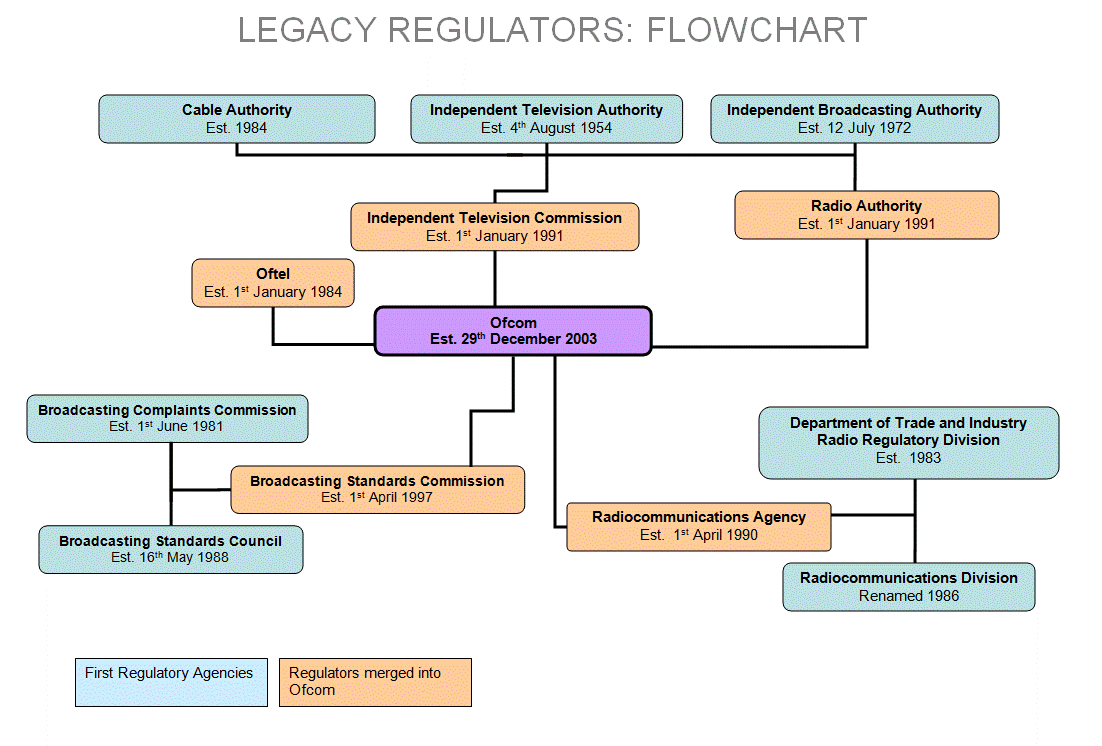
2.1 The main provisions of the draft Communications Bill provide for the transfer of functions to Ofcom from the five organisations that currently regulate the communications sector (see note two below). The Bill also sets out the regulatory structure for all communications services, including provisions for the establishment of the Ofcom Content Board, the regulatory structure for independent television and radio services, and the regulation of media ownership and control. As such, the scope of the Bill is wider than the scope of the Directives, although it does establish a new framework for the regulation of electronic communications networks and services to replace the current licensing system for telecommunications.

2.2 The main functions of Ofcom will be:

  • to further customer interests;
  • to promote competition in the provision of communications services and facilities;
  • to encourage optimal use of the radio spectrum;
  • to secure that a wide range of TV and radio services are available in the UK, comprising high quality services of broad appeal;
  • to protect the public from any offensive or potentially harmful effects of broadcast media; and
  • to safeguard people from being unfairly treated in programmes contained in television and radio services.

3. Will ISPs need to notify Ofcom about their intention to offer services?

3.1 It is a requirement under the new Authorisation Directive that providers of electronic communications networks and services will no longer be required to obtain a licence or permission from the NRA before they can offer those networks or services. They may be required to submit a notification of their intention to offer networks or services, but that is all.

3.2 The Communications Bill enables Ofcom to designate certain classes of networks, services or associated facilities as requiring notification. Having given notification, a provider may lawfully make networks or services available - and does not require a formal response from Ofcom. Only a very limited amount of information would be required in the notification - information about the person giving the notification, a short description of what is intended to be provided and when, and details of persons in the UK who can be contacted in case of an emergency.

3.3 Oftel will consult on its proposals for notification arrangements shortly. However, Oftel's present thinking is that no communication providers will be designated as being required to notify in advance of providing networks or services, at least initially.

4. Will ISPs be required to pay administrative fees?

4.1 Under the Communications Bill, Ofcom will be able to require providers of designated electronic communications networks, electronic communications services and associated facilities to pay a yearly administrative charge. The charge will meet the annual cost to Ofcom of carrying out its functions and will replace the licence fees currently payable. This change from the current regime may mean that some ISPs are subject to fees for the first time.

4.2 The Bill does not specify the basis on which charges are to be levied and before levying any charges Ofcom must publish a statement of the charging principles that will be applied in fixing charges. It is anticipated that there will be some time after 25 July 2003 prior to the full transfer of all functions from Oftel to Ofcom. Oftel has consulted on proposals in relation to a notification process and the collection of fees for the periods up to 24 July 2003 and from 25 July until the establishment of Ofcom. See www.oftel.gov.uk/publications/licensing/2003/fees0203.htm. It will be up to Ofcom to publish a statement of the charging principles to apply after that date.

4.3 Current thinking is that it is unlikely that all communications providers would be required to pay an administrative fee - only those companies with a relevant turnover of £5 million or more would be subject to the charge. It is unlikely that there will be a requirement for those with a relevant turnover of under £5 million to pay a minimum fixed fee. In addition, the relevant turnover would only relate to the provision of an electronic communications network or service, or associated facility. It would not, for example, include other types of service provided by an ISP such as content. Further, as is current practice in the levying of licence fees, the costs of administration would be apportioned between companies according to relevant turnover.

4.4 For a very rough indication of what Oftel’s costs are likely to be for the year 2003/2004 please refer to Oftel’s consultation on its management plan for 2003/2004 which is available on the Oftel website at www.oftel.gov.uk/publications/about_oftel/2002/manp1202.htm.

5. Will ISPs be required to negotiate interconnection?

5.1 Most ISPs (except Virtual ISPs – VISPs) will fall within the definition of a provider of a public electronic communications network and be subject to draft general condition 1 on general access and interconnection obligations. It requires public communications network providers to negotiate interconnection with such other communications providers in any part of the European Community. Oftel believes that this will be to the benefit of all ISPs.

5.2 Internet interconnection is organised in the UK through the London Internet Exchange (LINX) or another similar Network Access Point (NAP). NAPs provide a physical facility where ISPs can connect to each other to exchange Internet traffic. LINX provides a physical interconnection for its members to exchange Internet traffic through co-operative peering agreements. In general, any disputes over Internet interconnection arrangements are currently resolved through commercial negotiations and, if these arrangements continue to work well, it is unlikely that this condition would have any widespread effect on the ISP community in the UK.

5.3 For a more information on interconnection in the new regime see Oftel's draft guidelines for the interconnection of public electronic communications networks – www.oftel.gov.uk/publications/eu_directives/2002/intg0902.htm.

6. Will ISPs be required to comply with general conditions proposed by Oftel relating to consumer protection issues?

6.1 There are a number of conditions requiring compliance by all public communications service providers that relate to consumer protection or information issues. These conditions do not just apply to Significant Market Power (SMP) providers. Instead they require an assessment of the level of necessary consumer protection (see Oftel's Draft consumer protection policy review statement www.oftel.gov.uk/publications/about_oftel/2002/cppr1202.htm). Because these are consumer protection issues, they concern all consumers and all communications providers that serve them. This includes ISPs and their residential and small business customers.

Will ISPs be required to offer contracts?

6.2 Yes. Under the new regulations, all providers of public electronic communications services must offer to enter into a contract at the request of an end-user. As set out under draft general condition 9, the contract must include the following information:

  • the name and address of the Communications Provider;
  • the services provided, and the service quality levels offered, including the time for initial connection;
  • the types of maintenance services offered;
  • details of prices and tariffs, and how up-to-date information on all applicable tariffs and maintenance charges may be obtained;
  • the duration of the contract, the conditions for renewal and termination of services and of the contract, including the end-user’s right to terminate the contract without penalty if the provider modifies the contract to the detriment of the end-user;
  • any compensation and the refund arrangements which apply if contracted quality service levels are not met; and
  • how dispute resolution procedures can be initiated.

6.3 In practice, this means that all ISPs will be required to offer consumers a contract with minimum terms, if the consumer requests it. This is likely to have little effect on larger ISPs, but may affect some smaller service providers whose current procedures are more informal.

6.4 The intention behind this condition is to establish a minimum set of terms that should be included in a contract between a consumer and a communications provider. Oftel sees this as a key consumer right that is not related to a communications provider's size. This obligation is also required to be implemented in the UK by virtue of Article 20 of the Universal Service Directive (USD).

Will ISPs need to publish information on their quality of service?

6.5 Under the new regulations, NRAs will be able to direct that providers of public electronic communications services publish information on their quality of service (draft general condition 11) following a consultation. This will not cover any communications providers who have been in operation for 18 months or less. This is to reduce the regulatory burden on recent new entrants.

6.6 If Ofcom chose to ask an ISP to provide it with information on its quality of service, the request would relate only to the public electronic communications services offered by the ISP. It would not apply to other types of services (e.g. web hosting, content) that do not define it as a provider of an electronic communications service.

6.7 At present, there are two Oftel-endorsed quality of service publications:

It should be noted that both of these initiatives are voluntary and Oftel has not used its powers to enforce quality of service publication.

6.8 Oftel intends to continue this programme of work, and envisages that Ofcom would only use its ability to request further information for other services where that programme was insufficient for some reason. Without fettering the NRA's discretion, Oftel does not believe it likely that the current initiative will be extended to ISPs and Internet services and a cursory review of available information indicates that there is already some quality of service information available to consumers and users about ISP services.

Will ISPs be required to comply with codes of practice?

6.9 All providers of public electronic communications services to residential and small business customers will be required to produce a basic code of practice under Condition 15. This is a new policy initiative that stems from proposals set out in the Communications White Paper, see http://www.communicationswhitepaper.gov.uk/.

6.10 This basic code of practice should set out the ISP’s relationship with its customer in easy-to-understand language. Copies of the code will have to be provided on request and free of charge to any customer.

6.11 In addition, it is intended that those same communications providers should establish their own codes of practice dealing specifically with customer complaint handling. However, groups of ISPs could develop a common code of practice for complaints that they would all agree to follow, rather than each have individual codes of practice. However, if an ISP does not have a code of practice for complaints, or is not signed up to another code of practice, they will be in breach of the general conditions.

6.12 On 18 February 2003, Oftel published guidance on how it plans to assess codes of practice procedures for compliance with the Communications Act. Oftel is recommending that draft codes of practice and covering letters are sent to Oftel by 31 May 2003 to allow time for consideration and approval. See www.oftel.gov.uk/publications/ind_guidelines/2003/cop0203.htm.

Will ISPs be required to comply with a dispute resolution scheme?

6.13 Yes. Article 34 of the USD requires Ofcom to ensure that all consumers of electronic communication services have recourse to an out-of-court settlement procedure that is transparent, simple, inexpensive, fair and prompt. Out-of-court settlement procedures are sometimes also known as alternative dispute resolution.

6.14 The requirement for providers of public electronic communications services to provide and comply with a Dispute Resolution Scheme for the resolution of disputes between itself and its residential and small business customers in relation to the provision of electronic communications services, is set out in draft general condition 15.

6.15 The Telecommunications Ombudsman Service, established in June 2002 by an industry working group in consultation with consumer bodies is Oftel's (and the Government's) preferred solution to out-of-court dispute resolution. A current list of communications providers who have signed up to the Scheme is available at www.otelo.org.uk/memberlist.php.

6.16 If an ISP decides not to join the Ombudsman Scheme it is still obliged to have an out-of-court settlement system. This will need to be approved by Ofcom.

6.17 Oftel will be publishing guidance on how dispute resolution procedures will be approved. Not having a satisfactory dispute resolution system will be a breach of the general conditions.

7. Will ISPs be required to offer itemised billing?

7.1 No. Only providers of publicly available telephone services will be required to provide itemised bills in certain circumstances (see draft general condition 13). However all providers of public electronic communications services will be required to provide accurate bills to consumers (see draft general condition 12.1). The provision of accurate bills will include all types of Internet access packages offered by ISPs, for example unmetered and 'pay-as-you-go'.

7.2 Oftel does not propose at this stage to require any ISP to gain approval under the Metering and Billing Standard (which is to be named the 'Oftel Metering and Billing Direction' in the new regime). Any such proposal would require an amendment to the general conditions and be subject to consultation.

8. Can ISPs keep and use information about their subscribers?

8.1 The Directive on Privacy and Electronic Communications concerns the processing of personal data and the protection of privacy in the electronic communications sector.

8.2 The Directive allows providers of public communications networks or publicly available electronic communications services to retain traffic data for law enforcement purposes once it is no longer required for billing or other essential management purposes.

8.3 However, it places restrictions on the ability of providers to retain data for their own purposes, beyond billing, interconnection payments and dispute resolution. Any further processing of data, for instance the marketing of Internet services or the provision of value added services, may only be allowed if the consumer has agreed in advance to this.

8.4 In practice, providers may process traffic data relating to consumers in order to detect technical failure or errors in the transmission of communications. Providers can also process traffic data necessary for billing purposes in order to detect and stop fraud consisting of unpaid use of the service. This could be without the consent of the consumer.

8.5 Whilst the Directive merely sets out the general goals, it is a matter for the UK to implement these as practical regulation. DTI will be consulting on the implementation of the Directive in Spring 2003 and further details will not be known until the consultation process has been completed. Information about the consultation is available on the DTI website at: www.dti.gov.uk/cii/regulatory/telecomms/telecommsregulations/ec_telecomms_data_protection.shtml#cdpd.

9. Will ISPs be required to offer minimum data speeds?

9.1 The obligation to provide minimum data rates is a Universal Service Obligation (USO) and therefore only falls on designated universal service providers. ISPs are not likely to be designated as universal service providers.

9.2 The Universal Service Directive (USD) does not specify any minimum rate in terms of Internet access. Instead, it talks about 'functional Internet access'. It is therefore up to each member state to decide how it intends to ensure that this is provided. Oftel is consulting on this how it expects to interpret 'functional Internet access' as part of its consultation on the proposals for the designation of universal service providers. In this consultation, Oftel suggests that it is reasonable to expect a single narrowband connection on a public telephone network to support data transmission at a minimum speed of 28.8 kbps. See chapter 4 of Oftel's Notification of proposals for the designation of universal service providers and setting of conditions, www.oftel.gov.uk/publications/eu_directives/2003/uso0303.htm.

9.3 As ISPs are not likely to be designated as universal service providers, provision of 'functional Internet access' is a matter more for network providers rather than ISPs.

10. Will the wholesale products ISPs buy be affected?

10.1 Under the new framework, a market will be effectively competitive where no operator in that market possesses dominance or 'Significant Market Power' (SMP). The position can be held alone or jointly.

10.2 The introduction of the new Directives requires Member States to carry out reviews of competition in communications markets as soon as possible, in order to ensure that regulation remains proportionate in the light of changing market conditions. What conditions are imposed on providers in a given market will depend on whether there is significant market power and what the market reviews conclude.

10.3 Oftel will be consulting on levels of competition in wholesale communications markets, including broadband and narrowband Internet, and any proposed SMP conditions, in the first half of 2003. The SMP conditions proposed in these reviews are likely to be relevant to ISPs to the extent that they will impact the wholesale products that are available to them, for example NTS and FRIACO. More information about the market reviews can be found at www.oftel.gov.uk/ind_info/eu_directives/eu_mr/index.htm.

11. Will Ofcom regulate Internet naming and addressing?

11.1 No. Regulation of Internet naming and addressing (eg the domain names system) has been specifically excluded from the new regulations. Recital 20 of the Framework Directive’s preamble states that its provisions do not establish any new areas of responsibility for the national regulatory authorities in the field of Internet naming and addressing.

11.2 It is therefore likely that the key functions associated with the Internet domain name system:

  • acting as the registry for .uk, managing the central database and setting and enforcing domain name registration policy;and
  • running the Domain Name Server for .uk and the relevant second level domains, translating domain names into IP numbers

will continue to be performed by an independent organisation. Nominet UK currently has responsibility for these functions in the UK – see www.nominet.org.uk.

12. Will Ofcom regulate content available over the Internet?

12.1 As well as setting out the regulation of networks and services that deliver communications services, the Bill also outlines the extent to which Ofcom will regulate electronic content.

12.2 Content provided over the Internet is specifically excluded by the draft Bill from direct regulation. However Ofcom will have a statutory duty to promote public awareness that Internet content is unregulated, and how users can regulate and control access to it themselves.

12.3 The draft Bill requires Ofcom to establish and maintain a Content Board who will represent the interests of consumers in relation to Ofcom's work on the content of anything broadcast or transmitted by means of all electronic communications networks, including the Internet.

12.4 Ofcom will have a function to promote broadcasting and Internet media literacy and to conduct and publish research into content regulation and to take account of findings in its work.

Note:

1. The PEC must be implemented by 31 October 2003. It will be implemented in the UK by new Regulations introduced under the European Communities Act 1972, replacing the Telecommunications (Data Protection and Privacy) Regulations 1999.

2. Office of Telecommunications (Oftel), Independent Television Commission (ITC), Broadcasting Standards Commission (BSC), Radiocommunications Agency (RA), and Radio Authority.


Other guidance on various aspects of the new regulatory framework, published by Oftel


Disclaimer

The FAQs posted here are intended to be helpful and informative but they need to be read with the understanding that the answers are general in nature and apply to typical examples. They cannot be taken as applying absolutely to individual cases where a particular set of circumstances needs to be taken into account. Nor can they act as a substitute for specific legal advice. These FAQs do not fetter the discretion of the Director General of Telecommunications or Ofcom to resolve any dispute or investigate any matter to which this guide relates. Where terms defined by the Communications Bill are explained in the FAQs, the explanations cannot replace the formal Bill definitions but are written so as to make those definitions more comprehensible to people with a non-legal background. References to the Communications Bill in this set of FAQs are references to the print of 5 March 2003 that may be subject to change as it passes through Parliament.


Layout image
Layout image Layout image
Layout image Layout image Layout image
Layout image Layout image