Contents
Summary
Chapter
1 Introduction
Chapter
2 Summary of the responses
Chapter
3 The Process for the Calculation and Collection of the Administrative
Charge
Annex
A Charging principles
Annex
B Notice of designation
Annex
C Notice of intention to publish a general demand for information
as soon as possible after 25 July 2003
Summary
S1 This Statement
follows a consultation by the Director General of Telecommunications
(‘the Director’) on the implementation of the EC Authorisation Directive’s
provisions on notification and fees. In that consultation proposals
were made for the collection of licence fees for the period 1 April
– 24 July 2003 (‘the First Period’) and for the collection of administrative
charges for the period 25 July 2003- 31 March 2004 (‘the Second Period’).
The Director also indicated that he was minded not to introduce a process
of advance notification relating to the provision of electronic communications
networks (‘ECNs’), electronic communications services (‘ECSs’) and the
making available of associated facilities (‘AFs’) under Clause 30 of
the Communications Bill. A statement was issued by the Director on the
25 March 2003 in relation to the collection of fees for the First Period
(available at www.oftel.gov.uk/publications/licensing/2003/statfees0303.htm).
This Statement concerns the collection of administrative charges for
the Second Period and sets out the Director’s decision on a notification
procedure.
S2 For the reasons
set out in this document the Director has decided as follows:
Notification
- not to implement
a notification procedure for the time being;
- to rely on information
already in his possession or which he will acquire through ongoing
monitoring of the industry or from the publicly available databases
that Oftel and the Radiocommunications Agency maintains to identify
who are providers of ECNs, ECSs and persons making available AFs;
Administrative charges
during the Second Period
- administrative
charges will be payable by the providers of ECNs, ECSs and persons
making available AFs with a turnover from relevant activities of £5
million or above;
- to abolish the
fixed fee of £3000;
- not to specify
a list of relevant activities in the charging principles but to publish
guidance on the definition of relevant activity;
- to continue with
the use of turnover bands;
- to use gross
turnover figures as opposed to ‘net value’ turnover in the calculation
of the charge;
- to maintain a
cap of 0.08% on the amount of turnover that can be levied as an administrative
charge;
- to publish on
the Oftel web site a list of persons subject to the payment of administrative
charges; and
- to give notice
in this Statement and by way of publication in the Gazettes and on
Oftel’s web site of the Director’s intention to publish a general
demand for information as soon as possible after 25 July 2003.
S3 The Director
is considering whether terrestrial broadcasters may in addition to the
provider of the ECN be providing an ECS solely in respect to the transmission
of content services over an ECN. If the Director does decide that these
broadcast transmission providers are providing ECSs then they may be
subject to administrative charging in respect of the provision of these
services.

Chapter
1
Introduction
1.1 This chapter
sets out the background to proposals of the Director General of Telecommunications
(‘the Director’) in relation to the advance notification procedure and
administrative charging and sets out the next steps for the calculation
and collection of the administrative charge for the period 25 July 2003
– 31 March 2004 (‘the Second Period’). Chapter 2 contains a summary
of the responses to the consultation and the reasons for the Director’s
decisions. Chapter 3 describes in more detail the process for the calculation
and collection of the administrative charge.
The new EU regime
1.2 The implementation
of four EC Directives on the 25 July 2003 will change fundamentally
the way in which the communications sector is regulated, to reflect
the growing convergence between technologies and to promote competition
in the provision of electronic communication services for the benefit
of consumers. Of relevance here is the Framework Directive which provides
the overall structure for the new regulatory regime and sets out the
fundamental rules and objectives which read across all the new directives
in particular the Authorisation Directive.
1.3 The Authorisation
Directive establishes a new system whereby persons providing electronic
communication networks (‘ECNs’), electronic communication services (‘ECSs’)
and making available associated facilities (‘AFs) will be able to do
so under ‘general authorisation’ without the need to obtain prior approval.
The general authorisation replaces the existing licensing regime for
telecommunication system operators. However Article 3 allows Member
States to require undertakings to submit an advance notification before
exercising rights stemming from the general authorisation. In addition
Article 12 allows for administrative charges to be levied to cover the
costs of the regulatory authority.
1.4 The Government
has decided that a new regulatory body should be responsible for administering
the new regime and as a result the Office of Communications (‘Ofcom’)
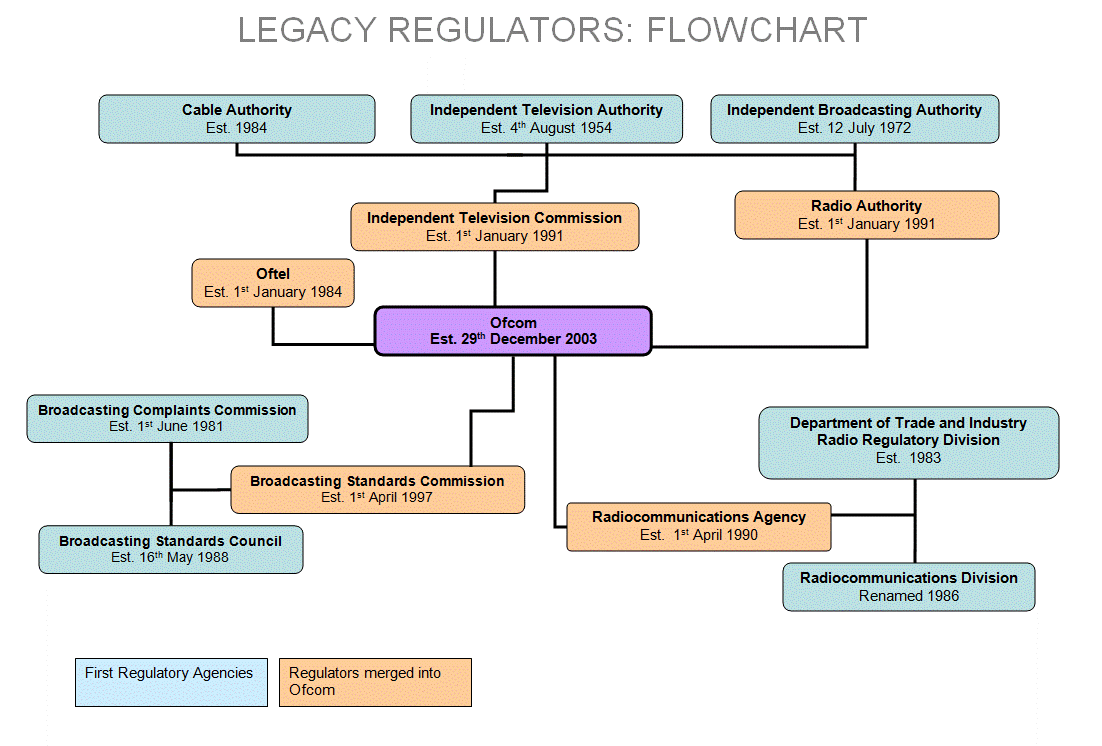
has been established to take over the responsibilities of Oftel and
four other regulatory authorities. The costs of funding Oftel and then
Ofcom under the new regime, will continue to be collected from the industry.
However new policy and procedures will need to be put in place to enable
the collection of these administrative charges.
Implementation
1.5 Parliament is
now considering the Communications Bill (the latest version as introduced
into the House of Lords on 5 March 2003 is available at www.comunicationsbill.gov.uk)
and amongst other things it will implement the four EC Directives.
It is intended for the Bill to receive Royal Assent in time for it to
enter into force by the 25 July 2003. However in the event that this
is not possible the implementation of the EC Directives will be achieved
through Statutory Instruments for an interim period until the Bill enters
into force.
1.6 Even if the
Communications Bill does receive Royal Assent in time for it to enter
into force by 25 July 2003 it is expected that Ofcom will not be ready
by then to assume all of its duties as foreseen by the Bill. Should
that be the case the Communications Bill allows Ofcom’s functions to
be carried out by the Director for a transitional period. For these
reasons this document refers to the Director rather than Ofcom. It is
expected that when Ofcom takes over the Director’s functions it will,
at least in the short term, adopt the decisions made in this Statement.
Ofcom would of course need to consult if any changes were proposed.
1.7 Of relevance
here are the provisions in the Bill relating to an advance notification
procedure (Clauses 30- 34) and the fixing of administrative charges
(Clauses 35 - 40) which implement Articles 3 and 12 of the Authorisation
Directive. There are corresponding provisions in the draft Electronic
Communications (Networks and Services) Regulations (‘the Regulations’)
regarding administrative charging, but nothing regarding advance notification
due to the Director’s intention not to put in place an advance notification
procedure (see below).
Notification
1.8 Under Clause
30 of the Communications Bill the Director is permitted to require advance
notification from those providing ECNs, ECSs and making available Afs.
In addition such providers can be obliged to provide basic information
including particulars of the person giving the notification. The Director
is not obliged to implement a notification procedure and under clause
6 of the Communications Bill he is under a duty not to impose unnecessary
burdens. In the consultation document the Director proposed not to implement
a notification procedure and to rely on information gathering powers
to identify those persons who should be subject to administrative charging.
Administrative
charges
1.9 Clause 35 of
the Communications Bill allows for the fixing of administrative charges
for the providers of ECNs and ECSs and those making available AFs. In
the consultation the Director proposed to calculate administrative charges
in a similar way to licence fees with some changes to reflect the new
regime. The main change being that instead of basing the charge on total
turnover from licensable activities of individual licensees it would
be based on total turnover from relevant activities of all the persons
subject to the general authorisation and who meet the relevant turnover
threshold.
1.10 The consultation
did not deal with the wider question of how Ofcom as a whole will pay
for itself. That question will need to be addressed in due course by
Ofcom.
1.11 In line
with the Communications Bill, the Director’s proposals were appraised
against the following objectives:
- the requirement
that charges are applied and collected through a non-discriminatory
and transparent procedure;
- that charges
are imposed which are proportionate and objectively justifiable;
- the system has
to be both practicable and reasonable for the Director’s purposes;
and
- finally, the
charges that are payable need to be sufficient to enable the Director
to carry out his functions satisfactorily while at the same time avoiding
unnecessary burdens on the industry.
Next Steps
1.12 Charging
Principles. Under Clause 35(3) of the Communications Bill before
fixing the administrative charge for the charging year the Director
must publish charging principles. As a result of the consultation the
Director has decided that he will implement the charging principles
set out at Annex A. There are some differences between what was proposed
in the consultation and what appears in those principles. First rather
than define a list of relevant activities, the Director has decided
to define ‘relevant activity’ by general reference to the provision
of public ECSs to end users, the provision of ECNs and ECSs and network
access to communications providers (as defined in clause 398 of the
Communications Bill) and the making available of Afs to communication
providers. This is in line with the definition of ‘relevant activity’
in the Regulations which have been consulted on by the Secretary of
State for Trade and Industry. Second the Director has clarified in the
charging principles which turnover figure he will use in any charging
year to calculate the charge i.e. the turnover from relevant activities
in the person’s financial year ending in the charging year immediately
prior to the charging year before the charging year in question.
1.13 Relevant
Activities. The Director will issue guidance shortly on the definition
of what is a public electronic communication network (‘PECN’) for the
purposes of establishing who has interconnection rights and obligations
under the Access Directive. The Director recognises the need to provide
more detailed guidance on the definition of ‘relevant activity’ for
the purposes of administrative charging and draft guidance will be published
shortly in a consultation document.
1.14 Designation.
Under clause 35(2) the Director can only charge those providers of ECNs,
ESCs and AFs of a description which has been designated. Having considered
the responses to this consultation the Director has decided to designate
those ECNs, ESCs and AFs where the person providing that network, service,
or making that facility available has a total turnover from relevant
activities of £5 million or more. The text of a notice of designation,
which will be published as soon as possible after the 25 July
2003, is attached at Annex B. The wording of the notice reflects the
wording which has been consulted on in the Regulations with some changes
to clarify when a person will be designated. Persons will be designated
in a particular charging year if their turnover from relevant activities
was £5 million or over in their financial year ending in the charging
year immediately prior to the charging year before the charging year
in question.
1.15 Demand for
Information. To obtain the necessary information to calculate
the administrative charge for the Second Period the Director will publish
as soon as possible after 25 July 2003 a general demand for information
under powers which are in clause 132 of the Communications Bill (or
corresponding powers in the Regulations). A notice of intention to publish
the general demand is at Annex C.
1.16 Charging
for the grant of the Electronic Communications Code. Oftel is consulting
on proposals for charging for the grant and administration of the electronic
communications code. A statement on this will be published when the
responses to that consultation have been considered.
1.17 Sixteen responses
were received to the consultation. Non-confidential responses were received
from:
1. Powergen
2. Scottish
and Southern Energy plc
3. MBG
4. Association
of Communication Service Providers (‘ACSP’)
5. Alternative
Networks Ltd (the figures submitted were marked confidential)
6. Centrica
7. AT&T
8. Innogy
plc
9. BT
10. Ntl
11. The Operator’s
Group (Energis, Opal Telecom, Fibrenet, Thus, Colt, Cable and Wireless)
The following chapter
summarises the responses and sets out the Director’s conclusions.

Chapter
2
Responses to
the Consultation
Notification
2.1 Implementation
of an advance notification procedure would enable the Director to obtain
information about the providers of ECNs, ECSs and those making available
AFs such as contact names and a description of the service or network
to be provided. The Director recognises that some information is needed
about such persons for the purposes of fixing the administrative charge
and the carrying out of his regulatory functions under the new regime.
However the question which was addressed as part of the consultation
was whether it is necessary to implement an advance notification procedure.
The Director’s view was that it is not necessary to implement such a
procedure and after consideration of the responses his view has not
changed.
Q1 Do
respondents agree that the imposition of a notification procedure would
be an unnecessary administrative burden?
2.2 The majority
of respondents welcomed the proposal and agreed with the Director’s
proposal that regulatory burdens should not be imposed which are unnecessary.
However a few respondents namely ntl, the Operator’s Group, AT&T
and BT were concerned as to how the Director would know who would be
subject to administrative charging in the absence of a notification
procedure. It was proposed that a list of persons subject to the charge
should be made publicly available in order to make the process transparent,
to make the Director accountable, and to prevent payment avoidance.
Only BT strongly expressed the view that the only legal way to maintain
such a list was through the implementation of a notification procedure.
BT was very concerned that the failure to implement a notification procedure
would have serious implications for the effectiveness of regulation
under the new framework and in particular for the efficient and impartial
application of the charging regime and the undertaking of market reviews.
2.3 Three of the
respondents thought that the implementation of a notification procedure
could be used to compile a list to replace the Annex II list of providers
of PECNs.
The Director’s
response
2.4 The benefit
of implementing an advance notification procedure would be that it would
enable the collection of information about such persons. However the
type of information that can be required under the procedure is of a
very basic nature. The Director will be able to gain information about
the providers of ECNs, ECSs and those making available AFs through the
exercise of information gathering powers currently contained in clause
132 of the Communications Bill. It is under this clause, for example,
that the general demand for information at Annex C will be issued. The
purpose of the demand will be to ascertain the total turnover from relevant
activities of persons liable to pay the charge. Such information could
not be obtained through the implementation of an advance notification
procedure.
2.5 Clause 132 allows
the Director to require a wide range of information from such persons
to enable him to carry out his duties effectively including information
to allow him to identify markets and carry out market analysis in accordance
with or for the purposes of any provision of Chapter 1 of the Communications
Bill. Similar powers are already available to the Director under the
current licensing regime and they have been used effectively to gather
information to support policy and decision making. The Director acknowledges
that save in the case of administrative charging where he can issue
a general demand for information he would need to know the identity
of the person from whom information was required in order to serve a
notice of a demand for information. However he is of the view that he
will be able to ascertain the identity of the providers of ECNs, ECSs
and AFs to enable him to carry out his functions effectively because
of the following:-
2.5.1 Many persons
subject to the general authorisation will already be known to the
Director because they will have been regulated under the current licensing
regime. This applies also to many providers of ECSs such as companies
who are reselling services provided over another company’s network
and would include Internet service providers, indirect access providers
and mobile service providers. Although currently these resellers are
unlicensed or are operating under class licences certain Regulations
apply to unlicensed providers and those persons operating under class
licences are subject to the conditions attaching to those class licences.
2.5.2 The Director
is already in possession of a large amount of information about the
industry through Oftel’s monitoring of commercial and industrial trends
for example by scanning the trade and financial press and company
announcements for information about new companies, size of existing
companies and performance. This monitoring is an ongoing process and
will continue under the new regime.
2.5.3 Further
information will be available from:-
- the Specified
Numbering Scheme, available at www.oftel.gov.uk/ind_info/numbering.sns1199.htm
which lists the public telephone numbers against the names of the
operators to whom they have been allocated (such a list will continue
to be maintained under the new regime);
- the awards
made of the public competition for radio spectrum to the public
mobile operators and the radio fixed access operators and which
are available on the Radiocommunications Agency’s web site at www.radio.gov.uk;
and
- the publicly
available register which will need to be maintained of all those
providers of ECNs who have been granted code powers;
- the list that
the Director has decided to maintain of the names of persons who
have responded to the general demand for information for the purposes
of calculating the administrative charge (see below).
2.6 For these reasons
the Director has decided that it is not necessary to implement an advance
notification procedure. However, Ofcom will be able to review this decision
in the future and introduce a procedure if it becomes apparent that
there is a clear need for one. The Director is sympathetic to the proposal
to maintain a list of persons subject to the charge and agrees that
it would help demonstrate that all those who should be subject to administrative
charging are in fact being charged. He has decided therefore to make
such a list available at the same time as the administrative charge
is collected. The list would only contain the names of those persons
who respond to the general demand for information in Annex C. The Director
does not intend to specify any names of persons who fail to pay the
charge but this may be introduced by the Director or Ofcom at a later
stage.
2.7 Responding to
the issue raised by respondents of a need for a list to replace the
list of providers falling within the categories set out in Annex II
of the Interconnection Directive, this issue was addressed as part of
Oftel’s recent consultation on who will be entitled to interconnection
rights and obligations under the EC Access Directive. A statement containing
guidance on this will be published shortly. The Director recognises
the benefits of maintaining a voluntary list of providers of PECNs with
interconnection rights and obligations which will be analogous to the
Annex II list. It is highly likely that the Director will decide to
maintain such a list. Such a list would be a further source of information
available to the Director to ascertain who are the providers of ECNs.
Calculation and
collection of administrative charges for the Second Period
2.8 Under the licensing
regime fees have been collected from individual licensees under the
licences granted under section 7 of the Telecommunications Act 1984.
An annual fixed fee of £3000 was collected from those individual licensees
with a turnover of less than £5 million and a fee based on gross turnover
from licensable activities was collected from those individual licensees
with a turnover of £5 million or more (‘Variable Fees’). The Variable
Fees were calculated in accordance with Oftel’s Statement on the Revised
Licence Fee Regime of August 1999. The Director is of the view that
the system for collecting fees has worked well and complies with the
requirements of the Communications Bill and the Authorisation Directive
as it allows the imposition of charges which are objectively justifiable
and proportionate. He has decided therefore to continue to calculate
administrative charges in the same way as licence fees have been calculated.
Gross Turnover
2.9 In the consultation
the Director considered moving away from using gross turnover (which
includes income generated from the provision of all services) to ‘net
value’ turnover (which includes only income generated from the provision
of ‘net value’ or ‘value added’ services) for the calculation of the
Variable Fees. Although there was slightly more support in the responses
for a move to calculation based on ‘net value’ turnover as opposed to
gross turnover (see below), the Director has not been persuaded of the
benefits of moving to ‘net value’ turnover and remains concerned about
how ‘net value’ turnover would be assessed in practice. He has decided
therefore to retain the current method of calculating fees based on
gross turnover.
Q2 Is
Oftel right to continue with a system whereby the administrative charging
will be based on gross turnover for relevant activities as opposed to
net turnover? If respondents support a ‘net value’ turnover system how
would it work?
2.10 Six of the
respondents, including BT, ntl, MBG and AT&T and the Operator’s
Group, were in favour of the Director continuing to base charging on
gross turnover as they considered it to be the most practicable, proportionate
and appropriate way of calculating charges. The others (including Alternative
Network Limited, Powergen, Scottish and Southern Energy plc, ACSP, Innogy
plc and Centrica) were against continuing on gross turnover because
they thought it did not meet any of the objectives outlined in paragraph
0 of this Statement. In particular they argued that the gross turnover
system discriminates against new entrants, providers of ECSs, and AFs
and favours in particular vertically integrated companies such as BT.
Moreover they felt that retaining gross turnover would hamper service
competition. However Innogy plc and Centrica acknowledged the difficulty
and impracticalities of measuring ‘net value’ turnover because it highly
depended on accounting principles applied by individual companies.
2.11 Four respondents,
Powergen, Innogy plc, Centrica and the ASCP, expressed the view that
administrative charges should only be imposed on network providers.
Part of the reason for this is that in their view the charges would
be passed down the chain to service providers and so the service providers
would be indirectly but proportionately charged anyway.
The Director’s
response
2.12 To exclude
service providers from administrative charging would, in the Director’s
view, discriminate against network providers and therefore would not
be acceptable.
2.13 The Director
does not consider that there is any discrimination in using gross turnover
as opposed to ‘net value’ turnover. The reason why the Director has
been prepared to consider moving to ‘net value’ turnover was because
it was recognised that there was an element of ‘double counting’ whereby
the income received from passing on wholesale costs down a chain of
providers would be reflected in the turnover figures of more than one
provider. This occurs now under the existing regime, for example, where
one provider (A) pays another provider (B) a fee to interconnect to
B’s network. This fee will be part of the gross income (turnover) of
B on which B’s contribution to pay the charge is assessed. However A
will pass these costs onto its customers and the income it receives
will also be included in the calculation of its gross income for the
purposes of calculating the charge. Where A’s customers are operators
rather than end users of the service, the same costs will similarly
be passed down the chain. The result is that more than one provider
will be including in their gross turnover figure, income derived directly
or indirectly from the same activity- i.e. interconnection to the network
owned by B.
2.14 The implication
for the calculation of the charges is that the gross turnover used to
calculate what percentage is needed to pay for the costs of Oftel is
larger than would be the case if ‘net value’ turnover were used. However
everyone will pay the same percentage of gross relevant turnover and
therefore using this system is not discriminatory. Some minor variations
in what an individual provider pays can be justified on the basis that
the system of calculation based on gross turnover is simple to administer
and does not impose undue accounting responsibilities and additional
costs on the persons liable to pay charges.
2.15 The Director
recognises that using ‘net value’ turnover may be more favourable to
service providers because the assessment of turnover would then include
income derived from the provision of the ‘value added’ services and
would therefore be less than gross turnover. This could result in a
service provider ending up in a lower turnover band with the result
that it would pay a lower charge. However it could also mean that the
burden of paying more of the charge falls on other type of providers.
Network providers might take the view that such a system discriminates
against them.
2.16 Changing to
‘net value’ turnover would not however be straightforward and a number
of questions were raised in the consultation concerning how in practice
a method using ‘net value’ turnover would work, including what does
net value mean? How is it to be calculated? Does the concept of ‘value
added’ involve some subjective assessment of what value has been added?
Unfortunately none of the respondents who were in favour of changing
the system provided substantive answers to these questions which convinced
the Director that moving to ‘net value’ turnover would, at present,
work in practice.
2.17 Alternative
Networks Limited suggested that ‘net value’ turnover could be calculated
by deducting the cost of supplying the relevant activities from the
gross relevant turnover. It suggested that the cost of supplying the
services would be made up of the wholesale inputs for ECSs and AFs providers,
or the initial inputs for ECNs providers, and proportionate operating
costs for providing the relevant activities. However no suggestion was
made as to how the Director should go about deciding what ‘wholesale
inputs’ should be included or how to work out the proportionate operating
costs for providing the relevant activities.
2.18 ACSP suggested
that ‘value added’ turnover could be worked out by calculating the difference
between gross relevant turnover and the wholesale inputs purchased from
the network operator or service provider, subject to a turnover threshold.
Again no suggestion was made as to what ‘wholesale inputs’ should be
included or what ‘value added’ meant.
2.19 Centrica proposed
that if gross turnover is retained service providers should be allowed
to retain a rebate on their charges equivalent to their network inputs.
Centrica also suggested an alternative which would be to require vertically
integrated companies such as BT to include in their final turnover figures
income from the provision of services to the different parts of the
same organisation. Generally, amongst those asking for a change it was
felt that BT should be required to account for income at each main stage
of the supply chain like any of the other independent providers. To
apply such a requirement throughout the industry would involve a significant
increase in regulatory accounting obligations for many of the large
and medium sized operators. These processes could vary depending on
the particular internal structure a vertically integrated company chooses
to adopt. It is doubtful however if this would reduce significantly
the degree of double counting which is recognised to exist in both the
previous system and the new system for the calculation of the charge.
As stated elsewhere in this Statement although double counting does
occur it has in practice made little difference to the relative amounts
which companies pay. The existing system is easy to understand and operate
for everyone including in particular the small operators with few compliance
resources.
2.20 Further turnover
is a clear measure of the trading activity that takes place between
a provider and its customers. Any provider will have a number of choices
as to how they meet the requirements of its customers. There will, for
example, be the choice between own provision of services (which might
be owning and operating some elements of infrastructure) and purchasing
the provision of some services from third parties. If the basis for
the calculation were to change to ‘net value’ turnover this would benefit
those using the latter option over the former. The use of gross turnover
is arguably a more neutral approach.
2.21 The Director
therefore remains of the view that changing to ‘net value’ turnover
would not be practicable and he does not believe that adopting a method
using ‘net value’ turnover would meet the objectives for the charging
regime outlined in paragraph 0 of this Statement. However Ofcom will
be able to reconsider the question again when they begin to collect
charges.
Turnover from
Relevant Activities
2.22 The majority
of respondents requested a clear definition of turnover from relevant
activities and clarification of the list of relevant activities. Alternative
Networks Limited disagreed with Oftel’s proposal to use turnover attributable
to relevant activities for the financial year 2 years before the charging
year. It argued that turnover from relevant activities should be from
the financial year 2 years before its current financial year. BT and
MBG argued the use of turnover bands should be abandoned and replaced
with a methodology based on actual relevant turnover.
The Director’s
response
2.23 The Director
agrees that there is a need for further clarity about the list of relevant
activities. Rather than expanding on the list here, the Director intends
to publish guidance to help persons who may be subject to the charge
determine for themselves whether an activity is relevant.
2.24 The Director
does not consider there is any benefit in changing the turnover requirement
from two years before the charging year to two years before the relevant
person’s current financial year. The present policy recognises that
companies have different financial years and that it can be several
months from the end of financial year before certified accounts are
available. In addition the Director’s view is that the proposal has
no advantage as it would still be necessary to determine the provider’s
‘current’ financial year. The use of turnover bands was a proposal made
by the industry in response to Oftel’s consultation ‘A Review of Telecommunication
Licence fees in the UK’ November 1998. The use of turnover bands has
proved simple to administer and it makes the system transparent. Changing
to a calculation based on actual turnover would increase the amount
of time that the regulator would have to spend calculating the charge
and this could lead to increased costs. Therefore the Director has decided
to retain turnover bands for now.
Abolition of
fixed fees
Q3 Do respondents
agree with the proposition that the abolition of fixed fees is a measure
that would assist smaller providers and further encourage new entrants
2.25 Half the respondents
including ACSP, Centrica, Innogy plc, Alternative Networks Limited agreed.
However some respondents namely Scottish and Southern Energy plc, MBG,
Powergen, BT and ntl were not supportive of the abolition of the fixed
fee. This was mainly because they feared that the abolition of the fixed
fee would result in material increases in the charges payable by other
providers and these respondents believed that it was the small companies
and new entrants that generate a disproportionate amount of Oftel’s
work.
The Director’s
response
2.26 Under the current
licensing regime approximately £300,000 is collected in fixed fees every
year. The Director believes that the impact of abolishing the fixed
fee on the level of charges for persons who are liable should be minimal
because Oftel’s administration costs will be paid by a greater number
of companies. Further, abolishing the fixed fee will reduce the regulator’s
costs incurred in calculating and collecting the charge. This change
will also help new entrants as approximately half of this income is
from such companies. This in turn should help to promote competition.
The purpose of administrative charging is to fund the costs of the regulator
and it is not focused directly on the amount of time and effort spent
by the regulator in regulating a particular provider. Therefore aligning
the charges to the costs of regulating certain companies would be very
difficult to do and in principle difficult to justify because of the
fact that the Director’s decisions, even if directly applicable to a
certain class of provider, often concern the whole industry.
Costs of the
Competition Appeals Tribunal
2.27 MBG and the
Operator’s Group were concerned about the industry having to pay, through
administrative charges, for any costs awarded against the Director by
the Competition Appeals Tribunal (‘CAT’). The Operator’s Group proposed
that the Director should only seek to recover costs from those providers
responsible for making the reference to the Competition Commission.
The Director’s
response
2.28 Defending decisions
in the CAT will be part of the Director’s functions under the new regime
and as such he will have the power to recover the costs incurred in
dealing with appeals through administrative charging, including any
costs which the CAT may decide to award against Oftel. Under clause
190 of the Communications Bill only price control matters must be referred
by the CAT to the Competition Commission.
Supplementary
charges and cap on charges
2.30 Energis welcomed
the fact that the Director will not raise any supplementary fees during
the course of the year. Regarding the proposal to retain the cap on
charges MBG was concerned that the cap applied to the charges imposed
for the charging year together with the charges imposed as a result
of a deficit in income for the previous year. BT asked that the cap
should be given ‘hard coded’ status through an appropriate regulatory
instrument. Energis, the Operator’s Group and MBG argued that the cap
on charges should be reduced from .08% to .0628% of turnover and then
reduced every year.
The Director’s
response
2.31 The Director
does not consider that a reduction in the cap level should be made at
this stage. This is largely because of uncertainty in the amount of
turnover that will be generated by all those subject to administrative
charging and because at this stage it is difficult for the Director
to predict what Ofcom’s resource needs will be. However Ofcom will be
able to review the cap when they begin to perform their functions. In
future years the Director anticipates that the cap will apply to the
level of charges that can be imposed to recover the costs estimate for
the charging year which will take account of any deficit or surplus
made in the previous charging year.

Chapter
3
Process for the
Calculation and Collection of the Administrative Charge
3.1 Following publication
of the designation set out at Annex 2 to this Statement (or the coming
into force of the Statutory Instruments) all providers of ECNs,
ECSs and those making
available AFs with a turnover from relevant activities (‘TRA’) of £5
million or more will be designated for the purposes of administrative
charging. The Director does not think it would be reasonable to expect
such persons to know whether in any particular charging year they will
have a TRA which meets the turnover threshold. Therefore he has decided
that such persons will be designated for a particular charging year
if their TRA was £5 million or more in their financial year ending in
the charging year immediately prior to the charging year before the
charging year in question. For the first charging year (the Second Period)
commencing on 25 July 2003 the relevant period for assessing TRA is
the12 month period (25 July 2001 – 24 July 2002) immediately prior to
the 12 month period (25 July 2002-24 July 2003) before the 25 July 2003.
So if their financial year ends on 30 September they will look at their
TRA in their financial year ending on 30 September 2001 to determine
whether or not they have been designated to pay an administrative charge
for the Second Period. This is because 30 September 2001 falls in the
12 month period running from the 25 July 2001 – 24 July 2002.
3.2 These charges
will be in respect of the network, or service provided or facility made
available. Oftel is consulting separately on proposals for calculating
charges in respect of the application of the electronic communications
code and a statement on this will be published when the responses to
that consultation have been considered.
Who are the providers
of ECNs, ECSs and AFs?
3.3 The definition
of ECNs, ECSs and Afs is set out at clause 29 of the Communications
Bill. At present, providers of ECNs will either be licensed individually
to provide telecommunication systems or be providing their network under
a class licence such as the Telecommunications Services Licence. These
companies are likely to be providing ECSs to their customers. In addition,
there are companies who do not run ECNs but are reselling services provided
over another company’s network. These resellers, which include some
Internet Service Providers, indirect access providers and mobile service
providers, are also providers of ECSs. These providers will become liable
to pay for the costs of the regulator for the first time.
3.4 Companies providing
mainly content services over ECNs will not be subject to the administrative
charging. For example, a company providing financial services over the
Internet will not be a provider of an ECS, as it is mainly providing
content not conveyance. Similarly, web hosting and the provision
of an Internet portal are content services not an ECS. The provision
of metered and unmetered access, video conferencing and voice mail will
be ECSs. In general broadcasters are suppliers of content services and
therefore would not be expected to be subject to administrative charging.
Estimate of costs
3.5 The calculation
and collection of the administrative charge can only take place after
25 July 2003. This means that soon after this date Oftel will have to
estimate what its costs will be for the Second Period. In future years
this estimate will be made at the beginning of the charging year (1
April –31 March). The estimate for the period commencing on the 25 July
2003 will be based on the costs estimate of £19,089,785 given in Oftel’s
Management Plan for the year 2003-2004. Part of the costs approximately
£5,500,000 are in the process of being collected through licence fees
under the old licence fee regime for the period 1 April 2003- 24 July
2003.
Collection of
information
3.6 The Director
recognises that because it may be several months before the statutory
audited accounts are available it would not be practicable to make a
request for information about financial performance in the year previous
to the charging year. Instead as with the designation information about
TRA will be requested for the financial year ending in the charging
year immediately prior to the charging year before the charging year
in question. For the Second Period (the first charging year) information
about TRA will be requested for the financial year ending in the 12
month period immediately prior to the 12 month period before 25 July
2003 (i.e. the 12 month period that ends on 24 July 2002). For the second
charging year (commencing on 1 April 2004) information about TRA will
be requested for the financial year ending in the 12 month period immediately
prior to the commencement of the Second Period (i.e. the 12 month period
that ends on 24 July 2003).
3.7 At Annex C is
a notice setting out the Director’s intention to publish a general demand
for information as soon as possible after the 25 July 2003.
The notice of intention will also be published separately on the Oftel
web site and in the Belfast, Edinburgh and London Gazettes.
3.8 The general
demand will ask those liable to pay administrative charges to notify
the Director of their TRA for the financial year ending in the period
of 12 months ending on 24 July 2002. The notice is being published to
provide those liable to pay the charge with as much time as possible
to calculate their TRA. If the Director is to calculate and collect
the administrative charge by the 31 March 2004 he will need
this information as soon as possible. Therefore the Director will only
be able to give six weeks, from the date the demand is published. However
the Director considers that this time period is reasonable given the
advance notification of the general demand.
3.9 As has been
past practice the TRA for the relevant financial year will have to be
supported by certification from two directors as well as a copy of an
extract of the statutory audited accounts for the relevant period.
3.10 The Director
will publish guidance to help those persons who may be liable to pay
the charge to assess what turnover should be attributed to relevant
activities.
The calculation
of the charge
3.11 The Director
then calculates the total turnover. For companies with a turnover of
over £1 billion, actual TRA is used. For companies with a turnover of
under £1 billion the Director uses the lower figure of the turnover
band which they fall into. For example if a company reports a total
TRA of £670 million the turnover figure used will be £600 million.
3.12 The turnover
bands are:
£750m – below
£1bn
£600m – below
£750m
£500m – below
£600m
£400m – below
£500m
£300m – below
£400m
£200m – below
£300m
£150m – below
£200m
£100m – below
£150m
£75m – below £100m
£50m – below £75m
£25m – below £50m
£10m – below £25m
£5m – below £10m
3.13 Once the Director
is in possession of the total turnover figure he will be able to calculate
what percentage of it is needed to cover the estimated costs. This calculation
will be carried out in the same way as before. Below is a worked through
example. The final figure in the example should not be relied on as
any indication of what the actual percentage might be.
3.14 Example
Oftel’s costs
for the charging year are estimated at £20 million. The total turnover
attributable to the relevant activities of those persons liable
to pay the charge is £29 billion.
Percentage of
turnover needed to cover Oftel’s estimated costs = Estimated Costs
(£20 million) / Total Turnover (£29 billion) x 100 = 0.068%
3.15 The administrative
charge for each person subject to charging will be calculated by multiplying
the percentage i.e. 0.068% by the lower figure of the turnover band
which each person falls into. For companies with a turnover of over
£1 billion actual TRA will be used.
Dealing with
a deficit or surplus in income
3.16 By the end
of the Second Period, Ofcom is expected to be functioning. Therefore
as soon as is reasonably practicable after the 31 March 2004 Ofcom will
have responsibility to publish a statement. This statement must set
out the aggregate amount of charges that have been received, the aggregate
amount of charges that remain outstanding and are likely to be paid
or recovered, and the actual cost incurred by them and Oftel in the
previous charging year. Any deficit or surplus in income will be carried
forward and taken into account by Ofcom to determine the estimate of
costs for the following charging year. This deficit could include the
loss of income arising as a result of the Director being unable to recover
a charge because, for example, a company had gone into liquidation and
inadequate provision had been made in the provision for bad debts.
Cap on charges
3.17 The charge
will be capped at 0.08% of the lower figure of the applicable turnover
band or actual TRA (whichever applies). The cap will apply to the whole
of the charge, which may include a charge for any deficit which is carried
forward from the previous charging year. If the cap in any one year
is not reached i.e. by 1 per cent then that 1 per cent will not automatically
be rolled forward to increase the cap level in the following year.
The Objectives
in the Communications Bill
3.18 The Director
is satisfied that the method described above for calculating and collecting
the administrative charge meets the objectives outlined in paragraph
0 of the Statement.
Procedure which
is non- discriminatory and transparent
3.19 The procedure
is non-discriminatory because charges will be applied to all persons
subject to the general authorisation who meet the turnover threshold
level on a pre-determined level and published formula. It is transparent
because the method and principles are known to all through the publication
of this Statement and the prior publication of the charging principles
which will take place as soon as possible after 25 July 2003.
Imposition
of charges which are proportionate and objectively justifiable
3.20 The charges
will be proportionate because they are based on TRA. They are objectively
justifiable because they will be levied to cover the costs of the Director
in carrying out his regulatory functions and they will only be calculated
and levied in respect of the provision of ECNs, ECSs and the making
available of Afs.
Practicable and
Reasonable
3.21 The method
is very similar to the method used by the Director to calculate licence
fees under the Licensing Directive (the predecessor to the Authorisation
Directive). This method has proved relatively simple to administer and
reasonable to apply.
Sufficient
3.22 The method
allows for any deficit in income to be collected in the following charging
year. Therefore the overall charges, subject to the cap, should be sufficient
to allow the Director to recover his costs so that he can carry out
his functions satisfactorily.
Penalties
3.23 Under Clause
39 of the Communications Bill the Director will have the power to impose
a penalty not exceeding twice the amount of the applicable administrative
charge for failure to pay such a charge. Where there is serious and
repeated contravention of the requirement to pay administrative charges,
the Director may direct a suspension or restriction of the general authorisation
for a particular person provided all the requirements of Clause 39 of
the Bill are satisfied.

Annex
A
This Annex contains
the charging principles which will be published by the Director in accordance
with his powers under the Communications Act 2003 as soon as possible
after 25 July 2003. If the Communications Bill does not receive Royal
Assent in time for it to enter into force by 25 July 2003 then Schedule
5 of the draft Electronic Communications (Networks and Services) Regulations
will apply instead. The section numbers cited in the notice are the
clause numbers of the version of the Communications Bill which was introduced
in the House of Lords on 5 March 2003. Therefore these section numbers
may have to be amended to reflect any changes introduced to the Bill
by the House of Lords.
‘Charging Principles
published for the purpose of fixing charges in accordance with sections
35 and 36 of the Act
1. Definitions
1.1 For the purposes
of interpreting these Charging Principles the following definitions
shall apply:-
'Act’ means the
Communications Act 2003;
‘Director’ means
the Director General of Telecommunications as appointed under section
1 of the Telecommunications Act 1984;
‘First
Charging Year’ means the period beginning with 25th July
2003 and ending on 31st March 2004;
‘Relevant Activity'
means any of the following:-
- the provision
of Public Electronic Communications Services to end-users;
- the provision
of Electronic Communications Networks, Electronic Communications Services
and Network Access to Communications Providers; or
- the making available
of Associated Facilities to Communications Providers;
‘Relevant
Person’ means a person liable to pay the administrative charge under
section 35 of the Communications Act 2003; and
'Relevant Turnover'
means-
- in the First
Charging Year, the Turnover made by any Relevant Person in that Person’s
financial year ending in the period of 12 months ending on 24th
July 2002;
- in the Second
Charging Year, the Turnover made by any Relevant Person in that Person’s
financial year ending in the period of 12 months ending on 24th
July 2003; or
- in any subsequent
Charging Year, the Turnover made by any Relevant Person in that Person’s
financial year ending in the Charging Year immediately prior to the
Charging Year before the Charging Year in question.
‘Second Charging
Year’ means the period beginning with 1st April 2004 and
ending on 31st March 2005.
‘Turnover’ means
the turnover made from carrying on any Relevant Activity after the deduction
of sales rebates, value added tax and other taxes directly related to
turnover.
1.2 Except in so
far as the context otherwise requires, words or expressions shall have
the meaning assigned to them and otherwise any word or expression shall
the same meaning as it has in the Act.
2. Charging Principles
2.1 For the purposes
of section 35 of the Act in any Charging Year the Director shall fix
the administrative charge to be paid by each Relevant Person in the
manner set out below.
2.2 The administrative
charge to be paid by each Relevant Person shall be a percentage of either:
- the lower figure
of the turnover band determined by the Director to be applicable to
each such person in accordance with sub paragraph 2.3; or
- in any case where
in accordance with sub paragraph 2.3 no turnover band has been determined
to apply to any Relevant Person, that person's Relevant Turnover.
2.3 The Director
shall determine the turnover band applicable to each Relevant Person
by reference to the turnover bands in sub paragraph 2.7 below and the
amount of Relevant Turnover notified to the Director by that person,
save that no such applicable turnover band shall be determined by the
Director where the Relevant Person's turnover is £1,000,000,000 or more.
2.4 The Director
shall determine the percentage referred to in sub paragraph 2.2 by carrying
out the calculation described in sub paragraph 2.5 below.
2.5 The Director
shall:
- take either the
lower figure of the turnover band applicable to each person as determined
in accordance with sub paragraph 2.3, or where in accordance with
sub paragraph 2.3 no such turnover band applies, the total Relevant
Turnover notified to the Director by that Relevant Person, and add
all those amounts together;
- divide the total
amount of the Director’s estimated annual costs of carrying out his
functions set out in Section 35 (5) of the Act by the sum resulting
from the calculation in paragraph (a); and
- apply the quotient
resulting from the calculation in paragraph (b) as the percentage.
2.6 The maximum
percentage which may be applied by the Director under sub paragraph
2.2 shall be 0.08%.
2.7 The turnover
bands for the purposes of fixing the administrative charges shall be
as follows:
|
Pounds (million)
|
|
Pounds (million)
|
|
5
|
To
|
Less than
10
|
|
10
|
To
|
Less than
25
|
|
25
|
To
|
Less than
50
|
|
50
|
To
|
Less than
75
|
|
75
|
To
|
Less than
100
|
|
100
|
To
|
Less than
150
|
|
150
|
To
|
Less than
200
|
|
200
|
To
|
Less than
300
|
|
300
|
To
|
Less than
400
|
|
400
|
To
|
Less than
500
|
|
500
|
To
|
Less than
600
|
|
600
|
To
|
Less than
750
|
|
750
|
To
|
Less than
1000’
|

Annex
B
This Annex contains
the notice of designation the Director intends to publish as soon as
possible after 25 July 2003 in accordance with powers under the Communications
Act 2003. If the Communications Bill does not receive Royal Assent in
time for it to enter into force by 25 July 2003 then Schedule 4 of the
draft Electronic Communications (Networks and Services) Regulations
will apply instead, which reflects the wording of this notice of designation.
The section numbers cited in the notice are the clause numbers of the
version of the Communications Bill which was introduced in the House
of Lords on 5 March 2003. Therefore these section numbers may have to
be amended to reflect any changes made to the Bill as it passes through
Parliament.
‘Notice of Designation
under Section 31 of the Communications Act 2003
- The Director
General of Telecommunications (‘the Director’) in accordance with
section 31 of the Communications Act 2003 (‘the Act’) hereby gives
notice of a designation, set out below, that he has made on [insert
date] for the purposes of section 35 of the Communications Act 2003
(Fixing of Charges).
- The designation
follows Oftel’s consultation on the Implementation of the Authorisation
Directive’s provisions on notification and fees dated 10 February
2003 and the consultation by the Secretary of State for Trade and
Industry on the draft Electronic Communications (Network and Services)
Regulations dated 19 March 2003.
Designation for
the purposes of section 35 of the Act
1.
Definitions
- For the purpose
of interpreting this Designation the following definitions shall
apply:-
‘Act’
means the Communications Act 2003;
‘Director’
means the Director General of Telecommunications as appointed under
section 1 of the Telecommunications Act 1984;
‘First
Charging Year’ means the period beginning with 25 July 2003 and ending
on 31st March 2004;
‘Relevant
Activity’ means any of the following:
- the provision
of Public Electronic Communications Services to End-Users;
- the provision
of Electronic Communications Networks, Electronic Communications Services
and Network Access to Communications Providers; or
- the making available
of Associated Facilities to Communications Providers;
‘Relevant
Turnover’ means turnover made from carrying on any Relevant Activity
after the deduction of sales rebates, value added tax and other taxes
directly related to turnover; and
‘Second Charging
Year’ means the period beginning with 1 April 2004 and ending on 31
March 2005.
1.2 Except in so
far as the context otherwise requires, words or expressions shall have
the meaning assigned to them and otherwise any word or expression shall
have the same meaning as it has in the Act.
- Designation
2.1 During the First
Charging Year, the Electronic Communications Network, Electronic Communications
Service or Associated Facility which is designated for the purposes
of section 35 of the Act is any Electronic Communications Network, Electronic
Communications Service or Associated Facility where the person providing
that Network or Service, or making available that Associated Facility
had a Relevant Turnover of £5,000,000 or more in that person’s financial
year ending in the period of 12 months ending on 24th July
2002.
2.2 During the Second
Charging Year, the Electronic Communications Network, Electronic Communications
Service or Associated Facility which is designated for the purposes
of section 35 of the Act is any Electronic Communications Network, Electronic
Communications Service or Associated Facility where the person providing
that Network or Service, or making available that Associated Facility
had a Relevant Turnover of £5,000,000 or more in that person’s financial
year ending in the period of 12 months ending on 24 July 2003.
2.3 During any subsequent
Charging Year, the Electronic Communications Network, Electronic Communications
Service or Associated Facility which is designated for the purposes
of section 35 of the Act is any Electronic Communications Network, Electronic
Communications Service or Associated Facility where the person providing
that Network or Service, or making available that Associated Facility
had a Relevant Turnover of £5,000,000 or more in that person’s financial
year ending in the Charging Year immediately prior to the Charging Year
before the Charging Year in question.

Annex
C
Notice
of intention by the Director General of Telecommunications to publish
a general demand for information as soon as possible after 25 July 2003
Following on from
the Statement made by the Director General of Telecommunications (‘the
Director’) on Implementation of the Authorisation Directive’s provisions
on notifications and fees of 16 May 2003 the Director hereby gives notice
of his intention to publish as soon as possible after 25 July
2003 a general demand for information, the text of which is set out
below, in accordance with his proposed powers under the Communications
Bill. The purpose of the demand will be to obtain information from persons
liable to pay the administrative charge as proposed under clause 35
of the Communications Bill so as to be able to ascertain the administrative
charges payable by them. In the event that the Communications Bill does
not receive Royal Assent in time for it to enter into force by the 25
July the Director will publish the demand in accordance with his proposed
powers under the draft Electronic Communications (Networks and Services)
Regulations.
"General Demand
for Information required by the Director under Section 132 of the
Communications Act 2003 and issued in accordance with Section 134
of that Act for the purposes of calculating the administrative charge
for the Charging Year commencing on 25 July 2003 and ending on 31
March 2004
- Definitions
1.1 For the purposes
of interpreting this Demand for Information the following definitions
shall apply:-
‘Act’ means the
Communications Act 2003;
‘Director’ means
the Director General of Telecommunications as appointed under Section
1 of the Telecommunications Act 1984;
‘Relevant Charging
Year’ means the period commencing on 25 July 2003 and ending on 31 March
2004;
‘Relevant Person’
means a person providing an Electronic Communications Network or Electronic
Communications Services or making available an Associated Facility of
a description designated by the Director for the purposes of Section
35 of the Communications Act 2003 such designation being contained in
a notice published by the Director on [insert date], at Annex 1, in
accordance with Section 31 of the Communications Act 2003;
‘Relevant
Activity’ has the same meaning as in the Charging Principles, at Annex
2, published by the Director on [insert date];
‘Relevant
Turnover’ means the Turnover made by any Relevant Person in that Person’s
financial year ending in the period of 12 months ending on 24 July 2002;
and
‘Turnover’
means the turnover made from carrying on any Relevant Activity after
deduction of sales rebates, value added tax and other taxes directly
related to turnover.
1.2
Except insofar as the context otherwise requires, words or expressions
shall have the meaning assigned to them and otherwise any word or expression
shall have the same meaning as it has in the Act.
2. Demand for
Information
2.1 In accordance
with his powers under Section 132 of the Act the Director hereby gives
notice that all Relevant Persons are required to submit to the Director
details of their Relevant Turnover.
2.2 The reason for
this request is to enable the Director to calculate and collect the
administrative charge for the Relevant Charging Year in accordance with
his powers under Section 35 of the Act.
2.3 All Relevant
Persons are required to send details of their Relevant Turnover for
by [insert date- six weeks after the date of publication] to:
[Insert contact
name]
Oftel
50 Ludgate Hill
London EC4M 7JJ
2.4 Details of the
Relevant Turnover of the Relevant Person must be supported by certification
from two Directors and a copy of an extract of the statutory audited
accounts prepared in accordance with the requirements of the Companies
Act 1985 as amended by the Companies Act 1989.
3. Penalties
for failure to respond
3.1 Relevant Persons
who fail to respond to this Demand for Information could face financial
penalties of up to £50,000 under Section 136 of the Act or criminal
prosecution under Section 141 of the Act. Relevant Persons in serious
and repeated contravention of the requirements in this Demand could
face a direction, under Section 137 of the Act suspending their entitlement
to provide electronic communication networks or electronic communication
services or make associated facilities available."

|