RA corporate plan logo*

Contents

Paragraph Section  
 

1 Strategy

1.1   DTI and Ofcom Context
1.5   Aim
1.6 Business Objectives 2003/04 – 2007/08
     
2.1

2 Policy Priorities and Implementation

2.2   Business Objective 1:
    To secure the best social and economic use of the radio spectrum, that balances the interests of all users and consumers through making full and appropriate use of all available spectrum management tools
2.2.1   Review of Radio Spectrum Management
2.2.4   Spectrum Pricing
2.2.7   Spectrum Access
2.2.11   Auctions
2.2.17   Spectrum Trading
2.2.20   Recognised Spectrum Access (RSA)
2.2.21   European Directive Changes
2.2.25   Spectrum Policy, Planning and Management
2.2.34   Economics and Statistics
2.2.38   Convergence
2.2.40   International Policy
2.2.49   International Regulations
2.2.51   Standardisation Policy
2.2.53   International Consultancy
2.2.54   Enforcement
2.3   Business Objective 2:
    To achieve a successful transition to Ofcom, improving quality of service and business efficiency while ensuring the integrity of our business
2.3.1   Ofcom Implementation
2.3.6   E-business
2.3.12   Customer Consultations
2.3.15   Nations, Regions and "One-Stop Shops"
2.3.21   Human Resources
2.3.25   Training and Development, Diversity and Investors in People
2.3.29   Health and Safety
2.3.30   Communications
2.3.31   Risk Management
2.3.32   Performance Measurement
2.3.36   Information Systems Strategy and Enhancement
2.3.39   Project Management
2.4   Business Objective 3:
    To ensure that RA and Ofcom have the necessary skills, resources and knowledge to fulfil their spectrum management duties
2.4.1   Test and Development
2.4.2   Spectrum Efficiency Scheme
2.4.5   Technical Computing
2.4.6   Research
2.4.10   Radio Technology Compatibility Group
2.4.12   Baldock Monitoring Station


3 Resources and Risk Register

3.1   Income Forecasts
3.2   Expenditure Forecasts
3.3   Business Growth and Efficiency
3.4   Complement
3.5   Risk Register


Annexes

    A Business Objectives/Risks/Resources 2003/04
    B Achievement of the 2002/03 Priorities laid out in the 2002/03 Corporate Plan
    C Published Performance Measures
    D Internal Performance Targets reported to the Management Board
    E Resource Expenditure and Income Forecast
    F Resource/Cash Reconciliation
    G IT Expenditure 2003/04
    H Breakdown of Agency Capital Payments
    I Weighted Index of Licensing Outputs
    J Agency Risk Register 2003/04
    K Glossary

Top button

*

Section 1: Strategy

DTI and Ofcom Context

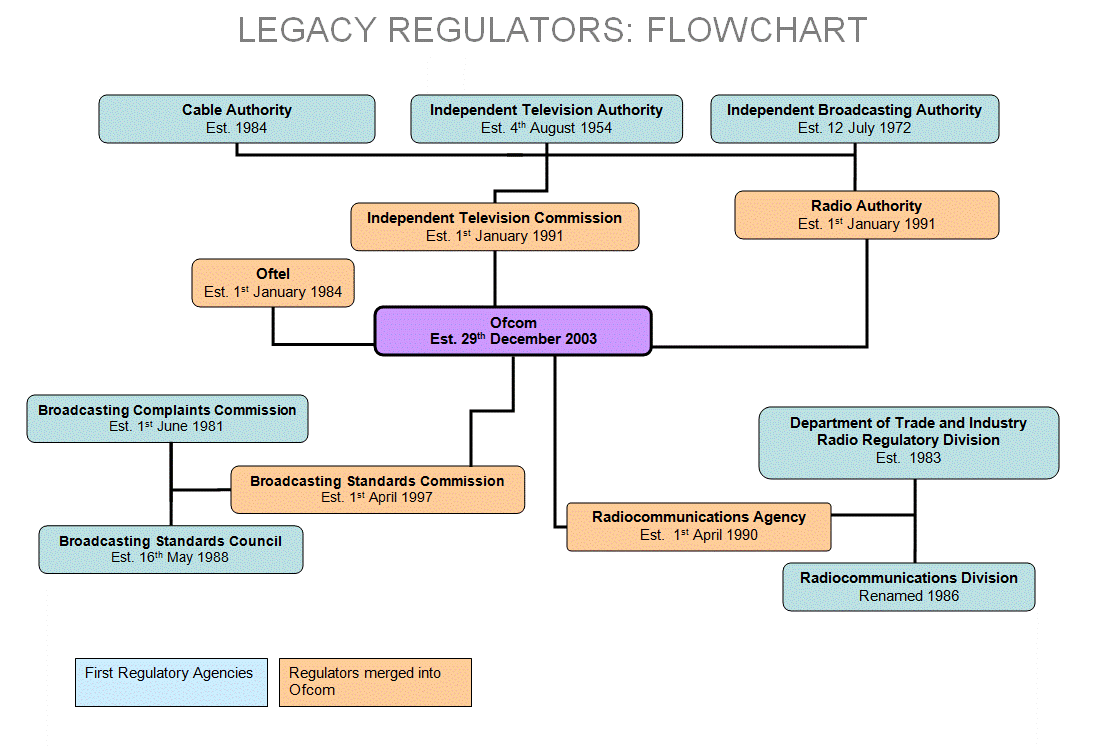
1.1 This year’s Corporate Plan has been drawn up while the Agency is still an executive agency of DTI but is preparing for transition to the new converged Office of Communications (Ofcom). This is expected to occur towards the end of 2003, subject to the passage of the Communications Bill.

1.2 The Corporate Plan objectives reflect the need to keep delivering the Agency’s major outputs, while prioritising activity to prepare people, systems and policies for convergence in Ofcom. Accordingly, staff resources for this year have been held at baseline, as have administration costs. Increases appear only in respect of activity arising from the new responsibilities of Cave implementation – which will also be an Ofcom priority.

1.3 Traditionally the Plan has covered the standard five-year period, but this Corporate Plan covers only the year leading up to the creation of Ofcom. However, spectrum planning is a long-term exercise; accordingly, the document also includes a detailed Forward Look to 2008, setting out future spectrum management issues as we see them now. Clearly it has not been possible at this stage to reflect changes arising from the converged Ofcom. The Forward Look should be viewed as illustrative and subject to review and development in the light of Ofcom’s wider objectives.

1.4 The presentation of the figures in financial annexes E, F and H has also been adjusted. The illustrative figures from 2004/05 onwards are shown in italics.

Aim

1.5 Optimal use of the radio spectrum to promote a dynamic and successful UK economy with enhanced quality of life through excellence, efficiency and innovation in spectrum management.
Business Objectives 2003/04 – 2007/08

1.6 These have been drawn up in line with the duties placed on Ofcom under the Communications Bill, and with the Agency's desire to achieve a successful transition to Ofcom. They are consistent with those established in the previous Plan, and with DTI's own business planning Operational Objective to "Improve the infrastructure to support business competitiveness and innovation" and the Sub-Objective to "Improve the communications infrastructure". For the Plan period, the Agency's Business Objectives are as detailed below; Annex A links these to the relevant Risks and Resources.

1 To secure the best social and economic use of the radio spectrum, that balances the interests of all users and consumers through making full and appropriate use of all available spectrum management tools, such as:
 

[

strategic spectrum planning and global and regional co-ordination;
 

[

transparent, accountable, proportionate, consistent and targeted regulation;
 

[

innovative and progressive techniques, such as trading, recognised spectrum access, spectrum pricing and auctions, to provide all users with incentives to use spectrum efficiently; and
 

[

ensuring compliance with requirements imposed for the benefit of all radio users in order to keep the spectrum clear of undue interference.

2 To achieve a successful transition to Ofcom, improving quality of service and business efficiency while ensuring the integrity of our business, through:
 

[

arranging the effective transfer of the Agency into Ofcom by Vesting Day;
 

[

improving licensing and business processes and operations to provide high-quality services that meet customers' needs;
 

[

maintaining and enhancing fully integrated, modern information systems that meet our business requirements and the demands of e-business; and
 

[

being a caring and considerate employer and, as an Investor in People, developing the skills of all our staff and unleashing their creativity.

3 To ensure that RA and Ofcom have the necessary skills, resources and knowledge to fulfil their spectrum management duties, through:
 

[

promoting a programme of contracted research to underpin developments in the utilisation of the radio spectrum;
 

[

facilitating more intensive exploitation of the spectrum through technical developments; and
 

[

maintaining a skilled in-house facility for technical studies and implementing a comprehensive spectrum monitoring and interference resolution strategy.

Top button

*

Section 2: Policy Priorities and Implementation

2.1 The strategy for this Plan has been drawn up in the context of Ofcom’s duties, DTI Business Planning and the supporting Agency Business Objectives. Within this section we are therefore setting out our major activities, priorities and target dates under each Business Objective.

2.1.1 Annex B contains a detailed analysis of our achievement of the priorities for 2002/03, as laid down in the last Corporate Plan.

2.1.2 For 2003/04 our top priorities are:
 

[

improving the quality of service provided to our customers;
 

[

achieving the effective transfer of the Agency into Ofcom; and
  [ implementing the recommendations of the Review of Radio Spectrum Management (the Cave Review).

These priorities are set out in more detail in this Section, grouped under the three high-level Business Objectives.

2.1.3 These priorities balance the ongoing objective of continuously improving the levels of service we provide to our customers, with two major change programmes. During the transition to Ofcom, the Agency will remain committed to providing the high-quality service our customers expect, and we expect that Ofcom will want these standards to continue. Furthermore, the Cave implementation programme will require fundamental changes to Agency/Ofcom work programmes and products. This programme is a Government commitment, which we expect Ofcom will want to continue and develop.

2.1.4 We recognise that there are risks attached to these priorities, and are taking action to manage these. The key risks to the Agency are detailed in Section 3 and AnnexJ. The most critical of these are:
 

[

loss of key staff;
  [ failure to make the necessary preparations for Ofcom and to manage the process of change; and
 

[

loss of credibility with customers.

2.1.5 These three risks cut across all, or nearly all, of our objectives. The loss of key staff would have a dramatic impact on the Agency’s ability to conduct its current business, much less embark on the changes discussed above. Failing to plan, co-ordinate and manage the transition to Ofcom would hamper Ofcom’s ability to fulfil its statutory duty of spectrum management, and would damage the perception of Ofcom and DTI. Lastly, we are a customer-focussed organisation, and any loss of credibility would damage our ability to manage spectrum in the interests of all and in accordance with our agreed objectives set out in this Plan.

Top button

2.2

Business Objective 1:

  To secure the best social and economic use of the radio spectrum, that balances the interests of all users and consumers through making full and appropriate use of all available spectrum management tools.
Review of Radio Spectrum Management
  Priority
  To implement the findings of the Cave Review (ongoing throughout 2003/04 – 2007/08)

2.2.1 Professor Cave's independent Review of Radio Spectrum Management reported in March 2002. It strongly endorsed the spectrum management reforms being pursued by the Agency, and recommended a wide-ranging and ambitious programme of further development to maintain and enhance the effectiveness of spectrum management into the 21st century. The Government has accepted the vast majority of the recommendations, with a commitment to:
 

[

develop and extend incentive pricing, including for the public sector;
 

[

continue the use of auctions where appropriate;
 

[

review licence conditions to ensure they are no more restrictive than necessary; and
 

[

commence rolling out spectrum trading in 2004.

2.2.2 Individual elements of this programme are described in more detail below.

2.2.3 The first phase of this programme includes major technical and economic studies into the optimal balance between international harmonisation and national flexibility, and the methodology of incentive pricing. These are due to be completed in early 2004. Steps to implement the findings are planned to commence in 2004, and will involve extensive and detailed consultation with spectrum users. Subject to the passage of the Communications Bill, decisions on these will fall to Ofcom.

Spectrum Pricing

  Priorities
  To consolidate economic and statistical data and analysis in support of administrative pricing (ongoing throughout 2003/04 – 2007/08)
  To review spectrum pricing methodology and extend it to new areas – broadcasting, aeronautical and maritime spectrum (2003/04 and 2004/05
  To implement further recommendations for changes as appropriate (ongoing throughout 2003/04 – 2006/07)

2.2.4 In its response to the Cave Review, the Government made a commitment to examine the existing spectrum pricing regime. As part of this response, we will review our spectrum pricing methodology. This review has been commissioned, and is expected to be completed in early 2004. We plan to extend market mechanisms more widely, including to sectors where spectrum pricing has not yet been applied. The project implications, and extensive work with the industry to implement the resulting changes, could extend over the whole five-year period of this Plan. It is proposed to make the first changes resulting from the review in the 2004 Ofcom licence charges order, which is anticipated in September/October 2004; however, if the changes involved are substantial, customers will expect them to be phased over a number of years.

2.2.5 We will continue with the impetus to implement pricing for broadcasting spectrum according to the template, and timescales, set by the Government response to the Cave Review. It is intended, inter alia, to determine the opportunity cost of the resource, the changing value of the spectrum to broadcasters and the costs and benefits, in spectrum terms, of public-sector broadcasting.

2.2.6 We are also looking carefully at areas where we can create market-type incentives via spectrum management organisations. Potential candidates for analysis include some private business radio use and programme-making. These are areas where we could capitalise on existing arrangements, both formal and informal, and develop them into an incentive-based arrangement.

Top button

Spectrum Access

  Priorities
  To secure expansion spectrum for 3G at the World Radio Conferences (WRCs) and to resolve refarming issues (ongoing throughout 2003/04 – 2007/08)
  To progress work towards digital switchover, and UK and international policy and planning work on spectrum use after switchover (ongoing throughout 2003/04 – 2007/08)

2.2.7 Hutchinson 3G (now named "3") has announced the intended launch of a commercial service in the first quarter of 2003. Other operators have indicated publicly that their rollouts may be later than originally envisaged, but they remain committed to implementing 3G networks in the near future. We plan to continue working closely with the 3G licensees to provide a regulatory, technical and licensing environment that facilitates the successful deployment of 3G services in the UK.

2.2.8 The 3G market is predicated on the evolving global vision developed in the ITU and 3GPP. Consequently, the Agency will continue to be active in relevant fora developing harmonisation measures in relation to spectrum and open standards. The forthcoming ITU-R WRC-03 has a number of 3G-related agenda items; the Agency has developed the UK position on these issues, and has agreed a provisional European common position for the Conference. This activity is further developed in ITU-R Study Groups such as Study Group 8 (Mobile Services).

2.2.9 There is increasing work on licence exemption, in line with the Communications Bill and the new EC Authorisation Directive. We recently consolidated Regulations exempting public wireless LANs at 5 GHz, links for uncoordinated bands at 58 GHz and some more land mobile satellite terminals. The new legislation requires that any individual licensing requirement must be objectively justified on spectrum management grounds. We have reviewed all existing licence classes to ensure that they are essential, and we have no further immediate candidates for exemption. However, we are currently consulting on whether Citizens' Band Radio will need to be licensed after some spectrum changes begin to be implemented in the next two years; exemption looks to be a strong possibility. As CB is currently a delegated licence class, contractual difficulties may make an earlier change problematic. At the same time, we intend to review the constraints on existing deregulated bands to ensure that they are as flexible as possible. This work is already under way, and will continue into year 1 of the current "The Future" programme.

2.2.10 The Agency is closely involved in the joint Government/industry arrangements (the "Digital TV Action Plan") focussed on promoting the take-up of digital TV and helping to create the conditions for digital TV switchover. Ministers have recently made decisions concerning spectrum issues, notably that the planning of the current six digital TV networks after switchover should be limited to the use of no more than 32 of the current 46 available channels. Particular priorities over the planning period include:
 

[

participation in more detailed planning work for the six digital networks, including sharing issues with other services such as programme-making and radioastronomy; and
 

[

considering the way in which the released spectrum (and spare channels among the six digital TV networks) might be re-used for a range of broadcasting and other services. This will lead to a number of new licensing opportunities.

The Agency chairs a subgroup of the UK Spectrum Strategy Committee (UKSSC). This subgroup is responsible for considering spectrum allocations in the freed-up spectrum and reflecting this in various international fora (notably WRCs) that have responsibility for determining international spectrum allocations. The subgroup will also agree the UK position (and whether we sign up to European Common Positions) for the forthcoming Regional Radiocommunications Conferences (2004 and 2005/06), which will negotiate the appropriate sharing of spectrum in the VHF and UHF broadcasting bands between administrations.

Auctions

  Priority
  To award licences for spectrum at 3.4, 3.6, 10, 28 and 40 GHz (2003/04 and 2004/05)

2.2.11 Auctions have important advantages, especially for new national or regional services where demand for licences is likely to exceed supply. They are a primary mechanism, as they allow the market to determine the value of spectrum. We plan to continue auctioning spectrum where new blocks of spectrum can be cleared.

2.2.12 Fixed Wireless Access (FWA) licences are to be awarded by auction in the 3.4 GHz band. Licences are to be offered on a regional basis, and an Information Memorandum has recently been published as a prelude to the award process planned for the summer.

2.2.13 In line with the Cave Review, we are re-issuing undesignated 28 GHz spectrum. We are also considering issuing pioneer licences at 40 GHz, to facilitate the development of equipment and services.

2.2.14 Proposals for issuing Fixed Wireless Access (FWA) licences in the 10 GHz band are currently under consideration. Potentially 2 x 60 MHz of spectrum previously occupied by Ionica and Cable & Wireless could be available, if technical issues regarding compatibility can be resolved. Options for the packaging and pricing of licences in these and the remaining 2 x 30 MHz, currently held nationally by an incumbent operator, will be considered during 2003.

2.2.15 An overlay auction is being considered in 2003/04 for spectrum at 3.6 GHz – expected to serve rural areas but not having national coverage, and involving only limited overlap with existing fixed links – in line with Government plans to promote broadband access for all and following consultation last year.

2.2.16 There will be areas where, because of wider public policy concerns, auctions are not the most appropriate vehicle for allocating spectrum. For example, in 2003 and 2004 we will be working with users to find spectrum to meet the requirements of the emergency services. It is likely that such spectrum will continue to be priced, but trading is unlikely to be allowed in the first tranche of traded spectrum.

Top button

Spectrum Trading

  Priority
  To introduce spectrum trading, depending on legislative changes (2003/04)

2.2.17 The new Framework Directive removes current obstacles in EU law to spectrum trading, and the Communications Bill will make the necessary changes to UK legislation. It will then be necessary for Ofcom to produce detailed rules before trading can be introduced. Trading is a major reform with significant implications for spectrum management practice, business systems and processes. It will require a shift in emphasis from technical to market regulation, including an appreciation of competition implications, and a further development of current spectrum trading models. We have a detailed programme of work to implement spectrum trading in as many licence categories as possible.

2.2.18 The Government’s response to the Cave Review stated that the first introduction of trading will commence in 2004. Implementation will be through Ofcom regulations, made using powers in the Communications Bill.

2.2.19 Detailed project planning is under way and a Trading Project Board has been established. This will report to the Spectrum Transitional Advisory Group (STAG). Depending on decisions by Ofcom on the pace of implementing spectrum trading, we would expect to require additional consultancy advice on setting up and running markets, spectrum engineering in a trading environment, and legal implications. This would need to be in place late in 2003/04 or early 2004/05 if Ofcom decided to introduce trading across a range of licence sectors by the end of 2004 (the date in the Government’s response to the Cave Review for the first introduction of spectrum trading). There will also need to be a central overview and monitoring function in place from the date of introduction of trading.

Recognised Spectrum Access (RSA)

  Priority
  To introduce the first RSA during 2004, following full and detailed consultation and subject to the passage of the Communications Bill (2003/04 and 2004/05)

2.2.20 The Communications Bill introduces a new system of recognised spectrum access (RSA) to complement licensing. Work is in hand to develop proposals for where and how RSA should be implemented. Proposals will be developed in 2003/04, with phased introduction commencing in 2004 subject to further consultation and decisions by Ofcom. Much detailed work will be done over the next year to select the services for which RSA will be offered, to define the degree of recognition that will be afforded RSA-holders and to set fees. An internal committee has been taking this forward, and its remit has recently been extended to include representatives from our Ofcom partners.

European Directive Changes

2.2.21 The new Authorisation Directive introduces many changes to the current licensing arrangements. These are largely subtle changes – mainly concerned with improving transparency – and it is intended to keep the basic Wireless Telegraphy Act licensing regime in place. The immediate changes under the Directives will be implemented into UK law on 25 July 2003. The Communications Bill provides about 10 new clauses to achieve the new measures. If the Bill is delayed, a Statutory Instrument will be made on these powers in the name of the Secretary of State. All the Powers will initially apply to the Secretary of State until Ofcom takes over.

2.2.22 The most significant immediate task for the Agency is the clause that requires Regulations to be made concerning limitations on the number of licences that may be granted, and objective justification for those limits. These Regulations need to be issued in draft by Easter for comment. This action also links to the new Frequency Authorisation Plan, which we will publish at the same time. We will need to indicate the conditions under which licences are issued on a limited basis; this includes listing each frequency at which we are open to receive licence applications. The Secretary of State/Ofcom will be specifically required to consider whether licences are required on spectrum management grounds before introducing any more licence products; if a licence is not required on these grounds, an exemption should be introduced. Licence terms (conditions) for current licence products are all being reviewed, and it is proposed to update terms on a number of classes. We are also introducing a generic simplified licence terms conditions booklet (in hard copy and online) for most of our “open for business” classes.

2.2.23 A further new requirement is that all valid applications for frequency use must be authorised within six weeks (unless there is an objective reason for refusal, international clearance is involved or there is a competition). Most Agency licensing processes are already considerably shorter, apart from those where national site clearance is involved. Our licence turnaround targets have been adjusted to ensure compliance (see Annex C).

2.2.24 Other changes include enforcement powers that are in line with the current enforcement concordat. The Framework Directive requires new procedures for handling disputes and appeals. The Agency has recently completed a joint consultation exercise with Oftel on disputes. In the interim period prior to Ofcom, we will handle any dispute applications on a case-by-case basis. In the longer term, we are looking to Ofcom to provide common facilities for administering disputes, although we will use our interference resolution resources to investigate any spectrum cases. On appeals, it is proposed under the Bill to have common procedures involving the Competition Commission Appeals Tribunal. All our customers will have a statutory right to appeal against decisions using the new procedures, which include consideration of the merits of a decision.

Top button

Spectrum Policy, Planning and Management

  Priority
  To continue to develop the UK Spectrum Strategy, in consultation with users, Business Units and the MoD and other Government departments (including through the UKSSC as required), as a strategic document that will be seen by spectrum users as a comprehensive and authoritative “road map” for the future development of spectrum use in the UK (ongoing throughout 2003/04 – 2007/08)

2.2.25 The strategic management of the radio spectrum remains crucially important. It is central to the Agency’s overall aim of ensuring optimal use of the radio spectrum, and will be central to Ofcom’s statutory duty “to secure the optimal use for wireless telegraphy of the electro-magnetic spectrum” having regard to “the different needs and interests...of all persons who may wish to make use of it”. Ofcom has a duty to manage the spectrum, and the crucial tool is the published Spectrum Strategy, widely acknowledged by UK business and the international community as the gateway into the long-term thinking and strategic planning of those who facilitate the developments across the whole of the spectrum. Developing the Spectrum Strategy is a very dynamic process involving extensive consultation and negotiation, both internally and externally. It is also inextricably linked to the extensive range of international work, in Europe and globally.

2.2.26 In developing our strategy for managing the spectrum, we will need to make full use of economic analysis alongside radio engineering skills. For example, improving and using data on the value to the economy of different radio services will enable us to analyse the effect of allocation decisions on markets for goods and services, especially on competition and benefits for consumers. However, although economic considerations should be given due weight, they cannot be the sole determinant of spectrum policy; we will need to balance economic considerations with social, cultural, strategic, scientific and public safety requirements.

2.2.27 The aim of our Spectrum Strategy is to ensure optimal use of the spectrum. A central plank of the Strategy is our approach to spectrum allocation. We will seek to ensure, internationally and domestically, that spectrum allocations are forward-looking and flexible and make spectrum available for those services that can use it most effectively for the benefit of the UK as a whole.

2.2.28 The Agency’s, and Ofcom’s, approach to spectrum allocation will reflect the recommendations of the Cave Review – particularly its emphasis on the need for a rigorous analysis of the costs and benefits of service-specific international allocations, the need to keep existing allocations under review, and the potential benefits of national flexibility in some cases. The benefit of spectrum flexibility is that it will allow markets to decide (within limits) to what purpose spectrum should be put. This will encourage spectrum to flow from low-value uses to high-value ones.

2.2.29 The Plan assumes a continued input from scenario planning into the Spectrum Strategy. The scenarios that the Agency has promoted provide a valuable tool for helping us to assess the likely evolution of society’s demands for spectrum and how these might be met. The Agency’s Scenario Planning, Evaluation and Review (SPEAR) project will ensure that the scenarios are continually reviewed and kept up to date, so that they provide valuable analytical tools for evaluating the spectrum management implications of particular scenarios. Ofcom will want to consider how best to build on this.

2.2.30 The need to ensure a joined-up approach to spectrum management within the Agency/Ofcom and within Government will continue to increase. The clear commitment in the 2000 White Paper that “the transfer of all the Agency’s Spectrum Management responsibilities to Ofcom will enable us to maintain a coherent approach to overall management of spectrum use” is given effect in the Communications Bill.

2.2.31 However, since Ofcom will be an independent public corporation rather than part of a Government department, the precise mechanisms for co-ordinating overall UK spectrum policy require careful consideration. These are currently under discussion.

2.2.32 The Plan assumes that, as is the case with DTI now, Ofcom will have an independent advisory group providing impartial expert advice on spectrum management priorities.

2.2.33 In the run-up to the creation of Ofcom, the Agency will be working even more closely with those Ofcom partners (Oftel, the ITC and RAu) that have an interest in spectrum strategy and (in the case of the ITC and RAu) are responsible for spectrum assignments. This will prepare the ground for the adoption of a coherent, flexible and forward-looking approach to spectrum management throughout Ofcom.

Economics and Statistics

  Priorities
  To study the costs and benefits of relaxing the mandatory international harmonisation of spectrum allocation and equipment standards (ongoing throughout 2003/04 – 2007/08)
  To provide analysis and estimation of the value of spectrum to a level required to make decisions relating to the allocation and assignment of spectrum (ongoing throughout 2003/04 – 2007/08)
  To provide the economic analysis required to design and implement spectrum pricing and trading; or, to act as an intelligent customer in the procurement of economic advice in these areas (ongoing throughout 2003/04 – 2007/08)
  To act as an intelligent customer concerning the outsourcing of customer satisfaction surveys and their analysis (ongoing throughout 2003/04 – 2007/08)

2.2.34 In its response to the Cave Review, the Government made a commitment to examine harmonisation. As part of this response, the Agency will commission a study to estimate the costs and benefits of relaxing the international harmonisation of spectrum allocations and equipment standards, for completion in 2003/04. We will also design a process to monitor and evaluate the costs and benefits of any changes in international harmonisation (to take place between 2004/05 and 2007/08).

2.2.35 The economic aspects of the Agency’s work and justification of the spectrum strategy objectives will continue to be essential to Ofcom. We will be building on the agreed programme of economic impact studies, support for auctions, advice on spectrum pricing and trading, market demand studies and customer surveys.

2.2.36 The Cave Review opens up the prospect of the Agency and subsequently Ofcom playing a more active role in managing the spectrum used by other Government departments, such as the MoD, on their behalf. The potential gains, in terms of more effective use of spectrum and consequent economic benefits, could be considerable. We will estimate the approximate gains and consider alternative uses of spectrum currently used for public purposes.

2.2.37 The Agency has commissioned a number of customer satisfaction surveys. We will continue to commission these studies and to analyse their results. In this regard, Agency statisticians act as intelligent customers, provide statistical analysis and help interpret the survey results in terms of actions the Agency might take to improve its customer relations.

Top button

Convergence

  Priority
  To utilise fully the convergence scenarios for the strategic planning of spectrum and more widely in Ofcom (2003/04)

2.2.38 Convergence will have rapid and unpredictable effects, calling into question accepted business models and service definitions. To help plan ahead in conditions of rapid and unpredictable change, the Agency commissioned a set of scenarios for the future of convergence and spectrum strategy and management, to provide alternative visions of the future for the decade ahead. These scenarios are increasingly being used to develop spectrum and other strategy. The priority for 2003/04 is to review and update the scenarios, and to develop modelling tools that will help us ask “what if?” questions and track how the scenarios are unfolding over time. The SPEAR project that is currently under way will provide updated scenarios, a rich convergence database and a flexible modelling tool. This will help test major decisions against the scenarios to check robustness.

2.2.39 The scenario planning exercise has been well received internally and externally, and has been incorporated in recent editions of the Spectrum Strategy.

International Policy

  Priorities
  To maintain the Agency’s (and subsequently Ofcom’s) position as a premier spectrum management organisation, and to provide international leadership in furtherance of UK interests in the relevant international fora, particularly in the ITU and CEPT (ongoing throughout 2003/04 – 2007/08)
  To undertake effective preparations, co-ordinate UK involvement and play a leading role in the 2003 World Radiocommunications Conference (2003/04)
  To reach agreement between DTI and Ofcom (and other Government departments as necessary) on Ofcom’s role and responsibilities in international representation and negotiations, and in the payment of the UK financial contributions to these bodies – particularly the ITU, CEPT and the European Communications Office (2003/04)
  To develop our strategic alliances outside Europe (e.g. with Commonwealth countries and the USA) while maintaining and extending our influence within CEPT, particularly in the work of the Electronic Communications Committee and especially its preparations for WRCs (ongoing throughout 2003/04 – 2007/08)
  To contribute fully and effectively to the new EU committees with spectrum management responsibilities, and to seek to ensure that the EU’s enhanced role in spectrum management supports our strategic priorities and supplements rather than duplicates the work of CEPT (ongoing throughout 2003/04 – 2007/08)

2.2.40 The breadth and scope of our international activity is a distinguishing characteristic of the Agency, compared to the other regulators that will become part of Ofcom. As international representation has traditionally been viewed as a “Government” function, it will be important to be clear about the roles and responsibilities in this area that will fall to Ofcom as a public corporation.

2.2.41 It has always been the Government’s intention that Ofcom will take on most, if not all, of the Agency’s international responsibilities. Clause 19 of the Communications Bill specifically provides for Ofcom to take on the task of representing the Government where required to do so by the Secretary of State.

2.2.42 Clause 19 of the Bill also provides for Ofcom to subscribe to international bodies as required by the Secretary of State. The Agency is currently responsible for the UK’s subscription to the ITU, the European Communications Office in Copenhagen, CEPT and certain other collaborative activities. It is expected that these responsibilities will pass to Ofcom.

2.2.43 The Agency is undertaking a rigorous review of representation on and involvement with international organisations, identifying those that are crucial in terms of spectrum management. This is leading to a refocus of priorities and the rationalisation of resources. Our international consultancy work will be phased out by the end of 2003, to avoid a possible conflict of interest in Ofcom.

2.2.44 We are revising the level of funding for the ITU subscription, reducing the UK contribution. Currently this is of the order of £2 million per annum (the actual amount depending on the size of the contributory unit and the exchange rate). We had intended to increase the contribution by slightly over 50% with effect from 2003, and to continue at that level for the coming years. However as a result of the decisions at the Plenipotentiary Conference 2002 in Marrakesh, the UK has decided not to go ahead with this increase in 2003. Furthermore, from 2004 onwards the UK contribution will reduce to two-thirds of its current level.

2.2.45 The next World Radiocommunications Conference will be held in 2003. We have secured a number of key positions in the European preparatory machinery, and we will be continuing our leading role on behalf of the UK. Overlapping with this event will be the preparations for the two-session Regional Radiocommunications Conference on digital broadcasting, with the first session in May 2004 and the second in 2005. We have taken on the chairmanship of the UK preparatory committee for this conference, and will be making a significant contribution to the preparations.

2.2.46 Throughout the Plan period, we will continue to press for further reforms of CEPT and the ITU, going forward from the improvements already achieved.

2.2.47 Following the completion in 2002 of the EU Communications Review, the EU will now be taking on a more prominent role in spectrum management. The Spectrum Decision has given the EU new powers to adopt harmonisation measures through a delegated "fast-track" procedure in certain circumstances, where this is in furtherance of an agreed EU policy objective. The Agency/Ofcom will represent the UK on the Radio Spectrum Committee, which has been set up under the Spectrum Decision to assist the European Commission (EC) and (where appropriate) to vote on proposed harmonisation measures. We will also represent the UK on the Radio Spectrum Policy Group (RSPG), a high-level advisory group which will agree high-level spectrum management priorities with the EC.

2.2.48 We are already taking an active role in the new committees, and will need to continue to do so. Our aim will be to ensure that the EU restricts itself to dealing with high-level strategic goals in support of agreed EU policy objectives, and that its work supplements that of CEPT rather than duplicating it. We have indicated to the EC that we are willing to stand for the vice-chairmanship of the RSPG for the first year, which could lead to the chairmanship in the second year. This could provide a valuable opportunity to influence EU spectrum policy in a helpful direction; it appears, from preliminary soundings, that a UK candidacy would be well supported by other Member States.

Top button

International Regulations

  Priorities
  To protect operational and proposed UK radio services through technical and regulatory examination by, and response to the fortnightly ITU Circulars (BRIFIC) and other bilateral communications that contain proposals for new and modified radio services. This co-ordination and notification activity ensures that UK radio services have equitable access to the radio spectrum and can plan in a known environment. Failure to target and act on potential conflicts can have serious consequences for UK radio services (ongoing throughout 2003/04 – 2007/08)
  To research, set and implement Agency satellite filing fees. To cover the expected cost of filing, co-ordinating and notifying UK satellite network filings, we propose to levy an up front filing fee to cover the expected resource and other costs over the co-ordination period (2003/04)
  To continue to encourage the co-ordination of terrestrial services with our European neighbours, thus maximising available spectrum. This will allow the development of new and innovative services in a known environment (ongoing throughout 2003/04 – 2007/08)
  To continue to support the efforts within the ITU to reduce the satellite filing backlog (2003/04)
  To continue to improve and encourage the use of the implemented common strategy for the co-ordination of UK satellite networks (2003/04)
  To encourage the implementation and application of electronic transactions and record-keeping through the Electronic Records and Documents Management (ERDM) initiative, ensuring that an efficient service is provided on international co-ordination (ongoing throughout 2003/04 – 2007/08)

2.2.49 We are reviewing our satellite processing strategy. Filings are increasing, and we need to ensure a robust, joined-up approach involving all the expertise within the Agency. As part of the move to Ofcom, there is a need to resolve handling regulatory and satellite issues for Overseas Territories. One possibility is for this function to be taken into Ofcom, at least for an initial period and on the basis of full cost recovery.

2.2.50 As part of our overall strategy, we are also reviewing satellite filing policy. This includes future business planning with existing operators on the progress or rationalisation of their current filings, and also the acceptance of filings from overseas companies that have the facility (if not necessarily the desire) to file through their own administrations. Given the current position of the telecommunications market we are also adopting a more stringent approach to the number of satellite networks which will be accepted for filing with the ITU.

Standardisation Policy

  Priorities
  To support the preparation of harmonised standards for radio equipment and systems, which will underpin the spectrum management objectives of ensuring mutual compatibility and preventing harmful interference to radio services (2003/04 – 2004/05)
  To ensure the effective co-ordination of standardisation work via the new standardisation subgroup of the Agency’s Spectrum Policy Committee (SPC) (2003/04)

2.2.51 Harmonised standards mandated by the EC against the R&TTE and EMC Directives provide the Agency with essential spectrum management tools. The harmonised standards are prepared by the European standardisation bodies, primarily ETSI, and provide for market access, spectrum management and enforcement activities. The Agency holds the chair of key committees in ETSI (TC-ERM) until June 2003 (renewable for a further two-year term) and IEC-CISPR until May 2005; this benefits the UK.

2.2.52 A wide-ranging review of Agency participation in the standardisation sector (the Cain Standardisation Review) has been completed, with specific reference to ensuring that consistent policy objectives are sought in all fora. There is increasing pressure on all staff who are members of such fora to limit participation due to cost constraints; for the Agency moving to Ofcom, this means that a more focussed, pro-active stance to achieve spectrum management objectives is required.

International Consultancy

  Priority
  To ensure a smooth withdrawal from RSI’s international consultancy business while fulfilling existing contractual commitments, with a view to cessation by Ofcom Vesting Day (2003/04)

2.2.53 We intend to phase out the international consultancy work, as this activity will not be taken on by Ofcom. Our partner, LogicaCMG, is in agreement, as Radio Spectrum International (RSI) is experiencing reduced profit margins. Our current contractual commitment, which extends into 2003/04, will be honoured, but no new work is being sought.

Top button

Enforcement

  Priorities
  To report to the Cabinet Office on our enforcement activities aimed at keeping spectrum clean and tackling interference, in line with the Government’s Enforcement Concordat (ongoing throughout 2003/04 – 2007/08)
  To implement the new enforcement powers contained in the Communications Bill (2003/04)
  To step up enforcement and monitoring activities so that they take account of legislation such as the Human Rights Act, the Freedom of Information Act, the Regulation of Investigatory Powers Act, the Police & Criminal Evidence Act and the Radio & Telecommunications Terminal Directive and its UK implementing Regulations (ongoing throughout 2003/04 – 2007/08)

2.2.54 The Cabinet Office Enforcement Concordat gives us a helpful framework, ensuring that the subjects of our enforcement activities have the protection of fairness, transparency, accountability, proportionality and consistency. We also abide by the Police and Criminal Evidence Act, the Human Rights Act and the Regulation of Investigatory Powers Act. Our enforcement work is monitored annually by the Cabinet Office and through our local customer panels; a consistent pattern has emerged of an organisation whose customers are appreciative of its transparent and proportional approach to enforcement activities.

2.2.55 Implementing the Communications Bill’s new enforcement powers should be a top enforcement priority in the Plan period. There will be a need to prepare guidelines for staff to work with the police powers of arrest, and for powers on condemnation of restricted radio apparatus. New powers on penalty fines will require secondary legislation and careful preparation, i.e. they must not be seen as draconian, but must not be so light that they have no effect.

2.2.56 The use of market mechanisms for assigning spectrum increases the profile of interference resolution. There is a pressing need for Broadband Britain to roll out with as much competition and choice as possible, but for digital subscriber line (DSL) and power line technology (PLT) we must also address the concerns of radio users over interference. Work in the UK on frequencies up to 1.6 MHz (MPT 1570) is complete for now, and we need to address the higher frequencies. We need to watch the European situation, which is confused at the time of writing, but our view is to go for interference limits that can be used fairly in cases of need, rather than compliance standards that appear impractical and uneconomic. Our own research programme and expertise will make an important contribution to this, and we will pursue resolution through the UKSSC where appropriate.

2.2.57 The battery of EC Telecommunications Directives will need to be translated into action for the Nations and Regions as they pass into UK law. The R&TTE Directive is already changing the enforcement landscape as market surveillance test purchases are becoming more familiar. Spectrum trading is also in this category; as this management tool comes into play later in the Plan period, there will be a need to set the policy steer for local enforcement. As businesses trade spectrum, there will be pressure to guarantee a stable and usable product. Benchmarking in other countries suggests that customer demands for enforcement increase in a trading regime.

2.2.58 Pirate radio remains a high-profile enforcement issue. We have an excellent record in raiding transmitter sites and we envisage maintaining that profile, as raids deny valuable airtime for pirates. However, we also need to continue the emphasis on in-depth work, with particular attention to advertisers, premises-holders and those who supply services to pirates.

2.2.59 With domestic interference work, a change in policy has seen the number of cases fall. We must continually review how we handle paid cases while responding to genuine complaints from customers.

2.2.60 The Stewart audit of emissions from cellular base stations is ongoing, in accordance with Ministerial wishes. The audits are providing reassurance for the public. The industry is also keen to see the work progress, as it sees our technical expertise as giving an independent view on a contentious subject. A further 100 audits of sensitive sites are planned for 2003/04, with an expectation of at least a further 100 in each year of the Plan period.

2.2.61 The Cave Review recommended that we should examine the scope for businesses undertaking more interference management on their own behalf. We are engaged in consultation, which will take in all parts of the industry.

2.2.62 Enforcement demands are changing. The legislation is more complex and the way that we enforce is also taking in new territory (e.g. analysis of computer data). All this calls for up-to-date training and policy guidelines for our field staff. We must continue to strive for the most cost-effective way of getting all this change across to the widely dispersed field staff.

Top button

2.3

Business Objective 2:

  To achieve a successful transition to Ofcom, improving quality of service and business efficiency while ensuring the integrity of our business Ofcom Implementation
Review of Radio Spectrum Management
  Priority
  To achieve the effective transfer of the Agency into Ofcom by Vesting Day (2003/04)

2.3.1 We continue to work in close co-operation with the Ofcom Board, the Regulators, the Bill Team, DTI and DCMS in progressing the Communications Bill and facilitating the creation and structure of Ofcom. The Chief Executive represents the Agency on the Ofcom Regulators Group and maintains regular liaison with Ofcom on a range of key policy and management issues. This has also meant heavy resource commitments during the organisation design phase, with Agency representation on a wide range of Ofcom teams and supporting groups involving Directors, Heads of Unit and key supporting staff. The need to prioritise in order to free up resources for the transition to Ofcom is expected to increase throughout 2003.

2.3.2 Prior to Vesting Day, the Agency’s Chief Executive will continue as its Accounting Officer, as appointed by the Principal Accounting Officer in DTI. Ofcom is currently drawing up its corporate governance strategy; the intention is that its Chief Executive will be the Accounting Officer, reporting to the Ofcom Board.

2.3.3 There is high-level liaison with the Ofcom Board and its Central Project Team (CPT) to ensure a smooth transition of spectrum strategy into Ofcom. This has led to the establishment of the Spectrum Transitional Advisory Group (STAG) – a high-level, cross-body spectrum policy group co-chaired by the Ofcom Chairman and the Agency’s Chief Executive, with membership drawn from our fellow regulators, DTI, DCMS and the Treasury. This will make recommendations on strategic spectrum issues, including the implementation of the Cave Review and spectrum trading.

2.3.4 The full integration of Oftel and the Agency’s work on wireless networks will be a challenge for year 2 of the programme, as will the work on broadband access. A concerted approach will be necessary to ensure a "one-stop shop" for information and guidance. In addition, work needs to be done to ensure that the assumptions underpinning various economic assessments currently made by different organisations but in future by Ofcom will be consistent throughout Ofcom's work. Efforts will concentrate on merging the Broadcasting Act and WT Act licensing functions for broadcasters who require both licences. This includes dealing with the policy, planning, co-ordination and licensing operations, which are currently distributed among the ITC, Radio Authority and Agency (and BBC), in a more "joined up" way.

2.3.5 In the run up to Ofcom vesting we anticipate developing detailed working-level relationships with the other regulators and Ofcom itself in a number of areas. We anticipate even closer working relationships on a horizontal basis. Good progress is already under way on research, with very constructive linkages being made with ITC in the Nations and Regions.

E-Business

  Priorities
  To implement an e-business strategy (2003/04)
  To increase the availability of services online, in accordance with Ofcom’s e-business strategy and customer expectations (2003/04 and 2004/05)

2.3.6 Ensuring that customers have good and flexible access to services, mainly via electronic means, is a key Agency objective. Ultimately we want most of the assignment and licence completion work to be done online by the customers with our help. There are considerable benefits to be gained by using electronic service delivery. Firstly, processing work needs only to be done once by the applicant. Secondly, it is not necessary for there to be any paper output at all – merely a database that all can examine. Thirdly, electronic systems can be built to respond flexibly to customers' needs. It is not necessary to have one size that fits all. Finally, electronic systems enable us to give customers access to sophisticated planning tools that they could not otherwise afford. They will be able to provide a better service to their customers in turn, and to be more specific to us about their exact spectrum requirements.

2.3.7 The Agency plans to improve substantially the technical and administrative data we hold about customers and spectrum use, which will take forward our plans for spectrum management (including self-assignment and trading). This is a considerable task with major IT implications. Although the work has already been started, the opportunity was taken recently to assess the viability of the current implementation plan in the light of the imminent transfer to Ofcom. As a consequence, although much of the work will continue because it is critical to meeting Agency obligations ahead of Ofcom, other items are not being started or are being “mothballed” until Ofcom’s requirements are clearer.

2.3.8 In terms of specific projects, SatClear is already live, as is IR2008, which went live in August. The latter allows the use of time division for some PMR data licences, allowing four times as many users on to the same channel. It is anticipated that all standard PBR licences will be available online from September 2003. MASTS, the new planning system, will be online by April 2003 for internal use, and by 2004 customers will be able to self-assign. If it is successful, MASTS will be used as a model for other assignments. Eventually the move to online self-assigning licences will change the organisation, as it will be possible to move resources from working on specific licences to dealing with policy issues and answering telephone queries via call centres and/or help lines. The aim is to enable assignments to be made and licences issued online wherever possible; however, complex assignments and those requiring national or international co-ordination may still require Ofcom action.

2.3.9 Spectrum Quality Management (SQM) provides remote access to the Agency’s IT databases and is a crucial business project. There were some launch problems and difficulties in bedding down, but giving mobile field officers access to real-time Agency databases will make a significant contribution to efficiency and customer service. The aim is to make SQM more responsive to users’ demands.

2.3.10 The benefits of e-business are already being seen. e-Flatco has helped release engineer time at Baldock, and the Stewart Audit work has given public prominence and recognition to our engineering expertise and electronic processes.

2.3.11 Our concerted efforts have been recognised in February 2003 with the commendation award for e-business from the Management Consultants Association, reflecting the achievements of our joint venture partnership with LogicaCMG.

Customer Consultations

  Priorities
  To seek the views of customers on our enforcement, interference resolution and spectrum monitoring activities through customer panels (ongoing throughout 2003/04 – 2007/08)
  To maintain a customer service performance measurement programme, and to develop further the associated service quality targets as appropriate to support Ofcom customer service policies (2003/04)

2.3.12 Local customer panels are providing an important channel for dialogue with customers, helping us to understand better their different requirements. The eight National and Regional panels and the Baldock panel are firmly in place, but we need to develop mechanisms for pulling together common themes and co-ordinating panel inputs and outputs. There is clearly an Ofcom dimension here, with both ITC and Oftel having local representation. The panels offer a vital tool for improvement. One of the many challenges for Ofcom will be to acquire coherent and consistent customer involvement. We are well advanced and will assist in building the wider Ofcom context. A unified approach will be pursued; one possible option is a reporting structure upwards to the Ofcom Consumer Panel. The local customer panels’ role in articulating the spectrum management theme would then take on more strategic importance in terms of forward strategy.

2.3.13 Roadshows have been a major annual feature of our interaction with customers, who have consistently welcomed this targeted approach. We will be discussing their future in the wider Ofcom context.

2.3.14 Formal quantitative licensee surveys continue to have a key role in monitoring and highlighting service issues, and the survey programme represents an essential tool to drive forward initiatives for continuous improvement. The reported levels of satisfaction have continued to rise in 2002/03 from the high base in 2001/02; the latest results and action plans, derived from specific detailed analysis, require dissemination and follow-up with head office and the Nations and Regions to maximise gains from the programme.

Nations, Regions and "One-Stop Shops"

2.3.15 Our local staff are the eyes and ears of the Agency in the marketplace. Feedback from them and from local customer panels helps to shape the Agency’s policies and facilitates the spread of enterprise, innovation and productivity.

2.3.16 Ofcom will need to be close to its customers. In the Nations and Regions we have been trying hard to foster close and friendly ties with colleagues in the ITC (the other organisation going into Ofcom with a National and Regional structure). The details of the structure are being finalised, but there is a clear requirement to provide a local service to local customers.

2.3.17 In the devolved Nations, a strong Ofcom presence is already a declared wish of Ministers. In all three Nations there is already a strong and close bond with ITC colleagues, and at the political level much progress has been made in cementing a close relationship with the local institutions. We are well placed to take this progress through into Ofcom.

2.3.18 E-business and electronic records generally will have an impact on the Nations and Regions. The push will inexorably be in that direction during the Plan period, and the transition will need management at both central and local level. E-business has already brought benefits to areas such as the licensing of satellite earth terminals. Customers will soon be able to access assignment and monitoring information electronically, and this will influence their dialogue with local staff. This transition will need careful management for the benefit of customers and the Agency. Local frequency assignments will maximise spectrum use and aid competition.

2.3.19 Follow-up work on the Cave Review, changes to digital technology and spectrum trading are all on the horizon, and we expect a gradual increase in enforcement. In an era when people trade radio licences and businesses try to resolve interference themselves, the demands on the regulator will be for more intervention to keep the spectrum clean in the first place and for the “honest broker” role where disputes arise. The pattern emerging for local services is very clearly demonstrated by the experiences of Australia and New Zealand.

2.3.20 The administrative work will similarly change from issuing licences to a much greater emphasis on recording changes of ownership and usage, and dealing with interference and enforcement issues. Data cleansing and data reliability are crucial issues in ensuring effective performance.

Human Resources (HR)

  Priority
  To sustain effective recruitment and retention policies during the transition to Ofcom (2003/04)

2.3.21 The HR Strategy published in April 2001 continues to provide the framework for developing our HR policy, with a strong focus on recruitment and retention. Targeted recruitment campaigns have cut into the historic level of vacancies. The Agency’s initial internal targets on handling vacancies and establishing response times provided opportunities for streamlining processes, including a redesigned and more focussed application form, together with qualitative improvements through systematic interviewing.

2.3.22 A particular priority in the run-up to Ofcom Vesting Day has been to retain key staff, including experienced spectrum engineers. The Agency has introduced a rigorous review of posts and long-term vacancies as we “firm up” our complement for 2003/04 in advance of Ofcom transfer.

2.3.23 The effective management and communication of HR issues is a key priority for 2003. Agency staff have, in addition to the option of transferring on TUPE terms or accepting an Ofcom offer, the opportunity to go to Ofcom on secondment from the DTI, with the right of return to DTI. We will continue to work with DTI on the secondment arrangements, and will take forward detailed arrangements to implement them.

2.3.24 The Agency will work with Ofcom to develop terms and conditions for those intending to transfer to Ofcom. We have diverted resources to ensuring that existing terms and conditions are understood, and to identifying the HR information infrastructure.

Training and Development, Diversity and Investors in People

  Priority
  To develop staff career paths that meet the needs of the business and individual career aspirations (2003/04)

2.3.25 The Agency achieved its third accreditation under Investors in People (IiP) last year. The accreditation will take us into Ofcom, and we will build on the strong platform created by the Leadership Development Programme and the Growing Leaders Programme. Strong leadership will be a key feature in the change programme for Ofcom start-up.

2.3.26 Our key priorities for 2003/04 will be to support managers to lead and manage their teams through organisational change, and to ensure that our staff are provided with the technical skills that will support Ofcom’s business challenges. We will also continue to provide opportunities for staff to maintain their continuous professional development.

2.3.27 We are committed to respecting the diversity of all our people and making the best use of their skills and abilities. As last year, the Agency has a specific objective relating to mainstreaming diversity, which is factored fully into business planning and the roles and responsibilities of staff at all levels. Our key priority for 2003/04 is to build on the success of the Diversity Open Forum that we hosted in 2002/03 for staff from all Ofcom partners. We plan to continue to work closely with the other regulators to build a culture of diversity, by hosting further events that aim to share and develop our knowledge and best practices. We also plan to network with the regulators to make an effective contribution to mainstreaming diversity in Ofcom.

2.3.28 At this stage, any forward planning beyond Ofcom start-up would be speculative. However, we have refocussed our training and development strategy to ensure that development associated with the transition to Ofcom is treated as critical. We have developed an interim programme of events, with a focus on building skills that match the emerging requirements of Ofcom, and we will continue to monitor and amend this programme as we gain greater clarity on the requirement. We will ensure that we support the Agency in building on our existing high levels of engineering expertise. We will do so by providing agreed technical training and Continuous Professional Development events, through lunchtime workshops and by continuing to align our work closely with the Institution of Electrical Engineers standards wherever appropriate. We will also continue to ensure that development is provided where it is business-critical to the Agency during the transition.

Health and Safety

  Priority
  To engage managers in the assessment and control of widespread risks and of particularly significant risks (2003/04)

2.3.29 We have raised the profile of health and safety via campaigns, newsletters, tours and cross-Agency working groups covering topics such as stress and vehicles. We will begin to integrate managers into the safety system via trained assessors, risk assessments, personal achievement plans, local action plans and proactive monitoring. We will also establish a basic occupational health system, from pre-employment checks through fitness-for-work assessments to rehabilitation, and will significantly increase the quantity and relevance of health and safety training.

Communications

2.3.30 We are closely involved in formulating Ofcom’s emerging communications strategy through membership of its Communications Group. This is taking place alongside our:
 

[

sponsorship and project management of the transitional website and intranet projects;
 

[

project management of the publications project, and membership of the project teams for the internal communications, corporate identity, events and information/ library projects; and
 

[

involvement in the production and publication of the "Ofcom & You" internal newsletter.

Progress is well under way in implementing the Agency’s communications strategy and the supporting action plan. There is increasing use of electronic interaction. In moving forward, we will review the focus and direction of the Agency Roadshows and other publicity activities in the overall Ofcom context.

Risk Management

  Priority
  To complete the process of fully embedding risk management into the culture (ongoing throughout 2003/04 – 2007/08)

2.3.31 The initial work undertaken is leading to greater co-ordination of Agency efforts; it is linking change management and culture with business planning, supported by targeted training and development. All this moves us forward in embedding effective risk management into the Agency. The Agency Risk Register for 2003/04 as agreed by the Management Board is attached at Annex J, and the key strategic risks are identified together with the necessary management and review mechanisms.

Performance Measurement

  Priority
  To revise licensing performance measures to comply with the EC Authorisation Directive, and to operate under the new regime (2003/04)

2.3.32 The new EC directives, which must be implemented in July 2003, require us to re-examine our licensing processes and make them comply with a statutory timescale. While most of our existing published targets comply fully, some changes are necessary. Article 5 of the Authorisation Directive requires a six-week timescale for routine classes; this translates into 42 calendar days. The new targets will apply from 1 July 2003; the existing licensing targets will remain operable until that date. These details are confirmed in Annex C. A new shadow target covering electronic clearance of satellite network stations has been added. However, the shadow target on the accuracy of common base stations has been removed, as there are now very few cases.

2.3.33 The remaining published targets covering enforcement, correspondence and prompt payment are continuing as currently cast, but all such measures will be reviewed shortly in terms of Ofcom.

2.3.34 We are also, for now, retaining the extensive range of internal performance measures. Key targets continue to be reported regularly to the Management Board, and are listed in Annex D.

2.3.35 Initial progress in developing the Balanced Scorecard provided a new framework for assessing our performance, in support of agreed Business Objectives. The full pilot Scorecard was completed and fully developed. However, it was agreed that further development work on the Scorecard should cease, and that the project should be parked in such a condition that it can be used and developed further if Ofcom desires to use it as a primary performance measurement tool. The necessary work to implement this decision is under way and will be completed before the end of this financial year. Additionally, the rollout of the European Foundation for Quality Management (EFQM) scheme across six Agency Business Units has provided, at a local level, a further demonstration of our commitment to quality management. Assessment against the EFQM model provides a diagnostic framework designed to help organisations measure performance, identify strengths and areas for improvement, prioritise activities and measure their effectiveness. An added benefit of the model is its close links with improvements in outcomes in our work with the IiP standard. Further moves are on hold for the moment as Ofcom starts to develop its own strategy for quality.

Information Systems (IS) Strategy and Enhancement

  Priority
  To enhance and develop the functionality and sophistication of the management information systems (ongoing throughout 2003/04 – 2007/08)

2.3.36 We are continuing to support the delivery of an efficient, economic and effective management structure for IS/IT, in both the Agency and Ofcom environments. Collaborative efforts are under way with Ofcom colleagues and consultants to establish the necessary capability to meet the business requirements. We are working in close co-operation to support the newly appointed Ofcom Chief Information Officer. Ongoing Agency support is through the existing partnership arrangements with RSI, and we await advice on th