|
|
Licensing Policy Manual |
![]()
|
|
Section A |
Why the manual was written |
|
How the Radiocommunications Agency policy is determined and publicised |
|
|
Section B |
Licences |
|
General procedure for a licence application (including renewals) |
|
|
Possible changes of policy to harmonisation of renewal dates |
|
|
Section C |
Charging and accounting procedures |
|
How we Implement annual amendments to administration to licence charges |
|
|
Section D |
Service targets and complaints procedure |
|
Section E |
Enforcement and work of local offices |
|
Section F |
Allocation and assignment processes |
|
Section G |
International and EU relationships |
|
Section H |
Disclaimer |
|
Annex |
|
![]()
|
This manual is aimed to provide an over view of the Agency's licensing and policy procedures. It is not meant to go into detail about specific licence categories, this is the job of the individual unit manuals which are to be produced parallel to this manual. This manual together with the business unit manuals will be periodically updated as and when policy and procedures change.
Legislative and administrative measures such as the Code of Practice to Government Information and more recently the Human Rights Act 1998 require government departments to make certain information available to the public. The Code of Practice requires government departments to make their policy and procedures guidelines available to the public whilst keeping commercially sensitive or private information relating to individuals confidential.
The Radiocommunications Agency Licensing Manual sets out the policy and procedures to be followed by the Agency. It is available by contacting:
Information
and Library Service
Radiocommunications Agency
Wyndham House
189 Marsh Wall
London
E14 9SX
Tel:
0207 211 0211
Email: library@ra.gsi.gov.uk
![]()
|
Reasons for the Radiocommunications Agency's existence
The Radiocommunications Agency was established as an Executive Agency of the Department of Trade and Industry on 2 April 1990. It is responsible for managing most non-military, civil radio spectrum in the UK and for representing the UK in international meetings on radio.
Managing the Radio Spectrum: The role of the Agency
Radio waves, used by millions world-wide, do not conveniently stop at political or administrative boundaries. Without adequate planning and management, radio signals from different users and services would interfere with each other and radio could become useless as a means of communication. It is the role of the Agency to manage the radio spectrum so as to ensure that it is used in the most efficient and effective way for the overall benefit of the UK.
The aims of the Radiocommunications Agency
The Agency aim is to excel as a world class spectrum manager in support of the Government's aim of making the UK the best environment for electronic trading in the world by 2005. Key elements of its strategy for achieving this include:
Ofcom
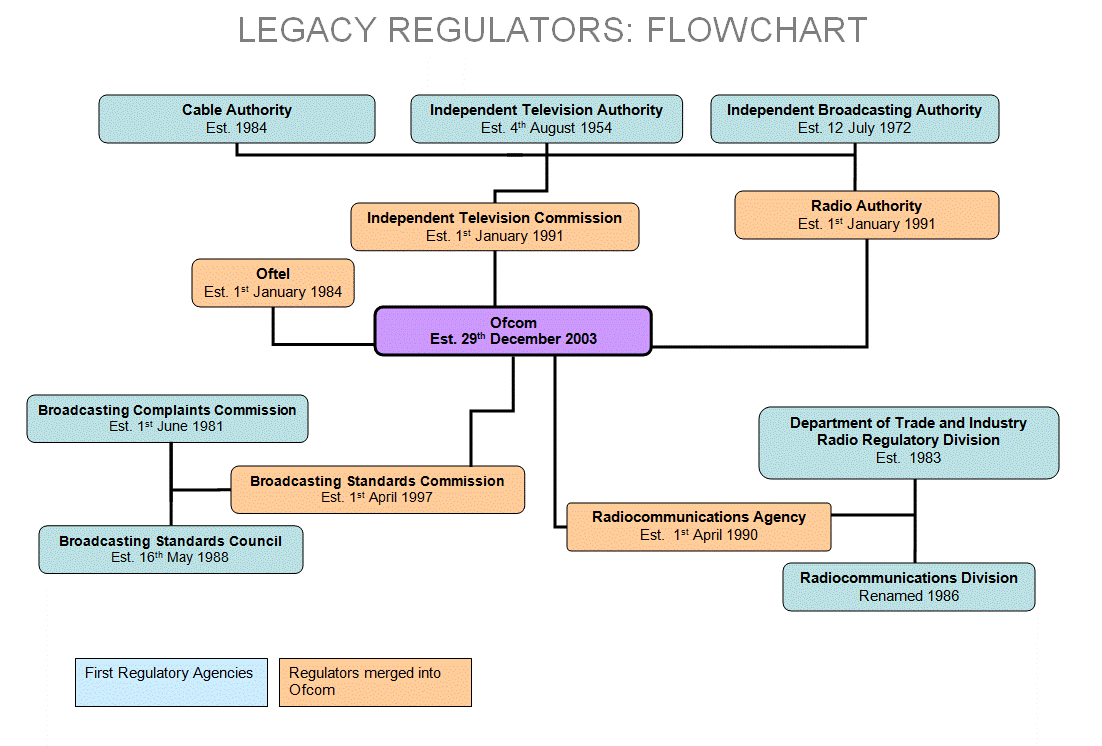
As announced in the Communications White Paper, published in December 2000, it has been proposed that the Agency will join with OFTEL, the Radio Authority, the ITC and the Broadcasting Standards Commission to form a single regulator, the Office of Communications (Ofcom). More information on Ofcom can be found on the Agency's website or www.ofcom.gov.uk.
|
In the UK radio users must be aware of both primary (Acts) and secondary (statutory instruments made under the Acts) legislation. Currently there are three main areas of primary legislation relevant to the radio spectrum.
Primary legislation
Under the WT Acts a licence is needed to use radio equipment as explained in Section B (Licences) below unless the equipment is licence exempt.
Independent television and radio stations, and restricted radio and TV services will need a Broadcasting Act licence, and telecommunications services need to comply with the Telecommunications Act licensing policy as well as holding a WT Act licence (issued by Radiocommunications Agency) in order to operate. Broadcasting Act licences are issued by the Independent Television Commission or the Radio Authority. Telecommunications Act licensing policy is the responsibility of the Communications and Information Industries Directorate (CII) of the Department of Trade and Industry (DTI).
Secondary legislation
Within an Act, there are powers to make secondary legislation typically in the form of regulations or orders. Regulations made under the WT Acts at the moment mainly relate to licence fees and exemptions (ongoing and updated yearly). These detail changes in licence charges and any equipment newly exempt from needing a licence respectively. Details of current exempted equipment can be found in RA 342 and current licence fee charges in RA 2(rev15). Other secondary legislation include anti-interference regulations and orders that restrict the use of certain radio equipment such as videosenders. Of special note are regulations made under the European Communities Act 1972 to implement European Directives. Such regulations include:
The European Licensing Directive (and hence the Regulations implementing them) effectively provides for Member States of the EU to have a fair and equitable licensing policy.
The WT Act 1998 The 1998 Act provides for licence fees to be set by regulation (administrative pricing) or by auction to reflect the following spectrum management objectives:
- efficient use and management of the radio spectrum;- economic benefit from the use of radio, including consumers;- innovation; and- competition in telecommunication services (including broadcasting).
|
How Policy is Determined
As stated in earlier chapters, Radiocommunications Agency policy is governed by the following:
The Agency has also to comply with Radio Regulations of the International Telecommunication Union, which are adopted at World Radio Conferences usually held every three years. This forms the framework globally for regional and national planning. Radio Regulations are legally binding in international law in Member States, including the UK.
The European Licensing Directive 97/13/EC will be repealed on 25 July 2003 by the Authorisation Directive, which is part of a wider package of Directives to harmonise Communications Networks and Services. Information on these Directives can be found in Section G Chapter 3.
How Policy is publised
The Radiocommunications Agency has various communication tools that it uses to publicise its stated policy on the use of the radio spectrum.
The Agency publishes each year its Strategy for the future use of the radio spectrum in the UK'. It also publishes each year its Annual Report and Accounts'. Guidance notes on the radio spectrum are also provided to customers, which give up-to-date information on the respective subjects.
All of these publications can be obtained from the Information and Library services from the address in Annex A of this manual.
|
A licence is an authority granted by the Secretary of State authorising a named person or persons to install or use radio equipment in a clearly defined way. In legal terms a person' may be an individual operating a business from his own premises, or two or more people acting together as a partnership, or a company or an incorporated association. A person may only apply for a licence in his name.
For further information on the legal status of a licence, please refer to Section B, Chapter 5 below or to individual Unit manuals.
A licence consists of a licence document (Section One) and a licence schedule or schedules (Section Two). The licence document contains the licence prefix (or six figure sector/class/product code) and number, the licensee's name and address, the licence issue/start and renewal dates and the licence terms and conditions.
The licence schedule lists the technical parameters of the service or services (a licence may have more than one service some licences have several hundred services) covered by the licence. There are a number of standard clauses contained in the schedule section, covering areas applicable to all licences of the same licence class, including: apparatus, inspection, and interpretation. These standard clauses define the rules of use for the radio system.
Any non-standard conditions (these include many of the specific technical and operational conditions) which apply to a particular radio system need to be added to the licence schedule in the form of additional clauses.
The above may not apply to all units; see specific Unit manuals for reference.
The radio spectrum is a finite resource for which demand greatly exceeds supply. This means that the use of frequencies needs careful planning in order to make the best use of the available spectrum, as well as ensuring that minimum interference is caused to authorised radio users. The basis for this planning is through the issue of licences enabling the Agency to control and plan the use of the spectrum effectively and efficiently. The installation or use of a radio service without a valid licence, is an offence under the Wireless Telegraphy Act 1949. The only exceptions to this are where equipment is 'Licence Exempt', or if the licensee is a Crown Body.
|
Every licence issued by the Radiocommunications Agency will fall into a sector (e.g. 'Aeronautical' or 'Maritime'). The sector is in effect the type of service (at a high and very broad level) the licence is intended to be for. The type of service is then defined further to the licence class allocated (e.g. within the Aeronautical sector 'Aeronautical Ground Station (Air traffic control/ground movement control)' class and 'Aeronautical Ground Station (General Aviation)' class). At this stage the licence is still not personalised to the customer and is still generic in nature.
At the next level the licence is narrowed to the specifics of the customer's system. This is done through the use of a licence schedule. However there may be exceptions, see Unit manuals for reference.
All of these licences issued by the Radiocommunications Agency then fall into three different types of licence. These are:
There are exceptions to the above descriptions for example, certain pre-packaged licences require co-ordination. Another point to note is that the Radiocommunications Agency licence document will greatly vary in terms of size and detail depending on the type of licence needed.
Where to obtain a licence
Radiocommunications Agency regional offices, due to their local knowledge on assignment details, issue many classes of licence. However, some Wireless Telegraphy Act licences are only available from the Radiocommunications Agency headquarters. Other types of licences have been contracted out to private companies, either because they are easy and quick to process (e.g. Amateur licences) or because they require particular expertise (e.g. Programme Making). Whatever means of licence issue is used, all licences are issued on behalf the Secretary of State and in accordance with the Wireless Telegraphy Act 1949.
What happens before a licence is granted
Before someone can install or operate a service, or install and use equipment (unless the service or equipment has been made exempt), they will need to apply for a licence. The majority of licence applications are made by forwarding an application form to the Agency.
Part of the licence issuing process might involve a process called site clearance'. This is the process of investigating whether an assignment of a frequency (or power output) at a particular site will cause interference to other users of the radio spectrum, (e.g. emergency services, military or aeronautical services).
Time-scale for new licences
For new licence applications, there are targets for licence issue after receipt of application. These are grouped into three categories:
Category A: licences, which do not require individual tailored frequency assignment, site clearance or international co-ordination: these licences will be issued within five working days of receipt of a correctly completed application form.
Category B: licences that require tailored frequency assignment but no site clearance or international co-ordination: 90% of applications to be processed and dispatched within 15 working days, with the remainder to be processed and dispatched within 25 working days.
Category C: licences which require frequency assignment and site clearance and/or international co-ordination: 90% to be processed and dispatched within 40 working days and the remainder to be processed and dispatched within 60 working days.
E-Licensing/Signatures
Under the Electronic Communications Act 2000 an application form sent electronically has the same status as the same form sent on paper. The Radiocommunications Agency will issue a licence in good faith to the person named and the customer will be given 28 days to notify the Agency if the licence is incorrect.
Renewals
Most licences issued by the Agency can be renewed annually (unless stated in the licence). Licences are renewed upon payment of the renewal fee. If you are a current Licensee, you are sent a renewal notice six weeks before the renewal date. It is then your decision whether to renew or cancel your licence. A final notice one-week prior to expiry is sent out to the licensee. If fees are not paid in breach of the terms and conditions of a licence then the licence is no longer valid. This means that the equipment is no longer covered by the licence and should not be used.
For Revocation procedures, see Section B Chapter 10.
Renewals of all licences in Category A will be processed in five working days, renewals of licences in Category B and C will be processed and dispatched within 10 working days.
When the renewal fee is received the Agency will send a renewal receipt document which confirms receipt of the renewal fee and states the next renewal date. The Agency does not issue a fresh licence document each time a licence is renewed.
|
Where to obtain a licence
Radiocommunications Agency regional offices, due to their local knowledge on assignment details, issue many classes of licence. However, some Wireless Telegraphy Act licences are only available from the Radiocommunications Agency headquarters. Other types of licences have been contracted out to private companies, either because they are easy and quick to process (e.g. Amateur licences) or because they require particular expertise (e.g. Programme Making). Whatever means of licence issue is used, all licences are issued on behalf the Secretary of State and in accordance with the Wireless Telegraphy Act 1949.
What happens before a licence is granted
Before someone can install or operate a service, or install and use equipment (unless the service or equipment has been made exempt), they will need to apply for a licence. The majority of licence applications are made by forwarding an application form to the Agency.
Part of the licence issuing process might involve a process called site clearance. This is the process of investigating whether an assignment of a frequency (or power output) at a particular site will cause interference to other users of the radio spectrum, (e.g. emergency services, military or aeronautical services).
Time-scale for new licences
For new licence applications, there are targets for licence issue after receipt of application. These are grouped into three categories:
Category A: licences, which do not require individual tailored frequency assignment, site clearance or international co-ordination: these licences will be issued within five working days of receipt of a correctly completed application form.
Category B: licences that require tailored frequency assignment but no site clearance or international co-ordination: 90% of applications to be processed and dispatched within 15 working days, with the remainder to be processed and dispatched within 25 working days.
Category C: licences which require frequency assignment and site clearance and/ or international co-ordination: 90% to be processed and dispatched within 40 working days and the remainder to be processed and dispatched within 60 working days.
E-Licensing/Signatures
Under the Electronic Communications Act 2000 an application form sent electronically has the same status as the same form sent on paper. The Radiocommunications Agency will issue a licence in good faith to the person named and the customer will be given 28 days to notify the Agency if the licence is incorrect.
Renewals
Most licences issued by the Agency can be renewed annually (unless stated in the licence). Licences are renewed upon payment of the renewal fee. If you are a current Licensee, you are sent a renewal notice six weeks before the renewal date. It is then your decision whether to renew or cancel your licence. A final notice one-week prior to expiry is sent out to the licensee. If fees are not paid in breach of the terms and conditions of a licence then the licence is no longer valid. This means that the equipment is no longer covered by the licence and should not be used.
For Revocation procedures, see Section B Chapter 10.
Renewals of all licences in Category A will be processed in five working days, renewals of licences in Category B and C will be processed and dispatched within 10 working days.
|
RA has plans to improve the level of service offered to customers through greater flexibility in methods of payment as well as timing of licence renewals. Policies on both these areas are under discussion, but are expected to generally arise when several licences are held and go along the following lines:
There may be exceptions to the above text on harmonisation of renewal dates; see individual Unit manuals for reference.
|
Background
Under the terms of the Wireless Telegraphy Act 1949 (WT Act), the licence is the instrument by which the Secretary of State authorises the use of radio apparatus to 'a person'. In legal terms 'a person' may be an individual operating a business from their own premises, or two or more people acting together in partnership, or a company or an incorporated association.
Sole proprietor or individual
A person may apply for a licence in his or her own name. If the person runs a business solely in his own name then that person is known as the sole proprietor. In legal terms, that person is wholly liable for all aspects of the business and all its obligations. If a person operates a radio system then he must hold a WT Act licence in his name.
If a person changes her name (e.g. through marriage), the licensee must provide a copy of her marriage certificate to the appropriate local office before her licence can be amended. The process is the same for licensees who change their name by deed poll, in that the licensee needs to provide a copy of the certificate of deed poll to the appropriate local office prior to an amended licence being issued.
Partnerships
Partnerships of individuals acting together to form a business for profit are fairly common amongst WT Act licensees. The simplest form of partnership is two people forming a common trading business. In such cases it is usual to state full names of both partners as the licensee in this instance.
However, where there are a number of partners (e.g. accounting firms), the licensee will be expressed to be either named partners or partners at the time of the grant of a licence. The licence will expire either when all the licensees had ceased to be partners or when a new partner had joined the partnership after any licensee had ceased to be a partner in the same partnership.
Trustees
In the case of Trustees, the licensee(s) are named as the trustees of the particular trust at the time of applying for the licence.
A new licence will be required when all the named licensees have ceased to be trustee. However, the Agency will not charge until the renewal date.
Clubs and societies
The licensee(s) of Clubs and Societies are expressed to be either the named trustees or committee-members or the trustees or committee members at the time of the grant of the licence. The licence will expire either when all the licensees had ceased to be trustees or committee member.
Partnerships in Scotland
In Scotland only, under the Partnership Act 1890 partnerships have a different legal status in that they are regarded as a distinct corporate entity rather than two or more persons acting together. If you require further information the operations manager in the Falkirk Office will advise. The telephone number is given in RA206 and in Annex C of this manual.
General rule
None of this of course affects the need for new licences in the ordinary course of events. Thus a periodic licence, which has to be renewed every so often one, three or five years or whatever should always when renewed reflect any interim changes in its identification of licensees and licensed users.
Registered companies
Under UK Company Law, businesses may incorporate to form a company, which limits their liability to that of the business itself and not its owners. There are two main forms of registered company, these being (i) Limited Company (Ltd) or (ii.) Public Limited Company (Plc).
Registered companies must be registered at Companies House, where trading details are sent for filing and made available for public scrutiny. All companies must have a director and a company secretary.
For any registered company applying for a licence, the licence must be held in the full registered name of the company. All companies are issued with a certificate of incorporation, which includes a unique registration number that the Agency requires for certain licence classes. Companies are also required to state their number and registered address on all company correspondence.
Joint ventures
A joint venture can be either:
Where a joint venture is a separate corporate vehicle it would be the corporate vehicle, with a separate legal identity and registered as such with Companies House, that must be licensed.
In the case of the joint venture being a partnership of a group of limited companies, each of the individual limited companies would have to be named on the application form in the same way as a partnership of individuals.
Death of a licence applicant
Should a licence application be received along with the relevant licence fee but unfortunately the applicant dies subsequently before the licence is issued, the payment will be returned on notification of death. Evidence of the licensee's death in the form of a 'Death Certificate' will be needed before a refund is made.
|
Charity status is attached to applicants who are a charity within the meaning of section 506(1) of the Income and Corporation Taxes Act 1988 or where their sole objective is the safety of human life in an emergency.
Such applicants are referred to as "a qualifying charity" and as such are entitled to pay half the prescribed licence fee for their licence.
Section 506 (1) of the Income and
Corporation Taxes Act 1988 limits a charity to a body of persons or trust
with exclusively charitable objects, it does not require registration with
the Charity Commission or as a Charitable company.
It is therefore a sufficient but not necessary condition when applying for
a licence for a charity to be registered with the Charity Commission and as
a Charitable company.
|
What is a Crown Body?
A Crown Body is any management unit of the Crown whose staff are servants and agents of the Crown. Most Government Departments and their Agencies are Crown Bodies. Other Government Bodies including non-departmental public bodies, office holders, commissioners, and regulators are Crown Bodies if the statute bringing them into existence confers upon them Crown Body status.
However, not all government bodies are Crown Bodies. Some of the newer government bodies have been formed without Crown Body status. Recent examples include the Data Protection Registrar and the Teacher Training Agency. Some Crown Bodies will lose their Crown Body status when they are privatised.
Unfortunately it is not possible to get a definitive list of Crown Bodies. Where the status of a body is not clear it will be necessary to contact the body concerned to establish its legal status.
Authorisation of radio use for Crown Bodies
Under Section 1 of the Wireless Telegraphy Act 1949, the use of apparatus for wireless telegraphy is unlawful unless authorised by a licence granted on behalf of the Secretary of State or is made licence exempt. Legally there is only one Secretary of State; the fact that each department has its own Secretary of State is an administrative convenience. Since one part of the Government cannot be in a legally contractual agreement with itself, licences for Crown Bodies cannot be used, so Side Letters are used instead.
What is a Side Letter?
A 'Side Letter' authorises the use of radio by Crown Bodies. Attached to this are the licence terms and conditions and the licence schedule. The Side Letter asks the Crown Body to abide by the described terms and conditions in the same way a normal licensee would be required to, and reminds them that should they not, the Agreement detailed in the Side Letter will be cancelled.
|
The transfer of licences
Radio users at present can only obtain access to the spectrum through a licence unless its a part of the spectrum that is exempted from needing a licence.
The Agency is presently considering the introduction of Spectrum Licence Trading' as an additional market based spectrum management tool, to complement spectrum pricing. More information on future Spectrum Trading can be found on the Agency website
In theory the market would provide an additional source of spectrum. Licensees would be able to transfer assignments more easily, e.g. when businesses, aircraft or ships change hands.
It should be noted though that spectrum trading would complement and not replace regulatory procedures already in place. These procedures are needed to ensure compliance with international obligations and safeguard spectrum access to essential services and small businesses.
Can a licence be transferred?
Currently licences may not be transferred from one person to another and consequently, whenever a person acquires a business from an existing licensee and wishes to use the radio system, an application must be made for a new licence.
An application for a new licence should be submitted as soon as the transfer/change occurs and wherever possible before the previous licence expires. It should be noted that payment of the licence fee does not mean that right to the licence is automatically transferred.
When equipment is transferred to a new licensee, there is often a delay in issuing a new licence. As a result of this, some licensees may be obtaining use of spectrum free of charge for several months. To avoid this from happening, the Agency will keep the original renewal date of the licence in order to cover the lost time.
Can licences be taken over?
Radio systems may be bought/sold but depending on circumstances may not be re-licensable. Intention to take-over should be notified to Radiocommunications Agency in advance for a ruling on that point. Frequencies may or may not be re-licensed to a new party. There is no obligation on Radiocommunications Agency to re-licence. Take-overs of radio systems and frequencies are often referred to incorrectly as take-overs of licences.
In reality, the licence is revoked (the licence of the current holder), and a new licence issued by Radiocommunications Agency for the prospective owner. Because in essence this is a take-over of the service, confusion can occur, and on occasion this technicality can be important.
It should be noted then, that as the licence is technically revoked and a new one issued, spectrum management policies/requirements may mean that the same (or any) frequencies are not available to the future owner. Accordingly, transferability of identical frequency and continuity of technical parameters or equipment in service is not guaranteed (e.g. parameters may need to meet more recent guidelines). However, the Radiocommunications Agency does undertake to make every attempt to provide authorisation for the same frequency/technical parameters/equipment in service where possible.
The only difference to this take-over' procedure, is where the prospective owner already holds a licence of the same class as that being taken over. If this is the case then the new assignments/services can simply be added to the existing licence, with no need for an entirely new licence to be issued (although in some cases a new licence will be needed; see Unit manuals for guidance). Again transferability is not guaranteed.
What is required when taking over' a licence?
To take over a service a new licensee must:
Obtain consent in writing from all of the previous licensees or their legal representative agreeing to the take-over and send it to the Agency. If written consent cannot be supplied, the new licensee must provide a statutory declaration explaining why it cannot be supplied, together with any supporting evidence.
What is a statutory declaration?
A statutory declaration is a voluntary declaration taken by a solicitor or other authorised person. A false statement made in a statutory declaration is an offence under Section 5 of the Perjury Act 1911.
Streamlining take-overs' at renewal:
The take-over of a licensed service of one customer from another comprises two stages:
As the bulk of take-overs are notified at renewal, to make the overall process simpler to administer the reverse of the renewal notice provides a form for requesting a take-over. The form will capture the prospective licensee's customer details, together with a signed declaration from the existing licensee agreeing to the take-over. This method has a number of benefits:
However it should be noted that this streamlined take-over service at renewal is only available on some of the Public Telecommunications Networks licences at present.
|
Status of information
As a general rule, all information relating to a licence will be regarded as a confidential matter between ourselves the Radiocommunications Agency (as the statutory authority of the Crown) and the licensee/applicant. Information includes details about a person, their licence/application and any assignments made. The exception to this general rule is if, on application, the licensee consents to the specific disclosure (e.g. to the radio supplier installing the system) or the application is, as often happens, routed to us through the supplier. A further exception applies under European Licensing Law, which requires transparency in the award of licences for which there has been some form of competition because of spectrum limitations. The Agency recently completed a national consultation exercise on the disclosure of Assignment and Frequency information. The Agency proposes to further consult each radio Sector in a rolling programme about disclosing information relevant to each of those sectors.
Data Protection Act 1998
The Data Protection Act provides further protection for the personal data of individuals, defined as anything that is identifiable with an individual, held on computer, on paper or on other media such as sound or video recordings. It prohibits disclosure of personal data except to persons specified in particulars registered with the Data Protection Registrar and in certain circumstances set into the 1998 Act.
EU Data Protection Directive 2002/58/EC
The EU Data Protection Directive provides protection of the right of privacy with respect to the processing of personal data in connection with the provision of publicly available electronic communications services in public communications networks in the EU Community.
Disclosure to other government departments or police
The Agency sometimes receives requests for disclosure about individuals from government bodies such as the Inland Revenue, Customs and Excise, Local Council Fraud Offices, and the Police. The Radiocommunications Agency is registered under the Data Protection Act 1998 to disclose information to investigators of this kind but the general rules only permit disclosure under certain circumstances. These are:
Where disclosure is required by law, either by specific statutory provision or where a court requires evidence to be produced. Where there is just cause, e.g. that the information points to a serious offence having been committed or being contemplated and disclosure is made with the object of preventing crime or bringing an offender to justice.
Requests for information should be made in writing, and no 'fishing expeditions' are permitted (e.g. checking all taxi firms in London).
NB: This is the situation at the current time. However, it should be noted that at present there is the prospect of changes to both UK and EU Law in this area. In light of this, policy on this issue may alter in the near future.
|
Revocation of a licence can occur for a number of reasons. A person authorised by the Secretary of State may revoke/modify a licence if, in his opinion:
The revocation process for non-payment of renewal fees starts six weeks before a licence is due, when the Agency sends the licensee a renewal letter stating the date the licence needs to be renewed by, the cost of the licence and assignment that the licence covers.
The day after the licence should have been renewed, an intention to revoke letter is sent to the licensee, stating that they have 28 days to appeal/settle, in accordance with Section IE of the Wireless Telegraphy Act 1949.
The Secretary of State may also revoke a licence:
Appeals against a revocation can be brought under the European Licensing Directive 1997, given force in UK Law through Statutory Instrument 1999 No. 3180.
|
Under SI 1999/3180 (Appeals) an aggrieved person may appeal against the followingdecisions of the Secretary of State in relation to the WT Act 1949:
How the appeals process works
A person aggrieved by any of the above decisions, on one or more of the following grounds can appeal:
In England and Wales and Northern Ireland, an appeal lies to the High Court, and in Scotland an appeal lies to the Court of Session.
The court determining an appeal may:
Where the court quashes a decision it may:
Refer the matter to the Secretary of State with a direction to reconsider it and to reach a decision in accordance with the findings of the court.
An appeal under this section cannot be made:
The effect of a decision to which an appeal relates will not be suspended in consequence of the bringing of an appeal unless the court has ordered this.
The forthcoming implementation of the framework Directive will mean that the current Appeal mechanism being overhauled and replaced by a mechanism similar to that of the Competition Commission Tribunal. It is proposed to have the new Appeals mechanism in place by late 2003.
|
A licensing regime is used to enable careful planning of the radio spectrum. However, some types of radio equipment are licence exempt (i.e. they do not need a WT Act licence). Equipment is made licence exempt by Regulations made under the WT Act using a Statutory Instrument (SI).Qualification for exemption is related to the nature of the equipment/frequencies being used. Factors influencing whether exemption occurs are:
If something is licence exempt, it will not have protection from interference, i.e. the spectrum will not be managed so that one authorised user does not impinge upon another.
Most exemptions concern domestic equipment where it is not necessary to have the same level of protection as afforded to licensed services. (e.g. emergency services)
When considering frequencies suitable for exemption the Radiocommunications Agency must take into account the difficulties involved in subsequent re-allocation of the spectrum. The problem arises due to the nature of unlicensed/exempt frequencies i.e. no or very little data exists on its use (who, where, what etc.) which means that changing the designated use of the spectrum takes time and is difficult to do. Due to this, the Radiocommunications Agency will only exempt frequencies it believes are unlikely to have a change of use in the foreseeable future.
Since the national consultation exercise on the possible use of Public Network Systems in licence-exempt bands, the Secretary of State has agreed to public services being allowed in certain exempt bands. More information on this can be viewed on our website.
|
Currently in the terms of the Wireless Telegraphy Act 1949, there is no requirement for persons to have a presence in the United Kingdom to become licensees for all classes of WT Act licences.Presence of some sort is desirable to facilitate variation or revocation of a licence under section 1E of the 1949 Act, because service of notice outside the United Kingdom is more difficult than service within; although this can be remedied by requiring an address for service in the United Kingdom.
|
The WT Act 1998 introduced two different ways of setting the prices for different parts of the radio spectrum:
1) Administrative pricing
Administrative pricing involves the spectrum manager in setting the level of licence fees as a surrogate for market forces. Most licence fees are set by administrative pricing rather than auctions. Licence fees are set by regulations (Statutory Instruments). There are consultation with users at various stages. Administrative pricing may include such variants as:
2) Auctions
The 1998 Act also permitted auctions to be used to determine prices. Auctions are used selectively and are only planned for new national and some regional services e.g. Broadband Fixed Wireless Access and 3G auctions.
Auctions offer important advantages of:
![]()
|
As stated earlier in Chapter 1 the 1998 Act permits the Secretary of State to set fees for WT Act Licences. The Agency requests the relevant Minister to lay in Parliament a Statutory Instrument, each year, detailing the new licence fees to be charged for the current year. Before this is done the Agency initiates a consultation exercise, setting out the fees charges and the reasoning behind the fee level for each relevant licence class, seeking comments from those affected by the changes.
There is also a statutory requirement to publish the Agency's proposed changes to licence fees in the Official Gazettes of London, Belfast and Edinburgh (these are publications where legal notices are published e.g. bankruptcy, planning notices etc), this allows 28 days from the date of the advert being published for representations to be made to the relevant Minister concerning the proposed changes. Once the 28 day deadline has passed (and subject to no objections being raised or objections overcome) the Agency requests the relevant Minister to lay in Parliament a Statutory Instrument, which comes into force 21 days after the date of laying in Parliament, allowing the Agency to charge the new fees levels. The Agency, in line with current Cabinet Office guidance, also publishes a Regulatory Impact Assessment (RIA). The RIA is a short structured document that is produced for primary, secondary and EC legislation. It briefly describes the issue that has given rise to a need for legislation; the risks, costs and benefits of the proposal; and who is affected.
In order to manage the process of implementing annual licence charges amendments the Agency works to a timetable, which sets targets and responsibilities for each step of the process. Please see below the timetable generally used to steer annual fees regulations process.
In addition to the timetable and to allow the smooth and informed implementation of the annual licence charges process the Agency nominates members of Radiocommunications Agency staff as "champions" within each relevant Business Unit (BU) ensuring responsibilities and ownership of respective parts of the fees setting exercise is clear.
The 'champions' are the main contact and signing off point for all aspects relating to the implementation of spectrum pricing/fees regulations from consultation, responses, fees drafting, RULES changes and User Acceptance Testing of new software.
The nominating of champions coupled with the timetable setting milestones etc ensures that the Statutory Instrument that is laid before Parliament is 100% accurate and that all of those affected by the changes of fees level have had been informed of the changes and will have had the opportunity to have their comments considered.
The overall responsibility for the fees setting exercise lies with the Licensing Policy Unit (LPU) and any queries on this section should be addressed to Radiocommunications Agency, Licensing Policy Unit, 189 Marsh Wall, London, E14 9SX, Tel: 020 7211 0017, Email: spectrumpricing@ra.gsi.gov.uk. All documentation relating the consultation and fees setting exercise is also published on our website.
TIMETABLE FOR IMPLEMENTING ANNUAL FEES REGULATIONS
|
Date |
Action |
Responsibility |
|
September |
Contribute and collate information to consultation document |
LPU & BU's |
|
October |
Finalise text of consultation and submit to Minister for approval |
LPU |
|
October |
Publish document; responses by December/January |
LPU |
|
January |
Consider responses to consultation publish response |
LPU & BU's |
|
February |
Submit draft Regulations etc to Minister |
LPU |
|
March |
Publish notice in Official Gazettes with 28 days for comment |
LPU |
|
March |
Consider any responses to Gazetting. |
LPU/BU's |
|
April |
Submit Regulations to Minister for approval and laying in Parliament |
LPU |
|
May |
Publish notices in trade paper and/or in newsletters informing customers of changes in fees (if necessary) |
BU's |
|
July |
Regulations come into force |
NOTE:
This timetable does allow for some slippage should it be needed. However it should be noted that the Regulations must come into force in July each year; in order to achieve this coming into force date the Regulations must be laid in Parliament 21 days before and the Agency's proposed fee changes must have been published in the Official Gazettes allowing 28 days for representations before Ministerial approval can be sought.
|
Licence amendments fall into two categories:
Licensees must not make any changes of any kind that would take them outside the boundaries of the licence until they sought and have been given permission to do so by authorised Agency personnel.
Customer details amendments
Customer details means information which is related to the licensee, i.e:
Licences can be amended at the request of licensees or third parties (should they be able to prove they are authorised/legally able to do so). Licences can also be amended at the request of Radiocommunications Agency personnel (e.g. correction of a simple error). Where changes to customer details do occur, a revised licence document must be sent to the licensee.
Technical amendments
A technical amendment is a change to anything that relates to the use of the radio spectrum, e.g.
Requests for amendments to a licence's technical details must be made in writing, preferably on an appropriate application form. Changes to technical information in any part of the licence can only be made by authorised Radiocommunications Agency personnel. Currently, most technical amendments do not attract a fee. There are however exceptions (see Unit manuals for further guidance).
If an amendment changes any of the details that appear on a licence schedule, a revised licence schedule must be sent to the licensee together with a covering letter before the equipment can be used.
Charging for amendments to licences
Charging for amendments to licences are based on the 1/12th rule.The Agency proposal for licences that are annually renewable is that fees for mid-year chargeable adjustments will be collected at the next renewal date.
Additional schedules:
An additional schedule is needed where a licensee wishes to add a new system/service in the same licence class as the licence held although in some cases a new licence will be needed, see Unit manuals for guidance.
Should the licence held and the new system/service desired be in differing classes then the licensee needs to apply for a new licence and not an additional schedule. In either case the licensee should apply in the appropriate method.
|
How the accounts process works
The licence fee is calculated using the Fees Regulations in place at the time of an application or at the renewal date. See RA2 (Rev14) notice for more details.
Renewal reminders are sent out six weeks before the licence renewal date, a renewal reminder is generated for each licence (excluding direct debit customers) for which the requested amount has not been received.
Means of payment
The following are methods of payment that the Radiocommunications Agency accepts;
*Currently this facility is only available to customers by them filling in a credit card form on the renewal notice or application form and sending by post to the Radiocommunications Agency. There is a limit of £1000 for all credit/debit card payments.
Cheques and postal orders must be made payable to 'Radiocommunications Agency'. The Agency collects direct debits on the renewal date or on the last working day of the month, if the renewal date falls on a weekend or public holiday.
The Agency does not offer instalment payment facilities. The full fee must be paid before the due date.
Failed Receipts
Cheques
When a bank/building society returns a cheque to the Agency, the Agency will inform the licensee that the cheque has not been honoured. The letter will state the bank's/building society's reason for failure and invite the licensee to submit a replacement cheque. If the renewal date has already passed the licensee will be given notice of the Agency's intention to revoke the licence(s). If a replacement cheque fails, the licence will be revoked immediately and the licensee will be given 28 days to make representations to the Agency against the revocation.
Direct Debits
If a direct debit fails the Agency will inform the licensee in writing that it has failed and ask the licensee to inform the Radiocommunications Agency whether they wish the direct debit to be re-presented or whether they wish to pay by another means. In either case the licensee will be given 28 days notice of the Radiocommunications Agency's intention to revoke the licence.
Refunds
If a licensee surrenders a licence before it expires, the Agency will not give a refund for the unused portion of the licence. The only situation where a refund is applicable is when an applicant has paid for a particular service, but the Agency is unable to provide that service due to the lack of available spectrum.
If you have any accounting queries, please contact:
Agency
Finance Services
Radiocommunications Agency
Wyndham House
189 Marsh Wall
London
E14 9SX
Tel: 0207 211 0211
|
Performance targets
Each year the Radiocommunications Agency is set a series of performance targets, endorsed by Ministers, as well as a separate overall efficiency target set by HM Treasury. Performance targets relate to the quality of service customers receive when dealing with the Radiocommunications Agency and include commitments to issue licences, renew licences, deal with reports of interference, respond to correspondence, deal with enquiries, and guarantee prompt payment within certain timeframes. These targets are reviewed annually to take into account performance achieved and customers' views (which can be found in RA 387).
Further to this the Radiocommunications Agency holds consultations and discussions with customers and representative organisations so that we understand the sort of service users need. The Radiocommunications Agency is also committed to regular surveys to find out how satisfied customers are with all aspects of the services we provide, including the handling of complaints.
Service first
In addition to the above performance targets, the Radiocommunications Agency also aims to meet the Whitehall-wide 'Service First' standards for Central Government set out in the Modernising Government White Paper (Copies of this document can be found on the internet at www.hmso.gov.uk). The Radiocommunications Agency also continues its policy of complying with the Charter Programme and has produced a Charter Statement as set out in leaflet RA387.
For more details on the subjects covered in this chapter please refer to the Radiocommunications Agency's latest Annual Report and Charter Statement RA 387.
|
If you have a complaint on how the Radiocommunications Agency is conducting itself, please let us know, so that we can deal with you complaint as quickly as possible.
What to do if you have a complaint
1. If you have a complaint about the Agency you will need to contact the relevant section in Radiocommunications Agency that your complaint stems from. They will initially be in the best position to understand your complaint.
If you are still not satisfied
2. If after this action, you are still not satisfied, please ask for your case to be reviewed by the Director of the relevant Branch of the Agency.
3. If after this action, you are still unhappy with how your case is being handled, please write to Rolande Anderson, the Chief Executive of the Agency at the following address;
Radiocommunications
Agency
Wyndham House
189 Marsh Wall
London
E14 9SX
The Chief Executive will call for a full report to see whether your treatment by the Agency has been fair or not. Your complaint will be treated in confidence and will be carefully investigated as quickly as possible.
4. The Agency will set itself a 10 working day target for a full and clear reply to be sent to you from the date your letter is received by the Chief Executive. If it is not possible to investigate your complaint fully within that time, the Agency will let you know and will keep you informed.
5. If you remain dissatisfied
If you are not content with the Chief Executive's response to your complaint, you can write to the Agency Steering Board, chaired by senior officials in the Department of Trade and Industry. The Board will examine any unresolved complaints. You should write to the Secretary of the Radiocommunications Agency Steering Board who can be contacted at the address above.
6. Other avenues of complaint
Finally, you can ask your Member of Parliament (MP) to take your case. Your MP can ask the Parliamentary Commissioner for Administration (the Ombudsman) to investigate (in some circumstances). General information on making a complaint to the Ombudsman (which under current legislation, can only be done through an MP) can be obtained from;
Office
of the PC
AMillbank Tower
Millbank
London
SWIP 4QP
|
The enforcement activity of the Radiocommunications Agency abides by the principles of the Citizen's Charter and Enforcement Concordat (Available from the Better Regulation Unit, Cabinet Office, Horse Guards Road, London, SW1P 3AL).
Radiocommunications Agency staff carry out an on-going programme of inspections of radio installations as well as campaigns directed at particular categories of radio users to ensure that they comply with all licence requirements. If discrepancies are found during an inspection it may be necessary to give a verbal or written warning with a deadline for rectification. If this is not done or the station has clearly been operated with complete disregard for licence requirements, officers will take action, including:
The maximum penalty for most offences under the Wireless Telegraphy Acts is two years imprisonment and an unlimited fine. Equipment may also be ordered forfeit. If a grave or persistent licence breach occurs, and it appears that the licensee has no regard for the interest of other radio users, the Secretary of State may revoke the licence. This is separate from any prosecution proceedings that may be brought.
When visiting, all our local staff carry personal identity cards with their names and photographs on and inspections are normally undertaken by prior appointment. However, sometimes the Radiocommunications Agency needs to take immediate action in order to ensure the spectrum is clear of interference for those operating legally.
The table below shows problems that cause interference, and action that Radiocommunications Agency would usually take.
|
Offence |
Action |
|
Illegal operation |
Radio users who fail to operate legally create the potential for interference to authorised radio users. Those who operate illegally and continue to do so after warnings will be liable to prosecution under the WT Act. Should the prosecution be successful, the maximum penalty for most offences is two years imprisonment and an unlimited fine. Equipment may also be forfeited. |
|
Sale/Hire/Advertisement of Equipment subject to a 'Banning Order' |
Some equipment does not meet the UK's planned frequency use and could cause serious interference to authorised users. Such equipment is banned under Orders made under the Wireless Telegraphy Act 1967. These Orders cover prohibition of sale, hire and advertisement and protect unwary customers from spending money on equipment they cannot legally use. The Radiocommunications Agency's local offices keep an eye on sales outlets and can seize equipment as evidence for court proceedings and subsequent forfeiture. Current Orders cover AM CB radios, non-approved cordless telephones and videosender equipment operating in the analogue television-broadcasting band. |
Priorities
The Radiocommunications Agency's priorities in dealing with interference are set annually and endorsed by Ministers. These are to deal first with interference affecting the emergency services; second to assist businesses; and finally to deal with other complaints. The specific priorities are laid out in full in the latest Annual Report.
Problems outside of the Radiocommunications Agency's regulatory responsibility
Often interference problems lie outside the Radiocommunications Agency's statutory responsibilities and should be dealt with by private sector service engineers, dealers or aerial contractors. These instances are usually when a radio or television has poor immunity to unwanted signals, or inadequate aerial arrangements, as opposed to interference from illegal use of radio or faulty electrical apparatus.
Help available from the Radiocommunications Agency outside its regulatory responsibility
The Radiocommunications Agency provides some help with matters outside its regulatory responsibility. We are happy to give help, advice and guidelines on radio matters, as well as provide consultancy services on the more technical problems.
Contact Details
If you have any questions in relation to the Enforcement Policy Unit, you can contact them at the address in Annex C.
|
The Agency has a national network of eight Local Offices throughout the UK. The local staff, are the points of contact for many of the Agency's customers, and carry out work in the following areas:
Frequency Assignment and Licensing
The Radiocommunications Agency's objective is to provide a prompt and efficient service that meets radio users' individual radio requirements and makes the best use of scarce radio spectrum. At each of our Local Offices, the Agency's staff utilises both their technical skills and their local knowledge of the area when making frequency assignments and issuing licences to customers. This de-centralised arm of the Radiocommunications Agency enables the provision of quick and accurately targeted service as and when required.
Refer to Annex C for a full list of addresses of the Agency's Local Offices, together with telephone/ fax numbers. The offices are open for telephone calls between the hours of 9am and 5pm.
|
Allocation
In the UK planning of frequency allocations can be split into 3 sections:
i. The Global Level
Planning of frequency allocations globally falls to the International Telecommunication Union (ITU), which is a United Nation Organisation based in Geneva, Switzerland, which currently has 185 member countries. The ITU is split into 3 Regions:
The UK is part of Region 1, (where the European Conference of Postal and Telecommunication Administrations (CEPT) are tasked with planning radio spectrum at a European level).
The ITU is generally tasked with regulating the use of the radio spectrum and the ITU Member States decide what procedures to adopt. The ITU usually holds a World Radio Conference every 3 years where various ITU Radio Regulations are revised by its final Acts, that in turn regulate the use of the radio spectrum internationally. The Radio Regulations have 'Treaty Status'. They also contain the international frequency allocation table. This forms the global framework for regional and national planning. Some spectrum services are harmonised at a global level i.e. satellite and fixed services.
ii. The European Level
Planning of the radio spectrum is conducted at the European level through the European Conference of Postal and Telecommunication Administrations (CEPT), which has 43 member countries. The CEPT structure dealing with spectrum planning is the European Radiocommunications Committee (ERC), which has three subordinate committees:
Working Group Frequency Management (WGFM)
Working Group Radio Regulations (WGRR)
Working Group Spectrum Engineering (WGSE).
The ERC produces recommendations and decisions on spectrum usage. The Decisions, when implemented by member countries, form the basis for pan-European (not just EU) harmonisation of spectrum usage at the level of specific applications such as cellular, digital, audio broadcasts, radio local area networks etc.
There is a growing trend within Europe and globally to harmonise the use of radio whenever possible. This means agreeing frequencies to be used for similar applications in neighbouring countries, and that where appropriate European standards and specifications are set out for the approval of radio equipment.
iii. The national level
The civil spectrum is mainly managed by the Radiocommunications Agency. However both the Home Office and the devolved governments also have a role. The military spectrum is managed solely by the Ministry of Defence.
Both the Radiocommunications Agency and MoD sit on an interdepartmental Cabinet Office committee, which formulates policy governing the planning and allocation of frequencies. Its subordinate committee structure includes the International Frequency Planning Group (IFPG) and the National Frequency Planning Group (NFPG).
The NFPG is a government committee that is responsible for maintaining the national frequency allocation tables and considering all proposals for change in frequency allocation.
NFPG in most instances will need to make sure that the proposed location for the service would not have any undue effect to other radio users in the surrounding area. This would come into effect when the radio equipment is intended to be used with power levels equal or greater than 17 dbw ERP (Effective Radiated Power) or where the antenna height exceeds 30 metres above ground level.
National frequency allocations generally reflect those agreed within ITU Region 1 (Europe and Africa), i.e. divided by different uses: mobile phones, PMR, radio-astronomy etc.
For detailed UK frequency allocation tables please see RA information sheets RA 365 and 339 or in the RA Spectrum Strategy document.
Assignment
Users of radio are assigned certain frequencies that they can use within the appropriate allocations so that the spectrum is used efficiently and without interference between users, e.g. PMR users are assigned certain channels in the land mobile service allocation.
Official authorisation for a user to use a certain frequency will come either through a licence or an exemption. The licence states certain service criteria that need to be complied with so that no undue interference occurs to other users.
Users that need to either modify, service/ repair equipment, do scientific research, train in radio theory and practice will need to apply for a Radiocommunications Agency Testing and Development licence, where a set channel will be provided under certain circumstances. Radio suppliers with PBR Suppliers licences can service and repair PBR and marine equipment without needing a Test and Development licence.
For further information on assignment in the different sectors, please refer to the individual Unit manual.
|
The Radiocommunications Agency interacts with many international bodies, both in Europe and the wider world. In Europe Radiocommunications Agency deals primarily with three bodies: The Commission of the European Union (EU); Conference of European Posts and Telecommunications Administrations (CEPT); and the European Telecommunications Standards Institute (ETSI); and the structures which support them.
Europe
In the case of CEPT, the structure is as below:

With regards to the EU Commission, the Radiocommunications Agency deals mostly with two Directorate-Generals: DG Infosoc (DG 13) and DG Enterprise (DG 3). Although the two DG's mentioned, they represent most part of the Radiocommunications Agency's involvement with the EU, Radiocommunications Agency has to be aware of other areas affected by UK's membership of the Union.
ETSI is a European standards-making body tasked to draft and publish European Telecommunications Standards (ETS). The body has many differing types of members due to its open membership policy, meaning almost anyone can join as long as they meet certain criteria, none of these are excessively exclusive. The Radiocommunications Agency is a member, and there is a significant representation from Industry. Its general structure can be found in Radiocommunications Agency's information sheet RA 168.
Global
International agreements are made by the International Telecommunications Union (ITU). The ITU consists of three Regions encompassing the globe and usually holds World Radiocommunications Conferences (WRC) every three years. At these conferences the ITU Radio Regulations (which hold the status of international treaties) are amended. In this forum the Radiocommunications Agency works through its membership of CEPT (which represents Region One of ITU) to further the UK's interests. Amendments to the ITU Radio Regulations are implemented in the UK either by legislation under the WT Act or by changes being made to national frequency allocation tables.
|
European Directive 97/13/EC
European Union Directive 97/13/EC sets a common framework for general authorisations and individual licences, in the field of telecommunication services (including radio), and came into force on 1 January 1998. The Directive has been enacted into UK legislation by Statutory Instrument 1997 number 2930, which amended licensing provisions in both the Telecommunications Act 1984 (T Act) and the Wireless Telegraphy Act 1949 (WT Act).
In summary the aim of the Directive is to ensure that Member States use fair and transparent procedures for issuing licences which allow licensees to provide telecommunication services or networks.
The Directive applies to approximately 75% of all WT Act licence classes, involving about 25% of all licences issued. However, in order to ensure equal treatment the Radiocommunications Agency seeks to apply the provisions of the Directive to all of the icence classes it issues including, where applicable, licences in areas not covered by the Directive such as amateur radio.
The WT Act 1949 extends to the Channel Islands and the Isle of Man. However, the EU Licensing Directive does not extend to those territories. Nonetheless, in order to ensure equality of treatment to all licensees, the Radiocommunications Agency has assumed that its Licensing Directive procedures also apply to WT Act licences in these areas.
The main requirements of the Directive are:
R&TTE Directive
Another EU Directive that has impacted on the radio spectrum is the R&TTE Directive that was implemented on 1 April 2000.
The Directive provides the European Radio and the Telecommunications Terminal Equipment industry with a more deregulated environment. The involvement of the Agency in conformity assessment is not necessary in most cases. The person(s) who places equipment onto the market will, in general, be regarded as taking full responsibility for its conformity to essential requirements, and for properly informing users of its intended use. Only in the case of radio equipment for which harmonised standards are not available, or are not used, is it mandatory to consult the Agency.
For further information on the R&TTE Directive refer to 'Section G Chapter 4'or to individual User manuals.
|
The following EU Directives were passed into the Official Journal on 24 April 2002. Each member State has been given 15 months to implement these Directives into their respective nation law. This means that they will have a legal force from 25 July 2003, except for the Spectrum Decision which came into force on 24 April 2002.
Following the Commission's green paper on spectrum management in 1999 they have proposed an EU decision on spectrum management:
EU Decision 676/2002/EC on a regulatory framework for radio spectrum policy in the European Community.
|
Notification The Radio Equipment and Telecommunications Terminal Equipment Directive (R&TTE Directive) was implemented in the United Kingdom on the 8th April 2000 through the Radio Equipment and Telecommunications Terminal Equipment Regulations 2000, Statutory Instrument 2000 No. 730. The Directive concerns radio equipment using frequency bands both harmonised and not harmonised throughout the European Community. Should anyone wish to place equipment that is not harmonised on to the UK market they must first notify the Radiocommunications Agency at least four weeks beforehand.
Notifications will be analysed against published UK Radio Interface Requirements and against Orders under section 7 of the Wireless Telegraphy Act 1998 (Banning Orders). It is the Radiocommunications Agency policy (not duty) to provide feedback to notifying parties where thought appropriate.
Timing of the notification procedure
The Radiocommunications Agency considers the four-week period to begin on receipt of the notification and not when it is sent.
Acknowledgement of receipt of notification
E-mailed notifications will be automatically acknowledged. Should an e-mail fail to be sent in reply, the Radiocommunications Agency advise that the notification be re-sent. All notifications received by post will be acknowledged on receipt.
For further details please see information sheet RA368
Conformity assessment procedures
Manufacturers have the choice of the following conformity assessment routes;
Internal production control (available for TTE and receiving parts of radio equipment)
It is the responsibility of the manufacturer to assess their product against the requirements of the RTTE Directive, put together the technical documentation listed and to declare that the equipment complies with essential requirements.
Harmonised standards may be used at the choice of the manufacturer and where they are used they give the presumption of conformity.
Internal production control plus specific apparatus tests (available for radio equipment only)
Following this route the manufacturer applies an applicable harmonised; if this harmonised standard does not contain the essential radio test suites the manufacturer needs to notify the Agency. It is then the responsibility of the manufacturer to have the identified radio suites carried out and to put together the technical documentation listed in Annex II of the RTTE Directive, and to declare that the equipment complies with the essential requirements.
The Technical Construction File (TCF) route (available for both radio equipment and TTE)
The manufacturer presents a technical construction file to the Agency with regard to radio equipment. This file should consist of the technical documentation listed in Annex II of the RTTE Directive. In addition, for radio equipment the file must contain the results of the essential radio suite agreed previously with the Agency (as per Annex III). The Agency then has four weeks to issue an opinion. After the manufacturer has received this opinion or after four weeks they are free to place the equipment on to the market.
The full quality assurance route (available for both radio equipment and TTE)
Following this route the manufacturer must operate an approved quality system for design, manufacture and final product inspection and test which has been assessed by the Agency with regard to radio equipment.
As an alternative to the above 4 routes the manufacturer has the choice of using: the procedures specified in the Low Voltage Directive (73/23/EEC) to demonstrate compliance with the essential requirement specified in Article 3.1(a) of the Directive; and/or
The procedures specified in Articles 10.1 and 10.2 of the EMC Directive (89/336/EEC) to demonstrate compliance with the essential requirement specified in Article 3.1. (b) of the Directive.
The important thing to remember with any of the above routes is that it is the manufacturer's responsibility to ensure their products complies and declares accordingly.
Interface regulations
The use of Radio in the UK is licensed (or licence exempt) under the Wireless Telegraphy Act 1949. Licences are granted subject to certain terms and conditions, provisions and limitations, one of which may be to use only apparatus which meets specified requirements. That a product conforms to the R&TTE Directive and relevant 'Interface Requirement' (IR) would signify that it should meet these requirements.
Often the end user of the equipment, the actual licensee, is in no position to know whether the equipment is operating within the limitations of the licence (for example whether it is giving out spurious emissions, which may affect other radio users). Compliance with the Directive, including IRs', enables the Agency and the end user to have reasonable confidence that the equipment can be licensed for use, and used without causing significant interference to other users.
A list of all Interface Requirements can be found on the Agency's website.
|
The European Telecommunication Standards Institute (ETSI) is a European standards-making body, which drafts and publishes European Telecommunication Standards (ETS). It also publishes ETSI Technical Reports (ETR) on background issues of related interest.
ETSI was set up in 1988 on the joint initiative of the European Commission and the European Postal and Telecommunication Conference (CEPT), to set common telecommunication standards to aid the development of European communication systems.
ETSI consists of:
The R&TTE Directive adds a new role for ETSI in preparing candidate harmonised radio standards for radio equipment and systems. The concept of 'type approval' is replaced by a manufacturer's declaration of compliance with the essential requirements of the Directive.
|
This document is designed to give an overall picture of Radiocommunications Agency's policy on licensing procedures. Due to the nature of the organisation it is not possible to encompass every Business Unit with one policy manual and be 100% accurate. As such, this document should not be taken as giving exact policy for all areas of licensing undertaken by the Radiocommunications Agency.
Therefore the Agency accepts no responsibility as to the accuracy or completeness of the attached information and for any inaccuracy or omission of any information is hereby expressly disclaimed.
Please contact the appropriate business unit directly if you have any queries or concerns, which can be found in Annex B.
Revisions to this document will be done periodically or when there is a substantive need to update the document.
|
|||
Click on image to
download ![]()
|
|||
The table below shows where particular licences can be obtained from and also gives telephone numbers for enquiries on individual licences.
|
Headquarters: Enquiries for |
Telephone Contact Number |
|
Aeronautical |
020 7211 0614 |
|
Amateur and Citizens Band |
020 7211 0159 |
|
Broadcasting 2 |
020 7211 0341 |
|
Fixed Services1 |
020 7211 0300 |
|
Maritime |
020 7211 0215 |
|
Private Business Radio (PBR)1 |
020 7211 0206 |
|
Programme Making & Special Events |
020 7211 0391 |
|
Radio Paging Standard (on-site)1 |
020 7211 0206 |
|
Public Mobile Communications1 |
020 7211 0236 |
|
Space Services1 |
020 7211 0278 |
|
Enforcement Policy |
020 7211 0455 |
|
Technology Development |
020 7211 0153 |
|
Library |
020 7211 0505/0502 |
|
Radiocommunications Agency Regional Organisation deals with PBR speech and data systems, Coastal Station Radio Licensing, Private Wide Area Paging and Interference Complaints. |
|
|
Northern Ireland |
028 9081 0200 |
|
Midlands and East Anglia |
0121 423 5200 |
|
Scotland |
01324 616200 |
|
North East England |
0113 203 0200 |
|
North West England |
01942 528200 |
|
Wales |
029 2052 4200 |
|
Isle of Man |
0208 908 10200 |
|
London and South East England |
020 8645 2200 |
|
Licences distributed or issued by contractors |
|
|
Programme Making & Special Events1 |
JFMG Ltd 020 7261 3797 |
|
Restricted TV Service2 |
ITC 020 7255 3000 |
|
Restricted Radio Service1&2 |
Radio Authority 020 7430 2724 |
|
Amateur & CB Radio |
Radio Licensing Centre 0117 925 8333 |
|
Ships Licensing |
POCM 0870 243 4430 |
|
1 = Also subject to the Telecommunications Act 1984 Provisions. CII contact numbers for enquiries on: PTO application, International facilities licences 020 7215 1777 Cable & Local delivery operator licences 020 7215 1755 Mobile licences (exempt regional PAMR) 020 7215 1783 Satellite, SMATV and regional PAMR 020 7215 1489 2 = Requires a licence under the Broadcasting Acts 1990 and 1996 |
|
Documents published by the Radiocommunications Agency may be obtained free of charge by telephoning our 24 hour document delivery service on 020 7211 0211, or by contacting the Agency's Information and Library Service. The Agency's address is:
Radiocommunications
Agency
Wyndham House
189 Marsh Wall
London
E14 9SX
All our information sheets are available on our website.
For general enquires contact the Agency Enquiry Point:
Tel:
020 7211 0211
Fax: 020 7211 0507
Email: library@ra.gsi.gov.uk
|
|||
REGION 1 NORTH EAST ENGLAND
| BD-Bradford;
DH-Durham; DL-Darlington; DN-Doncaster; HD-Huddersfield; HG-Harrogate; HU-Hull; HX-Halifax; LN-Lincoln; LS-Leeds; NE-Newcastle; S-Sheffield; SR-Sunderland; TS-Cleveland; WF-Wakefield; YO-York. |
Radiocommunications
Agency
PO Box 2500, Leeds, LS16 5XQ
Tel: 0113 203 0200
Fax: 0113 203 0221
E-mail: leeds@ra.gsi.gov.uk
REGION 2 NORTH WEST ENGLAND
| BB-Blackburn;
BL-Bolton; CA-Carlisle; CH-Chester; (English section);
CW-Crewe; FY-Blackpool; L-Liverpool; LA-Lancaster; M-Manchester; OL-Oldham; PR-Preston; SK-Stockport; WA-Warrington; WN-Wigan. |
Radiocommunications
Agency
PO Box 2500, Newton Le Willows, Merseyside WA12 ONP
Tel: 01942 528200
Fax: 01942 528218
E-mail: haydock@ra.gsi.gov.uk
REGION 3 SOUTH & SOUTH WEST ENGLAND
| BA-Bath;
BH-Bournemouth; BS-Bristol; DT-Dorchester; EX-Exeter; GL-Gloucester; GU-Guildford; GY-Guernsey; JE-Jersey; OX-Oxford; PL-Plymouth; PO- Portsmouth; RG-Reading; SL-Slough; SN-Swindon; SO-Southampton; SP-Salisbury; TA-Taunton; TQ-Torquay; TR-Truro. |
Radiocommunications
Agency
PO Box 2500, Bristol, BS99 7LJ
Tel: 0117 959 7200
Fax: 0117 959 7230
E-mail: bristol@ra.gsi.gov.uk
REGION 4 MIDLANDS & EAST ANGLIA
| B-Birmingham;
CB-Cambridge; CV-Coventry; DE-Derby; DY-Dudley; HP-Hemel Hempstead; HR-Hereford; IP-Ipswich; LE-Leicester; LU-Luton; MK-Milton Keynes; NG-Nottingham; NN-Northampton; NR-Norwich; PE-Peterborough; ST-Stoke; SY-Shrewsbury (English section); TF-Telford; WR-Worcester; WS-Walsall; WV-Wolverhampton. |
Radiocommunications
Agency
PO Box 2500, Birmingham B32 ITA
Tel: 0121 423 5200
Fax: 0121 423 5232
E-mail: birmingham@ra.gsi.gov.uk
REGION 5 LONDON & SOUTH EAST ENGLAND
| AL-St
Albans; BN-Brighton; BR-Bromley; CM-Chelmsford; CO-Colchester; CR-Croydon; CT-Canterbury; DA-Dartford; E-London East; EC-London East Central; EN-Enfield; HA-Harrow; IG-Ilford; KT-Kingston; ME-Medway; N-London North; NW-London North West; RH-Redhill; RM-Romford; SE-London South East; SG-Stevenage; SM-Sutton; SS-Southend; SW-London South West; TN-Tonbridge; TW-Twickenham; UB-Southall; W-London West; WC-London West Central; WD-Watford. |
Radiocommunications
Agency
PO Box 2500, Whyteleafe, Surrey,
CR3 OYL
Tel: 020 8645 2200
Fax: 020 8668 2194
E-mail: kenley@ra.gsi.gov.uk
SCOTLAND
Radiocommunications
Agency PO Box 2500, Falkirk FKI IXP
Tel: 01324 616200
Fax: 01324 616212
E-mail: scotland@ra.gsi.gov.uk
WALES
Radiocommunications
Agency
PO Box 2500, Cardiff CF14 4YW
Tel: 029 2052 4200
Fax: 029 2052 4217
E-mail: wales@ra.gsi.gov.uk
NORTHERN IRELAND & ISLE OF MAN
Radiocommunications
Agency
PO Box 2500, Belfast BT8 8SA
Tel: 028 9081 0200
Fax: 028 9081 4515
E-mail: northern_ireland@ra.gsi.gov.uk
This Map locates the Postal Codes Regions within the United Kingdom.

|
|||
Goods and services, which are, exempted from the individual licensing requirements of the WT Act 1949 by the Wireless Telegraphy (Exemption) Regulations 1999 SI No. 930 as amended by SIs 2000/1012, 2001/730, 2002/1589. The Agency are in the process of consolidating the above Regulations into one SI.
1.1 Network user stations
User equipment
under Public Mobile Operator Licences;
Public Mobile data systems (Non Voice only);
Extended Total Access Communications Systems (ETACS);
Total Access Communications Systems (TACS);
Digital cellular radio telephones; Global System for Mobile Communications
(GSM);
Digital cellular PCN Radiotelephone; Personal Communications Network (PCN);
Public Access Mobile Radio Equipment (PAMR);
Common Base Stations (CBS);
3G Handsets.
Analogue cordless
telephony apparatus which meets either the MPT 1322 or 1384 Standard;
Analogue cordless telephone extended range apparatus (extended range CT1)
which meets MPT 1371 standard;
Digital cordless telephone apparatus (CT2) which meets either MPT 1334 or
I-ETS 300 1331 standards;
Digital cordless telephone apparatus (DECT) which meets the ETSI technical
basis for regulation TBR 006 standard.
1.3 Land Mobile Saellite Swevice (LMSS)
Land Mobile Earth
Stations in the Inmarsat LMSS;
Land Mobile Earth Stations in the Eutelsat LMSS;
Land Mobile Earth Stations in the Italsat LMSS;
Land Mobile Earth Stations in the Iridium LMSS;
Land Mobile Earth Stations in the ICO LMSS;
Land Mobile Earth Stations in the Globalstar LMSS;
Land Mobile Earth Stations in the Thuraya LMSS.
1.4 Short Range Devices
Cordless radio apparatus, emergency alarms, field disturbance and Doppler apparatus, fixed alarms, general purpose devices, induction system apparatus, lone worker safety alarms, mobile and transportable alarms, motor vehicle radio keys, motor vehicle theft paging alarms, narrow band radio microphones, radio hearing aids, short range data links, telemetry and Tele-command apparatus, wide band radio microphones, high performance radio local area networks (HIPERLANS), narrow band domestic telemetry and telecommand devices, visual image transmission equipment, narrow band radio apparatus, ultra-low power active medical implants, road and traffic telemetry.
1.5 PMR 446
Which meets European Standard ETS 300 296.
1.6 Receive Only Devices
![]()
|
The Radiocommunications Agency is an Executive Agency of the Department of Trade and Industry The Agency
General Enquiry Point/Switchboard telephone number:
|
|
![]()
| Version
0.4 July 2003 |