![]() |
Citizen's Band Radio Information Sheet |
This information sheet briefly describes the Role of the Radiocommunications Agency and outlines the regulations, which govern use of CB Radio.
The installation and use of all Citizens' Band Radio (CB) transceivers must be covered by a licence issued on behalf of the Secretary of State for Trade and Industry. This Section explains how to obtain a licence, how much it costs and who is covered by it.
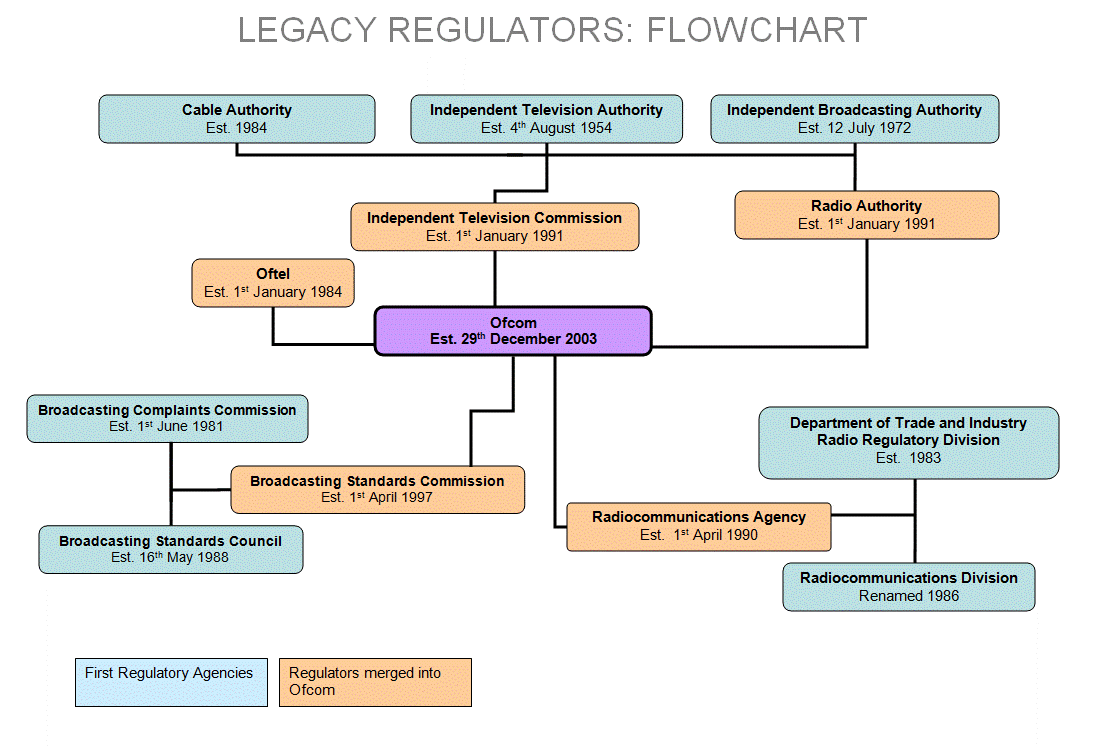
The Agency is an Executive Agency of the Department of Trade and Industry and is responsible for the management of that part of the radio spectrum used for civil purposes within the UK. It is also responsible for representing UK radio interests nationally and internationally.
Radio signals, which are used by millions of people world-wide, do not stop at national borders. Without adequate planning and management, the radio signals from different users and services would interfere with each other and, above a certain level of interference, radio would become useless as a reliable and effective means of communication. The Agency plans and manages spectrum to ensure that the appropriate kind of spectrum is available to those who need it, that it is used efficiently and with as little interference as possible. In order to ensure the optimum spectrum use for the benefit of all users the RA:
CB is a short range radio service for both hobby and business use. It is designed to be used without the need to have any technical qualifications and not to cause interference to other radio users. Hence, only radios meeting certain specific requirements may be used. Antennas need to conform to clause 4 of the licence.
To use CB, you either need to hold a licence yourself or be directly supervised by a licence holder. However, we do offer exemptions to Scouts, Girl Guides and OAP networks, etc.
Unless you are using CB radio under the direct supervision of another CB licence-holder, you will need to take out a CB licence in your own name. Please note that children under the age of 14 years cannot hold a CB licence.
The licence currently costs £15 per year, free to those 21 years of age and younger and from 1 April 2001 free to those aged 75 years and older, no matter how many sets or channels you use.
Since 1992, CB licensing has been centralised and application forms are no longer available 'over the counter' from Post Offices.
To apply for a CB licence, a completed application form must be sent to the Radio Licensing Centre. (see Section D. Contact points) together with a cheque or postal order for £15 made payable to: "Radio Licensing Centre".
A CB licence runs for one year from the date of issue. You will be sent a renewal notice six weeks before the expiry date and, if necessary, a final notice.
Since 1 November 1999, the licence has been amended so that to use CB, you either need to hold a licence yourself or be directly supervised by a licence holder. Direct supervision means that the licence holder should be in the general proximity of the non-licence holder, for example, in the same room. We recognise that there are groups that previously benefited from the general supervision facility. The Agency is prepared to consider applications for exemptions to the direct supervision requirement. The following are examples of areas that may be considered:
This covers any person who
the licensee has control and authority over. The licensee must be willing to take full
legal responsibility for any person supervised. For example, members of the same family
living at the same postal address, may be covered by one licence even if operating away
from home.
This applies to official OAP networks with a superintendent (or equivalent) who uses CB radio to contact the OAPs in the network at certain times of the day to check they are all right. This does not apply in cases where a CB club has provided a free CB set to an OAP for use in an emergency or for general communication purposes.
Where exemption is agreed, a Notice of Variation (to be attached to your licence) will be issued. Please contact the Agency for further information. Contact details are given in Section D.
No, refunds are not offered for CB licences. The licence is not offered on a 'time basis' or to cover specific items of equipment.
Yes, if they operate within the CB bands. Even low power hand-held CB radios must be covered by a licence.
Note: Operation of walkie talkies at 49 MHz is licence exempt, however, the walkie talkies must conform to specific equipment approval requirements.
No, the CB licence allows you to operate on either or both of the sets of CB frequencies.
The Performance Specification MPT 1321 to which 934 MHz CB transceivers were manufactured was withdrawn in 1988. No new sets were manufactured from that date and no sets were imported. From 1 January 1999 the use of 934 MHz CB equipment has been prohibited.
MPT 1320 was withdrawn in March 1995 and replaced by a new Specification MPT 1382. All equipment type-approved to MPT 1320 may continue to be used for its foreseeable useful life.
Yes, if a transmitter-receiver (transceiver) is used but no, if a receiver only is used (i.e. apparatus inherently incapable of transmission).
Since 1 December 1999, licences have been free to those individuals who are under 21 at the time of renewal or issue and from 1 April 2001 to those aged 75 or over.
The Agency publishes information sheets on various topics free of charge.
The results of the Agency's 1995 survey clearly showed that the majority of licence holders supported the idea of a national organisation for CB. As a result of this a working group of licence holders was set up at the 1995 Open Forum held in Nottingham and the British Citizens' Band Confederation (BCBC) has now been launched (see Section D, Contact points).
Specific equipment requirements that must be met
The following services operate in the UK:
As indicated above there are two sets of frequency bands allocated
to Citizens' Band Radio (CB) in the UK. This Section gives details on aspects of operation
and types of equipment that can be used together with some information on ancillary
equipment.
Under the Radio Equipment and Telecommunications Terminal Equipment Regulations (SI 2000:730), which implements the EU Directive 99/5/EC (the R&TTE Directive), it is a legal requirement that all radio equipment (with certain specific exceptions) meets certain essential requirements. It is the responsibility of any person who places CB radio equipment on the market or takes it into service to ensure that the requirements of the R&TTE Directive are met, that it is marked with the CE marking together with the "alert" symbol, and that a written declaration of conformity has been drawn up for it together with information for the user on the intended use of the equipment.
The R&TTE Directive replaces the old type approval regime and comes into force on 8 April 2000; prior to this time it is still a legal requirement for CB radio equipment to be type approved under section 84 of the Telecommunications Act 1984. The R&TTE Directive also has a one year transition period during which, equipment already covered by a type approval may continue to be placed on the market and taken into service. No new type approvals will be issued after 7 April 2000. After 7 April 2001, only equipment that complies with the R&TTE Directive may be placed on the market, though equipment already type approved prior to 8 April 2000 may continue to be taken into service. Moreover, such equipment already taken into service would satisfy the terms of the licence.
In addition, it is the licensee's responsibility to ensure
that the CB radio equipment meets the relevant UK Radio Interface Requirement
(IR 2027). UK Radio Interface Requirements provide a high level description
of spectrum use (frequency range, channel spacing, output power, where appropriate
a technology to be used, licensing regime, etc). UK Radio Interface Requirements
can be obtained from the Radiocommunications Agency, telephone: 020 7211 0502/0505
or e-mail: library@ra.gsi.gov.uk.
In summary, CB radio equipment that has already been type approved, and will
necessarily comply with the relevant UK Radio Interface Requirement (IR 2027),
may continue to be used. Such equipment will have been type approved to MPT
1320, MPT 1333, MPT 1382 and ETS 300 135. Please note that MPT 1320 and MPT
1333 have been withdrawn but equipment type approved to these specifications
may continue to be used for the lifetime of the equipment.
Non-type approved equipment must be in conformance with the R&TTE Directive (U.K. R&TTE Regulations SI 2000:730).
Use of all CB radio equipment must comply with the relevant UK Radio Interface Requirement (IR 2027).
"Legal CB" refers to CB equipment in conformance with the above. A legal CB Station will in addition, use an antenna (aerial) that conforms with the restrictions contained in the CB licence and repeated in this Section.
All legal CB radios bear a mark to show that they comply with the
specifications. These are:

Only radios type-approved to, or based on MPT 1382 (December 1997) (marked "PR27/97 - for use in UK only") may be used. These provide the option of any combination of channels from both the UK 27/81 and the CEPT frequencies. The use of any other combined equipment is strictly prohibited.
No, you may not use equipment that has been altered in any way. This includes radios that have been fitted with proprietary conversion boards. Converted equipment will not meet the specification and can cause interference to other radio users.
Only Frequency (FM) or Phase (PM) Modulation may be used. The use of Amplitude Modulation (AM) or Single Sideband (SSB) in the UK is strictly prohibited. However, the Agency is currently undertaking extensive compatibility studies following the publication of a European AM/SSB standard. This standard has not been adopted in the UK.
No. The use of data (other than signals of less than 21/2 seconds in length which are intended to call up any other CB station) or signals of less than 1 second in length which are intended to identify a CB station (or to mark the end of a message sent by a CB station) is strictly prohibited. However, the agency is currently considering a proposal to allow data (on a limited basis).
Yes! Since 1 November 1999 all licences have been issued with callsigns. The format of CB callsigns is "2 + letter + digit + 2 letters".
*N.B. Whilst we encourage their use, it is not mandatory and it will be up to you to decide whether or not to use your allocated callsign.
The channels available for CB are shown on pages 6 & 7. No other frequencies can be used.
The maximum transmitter RF carrier power output allowed is 4 Watts and the antenna is restricted as described below. (In the case of equipment with an integral antenna, the maximum effective radiated carrier power is limited to 4W).
The use of power microphones, echo boxes and speech processors is not illegal but neither is it recommended - they offer no advantages when used with FM/PM and can cause interference. The microphone is subject to conformance requirements and hence must not be replaced with a different type of microphone. Locking push-to-talk microphones are not allowed.
One piece of equipment that is now legal is a "chat-back unit"; this is felt to be of particular benefit to the blind. It allows the use of a voice simulator to inform users which channel they are operating on. Use of an antenna receive pre-amplifier for 27 MHz is prohibited however, you may use a mechanical antenna switch. You may also use meters to set up a station (see overleaf). The use of power amplifiers (burners, boots etc.) is strictly prohibited.
Yes, you can use a Voltage Standing Wave Radio (VSWR) meter and an output power meter to set up a station, but they must be removed before the station is used as they may cause interference if left in place.
The following types of antenna are legal:
Please note that the use of a loop, yagi or any type of beam antenna is prohibited.
No, apart from local planning restrictions and a requirement that within 1 km of airfields the overall height of the antenna plus mast must be less than 15m.
The performance Specification MPT 1333 was withdrawn in January 1995 and no equipment type approved to that Specification is permitted to be manufactured or imported from that date.
Users of equipment type approved to either MPT 1320 or MPT 1333 may continue to use their equipment for its foreseeable useful life.
MPT 1382 (December 1997) has been revised to permit any combination of the existing 40 UK channels (MPT 1382) and the 40 CEPT channels (ETS 300 135). This allows for up to a maximum of 80 channels within one set. Equipment based on this revised specification will be strictly for use in the UK only.
Channel |
Frequencies (MHz) based on MPT 1382/1320 "UK Channels" |
Frequencies (MHz) based on ETS 300 135/MPT 1333 "CEPT/EU Channels" |
| 1 | 27.60125 | 26.965 |
| 2 | 27.61125 | 26.975 |
| 3 | 27.62125 | 26.985 |
| 4 | 27.63125 | 27.005 |
| 5 | 27.64125 | 27.015 |
| 6 | 27.65125 | 27.025 |
| 7 | 27.66125 | 27.035 |
| 8 | 27.67125 | 27.055 |
| 9 | 27.68125 | 27.065 |
| 10 | 27.69125 | 27.075 |
| 11 | 27.70125 | 27.085 |
| 12 | 27.71125 | 27.105 |
| 13 | 27.72125 | 27.115 |
| 14 | 27.73125 | 27.125 |
| 15 | 27.74125 | 27.135 |
| 16 | 27.75125 | 27.155 |
| 17 | 27.76125 | 27.165 |
| 18 | 27.77125 | 27.175 |
| 19 | 27.78125 | 27.185 |
| 20 | 27.79125 | 27.205 |
| 21 | 27.80125 | 27.215 |
| 22 | 27.81125 | 27.225 |
| 23 | 27.82125 | 27.255 |
| 24 | 27.83125 | 27.235 |
| 25 | 27.84125 | 27.245 |
| 26 | 27.85125 | 27.265 |
| 27 | 27.86125 | 27.275 |
| 28 | 27.87125 | 27.285 |
| 29 | 27.88125 | 27.295 |
| 30 | 27.89125 | 27.305 |
| 31 | 27.90125 | 27.315 |
| 32 | 27.91125 | 27.325 |
| 33 | 27.92125 | 27.335 |
| 34 | 27.93125 | 27.345 |
| 35 | 27.94125 | 27.355 |
| 36 | 27.95125 | 27.365 |
| 37 | 27.96125 | 27.375 |
| 38 | 27.97125 | 27.385 |
| 39 | 27.98125 | 27.395 |
| 40 | 27.99125 | 27.405 |
Frequency (MHz) |
Channel Number |
Frequency (MHz) |
Channel Number |
| 26.965 | EU 1 | 27.60125 | UK 1 |
| 26.975 | EU 2 | 27.61125 | UK 2 |
| 26.985 | EU 3 | 27.62125 | UK 3 |
| 27.005 | EU 4 | 27.63125 | UK 4 |
| 27.015 | EU 5 | 27.64125 | UK 5 |
| 27.025 | EU 6 | 27.65125 | UK 6 |
| 27.035 | EU 7 | 27.66125 | UK 7 |
| 27.055 | EU 8 | 27.67125 | UK 8 |
| 27.065 | EU 9 | 27.68125 | UK 9 |
| 27.075 | EU 10 | 27.69125 | UK 10 |
| 27.085 | EU 11 | 27.70125 | UK 11 |
| 27.105 | EU 12 | 27.71125 | UK 12 |
| 27.115 | EU 13 | 27.72125 | UK 13 |
| 27.125 | EU 14 | 27.73125 | UK 14 |
| 27.135 | EU 15 | 27.74125 | UK 15 |
| 27.155 | EU 16 | 27.75125 | UK 16 |
| 27.165 | EU 17 | 27.76125 | UK 17 |
| 27.175 | EU 18 | 27.77125 | UK 18 |
| 27.185 | EU 19 | 27.78125 | UK 19 |
| 27.205 | EU 20 | 27.79125 | UK 20 |
| 27.215 | EU 21 | 27.80125 | UK 21 |
| 27.225 | EU 22 | 27.81125 | UK 22 |
| 27.255 | EU 23 | 27.82125 | UK 23 |
| 27.235 | EU 24 | 27.83125 | UK 24 |
| 27.245 | EU 25 | 27.84125 | UK 25 |
| 27.265 | EU 26 | 27.85125 | UK 26 |
| 27.275 | EU 27 | 27.86125 | UK 27 |
| 27.285 | EU 28 | 27.87125 | UK 28 |
| 27.295 | EU 29 | 27.88125 | UK 29 |
| 27.305 | EU 30 | 27.89125 | UK 30 |
| 27.315 | EU 31 | 27.90125 | UK 31 |
| 27.325 | EU 32 | 27.91125 | UK 32 |
| 27.335 | EU 33 | 27.92125 | UK 33 |
| 27.345 | EU 34 | 27.93125 | UK 34 |
| 27.355 | EU 35 | 27.94125 | UK 35 |
| 27.365 | EU 36 | 27.95125 | UK 36 |
| 27.375 | EU 37 | 27.96125 | UK 37 |
| 27.385 | EU 38 | 27.97125 | UK 38 |
| 27.395 | EU 39 | 27.98125 | UK 39 |
| 27.405 | EU 40 | 27.99125 | UK 40 |
C) Additional information
You will not be permitted to use CB equipment abroad, which incorporates the UK channels (27.60125 MHz - 27.99125 MHz) i.e. UK channels 1 - 40.
Use of CB equipment abroad, with EU channels only, as denoted in and based on ETS 300 135 is likely to be permitted, but you must check with the administration of the country concerned whether it may be used and whether any conditions apply.
When operating abroad, licensees must comply with the conditions of the appropriate licence of the country which they are visiting. Any breach of the licence conditions of the country visited could be regarded as a breach of a licensee's UK licence as well as being an offence in the country visited. Licensees should ensure that they carry with them their current validation document.
Yes, CB licencees from the following countries may operate in the UK
under the terms of their licence and under the conditions as detailed below:
Country |
Symbol |
| Albania | AL |
| Austria | A |
| Belgium | B |
| Bosnia and Herzegovina | BH |
| Bulgaria | BG |
| Croatia | HR |
| Cyprus | CY |
| Czech Republic | CZ |
| Denmark | DK |
| Estonia | EST |
| Finland | FI |
| France | F |
| Germany | D |
| Greece | GR |
| Hungary | H |
| Iceland | IS |
| Ireland | IRL |
| Italy | I |
| Latvia | LV |
| Liechtenstein | FL |
| Lithuania | LT |
| Luxembourg | L |
| Malta | M |
| Moldova | MLD |
| Monaco | MC |
| Netherlands | NL |
| Norway | N |
| Poland | PL |
| Portugal | P |
| Romania | RO |
| Russian Federation | |
| San Marino | RSM |
| Slovakia | SK |
| Slovenia | SLO |
| Spain | E |
| Sweden | S |
| Switzerland | CH |
| The Former Yugoslav | |
| Republic of Macedonia | |
| Turkey | TR |
| United Kingdom of Great Britain & Northern Ireland | GB |
| Vatican City | SCV |
Schedule 2 of the WT (Citizens' Band and Amateur Apparatus) (Various Provisions) Order 1988 provides for equipment approved in certain countries and marked with the appropriate country symbol to be used in the UK. A list of legal markings is included below.
Legal CB equipment conforming to MPT 1333 or ETS 300 135 which has been approved in a country as listed, will be marked as:
CEPT PR 27 + the symbol indicating original country where type-approval occurred.
e.g. equipment type-approved in France will be marked:
CEPT PR 27 F
Additionally, CB radio equipment that complies with the R&TTE Directive and also conforms with the relevant UK Radio Interface Requirement (IR 2027), is permitted.
Code of Practice
The operating conditions of the CB service have been deliberately made simple with few restrictions. Although it has always been made clear that no-one has preferential rights at any time or place or on any channel, a recommended voluntary Code of Practice has been agreed by CB User Groups and is printed in the CB Radio Licence Terms, Provisions and Limitations Booklet. Among other things the Code asks that priority be given to calls for help, and in particular recommends that Channel 9 be left clear for emergencies and assistance only. All operators are asked to follow the Code and so promote good operating practice within the CB service.
The CB Radio Code of Practice contained in the Citizens' Band Radio Licence Terms, Provisions and Limitations Booklet recom-mends that all CB radio operators follow operating convention and use Channel 9 only for emergencies and assistance.
The Code of Practice recommends that the channel be left clear for emergencies but this does not constitute a legal requirement and is not a licence condition.
Volunteers do valuable work by giving up their time to monitor Channel 9 for emergency calls and their frustration when the channel is misused, is understandable. However, legal protection for the channel is not an easy remedy for channel abuse, because it would have to involve effective checking and enforcement action. The cost of providing resources on a large enough scale to do this would be difficult to justify and would put up significantly the cost of the CB service.
No, any group or individual licensee can monitor Channel 9, or indeed, any other channel. No permission is needed from the Agency, and the Agency does not maintain a register of monitors.
This is not necessary but you may like to contact the emergency services to let them know you are there (some like to keep a list of known CB monitors in their area) and to get any advice they may wish to give you about the passing of emergency calls.
It is also important to get in touch with the local police if you wish to help in incidents such as searches for lost children. Sometimes the emergency services can be hindered rather than helped when people turn up on the scene of an accident or search and it is therefore, very important to make sure that your efforts are properly directed.
No, a CB monitor, like any other user, must comply with the conditions of the CB licence at all times. For example, it is an offence to use equipment which is not permitted in the licence and there are no exceptions to this.
Some operators are under the impression that large antennas can be installed for use in an emergency or for reception only, but this is not the case. Similarly, the use of transmitter power levels greater than 4 Watts is an offence.
In short, Channel 9 monitoring is a useful part of CB, but it must be carried out within the normal rules of the service.
Many Channel 9 monitors do belong to a local or national monitoring group and this brings the benefits of collective experience and good training. It is not necessary to join such groups, however, and you are quite free to monitor on your own if you wish to do so.
Generally no, some monitoring may be done locally by services such as police traffic controls but this is not usually on a regular basis. The emergency services certainly do not have sufficient resources to undertake monitoring on anything but a small and selective scale. CB is no alternative to the maritime emergency service, for example.
Tel: 0117 925 8333
Minicom: 0117 921 9550
In order to comply with the requirements of the Criminal Procedures and Investigations Act (CPI) 1996, all telephone calls to the Radio Licensing Centre are recorded.
Tel: 020 7211 0159
Tel: 020 7211 0160
Tel: 020 7211 0161 (Answerphone)
Fax: 020 7211 0228
E-mail: amateurcb@ra.gsi.gov.uk.
| RA 0 | Current List of Agency Publications |
| RA 2 | Information on Licence Details, Enquiry Points and Organisational Structure |
| RA 67 | The Radio Users Guide to the Law |
| RA 169 | Receive Only Radio - Scanners etc |
| RA 206 | Addresses of the RA Local District Offices |
| RA 240 | CB Licence Application Form |
| RA 246 | Information on CB |
| RA 344 | Abuse of CB Radio |
| RA 354 | The Radiocommunications Agency and its Role in Managing the Radio Spectrum |
RA 246 (Rev 8)
|