Ship Portable Radio Licence Guidance Notes

line.gif (972 bytes)

RA 385gn is also available in pdf document (73KB)


Contents

Part A: Information specific to radio licensing
1.0 Introduction
2.0 What the licence covers
3.0 Radio equipment performance requirements
4.0 T-References
5.0 Maritime Mobile Service Identity (MMSI) numbers
6.0 Payment of licence fees
7.0 Other licensing information
8.0 Enquiries

Centre pages 406 MHz / 121.5 MHz PLB registration form 8/9

Part B: General maritime information
9.0 International maritime VHF frequencies table
10.0 Emergency Position Indicating Radio Beacons (EPIRBs)
11.0 Operator qualifications
12.0 Contacts for further information


Part A: Information specific to radio licensing

1.0 INTRODUCTION

1.1 These notes are designed to help those applying for a Ship Portable Radio Licence. The following notes cover the types of equipment that are licensable, specific requirements that the equipment must meet; radio operators' certificates, callsigns, Maritime Mobile Services Identities and other licensing information that applicants need to be aware of.

1.2 If the application form is not fully completed it may be returned to you for you to complete the missing details. If you are uncertain about the information required, please contact either the Radio Licensing Centre on 0870 243 4433 or the Agency's Aeronautical & Maritime Section on 020 7211 0215.

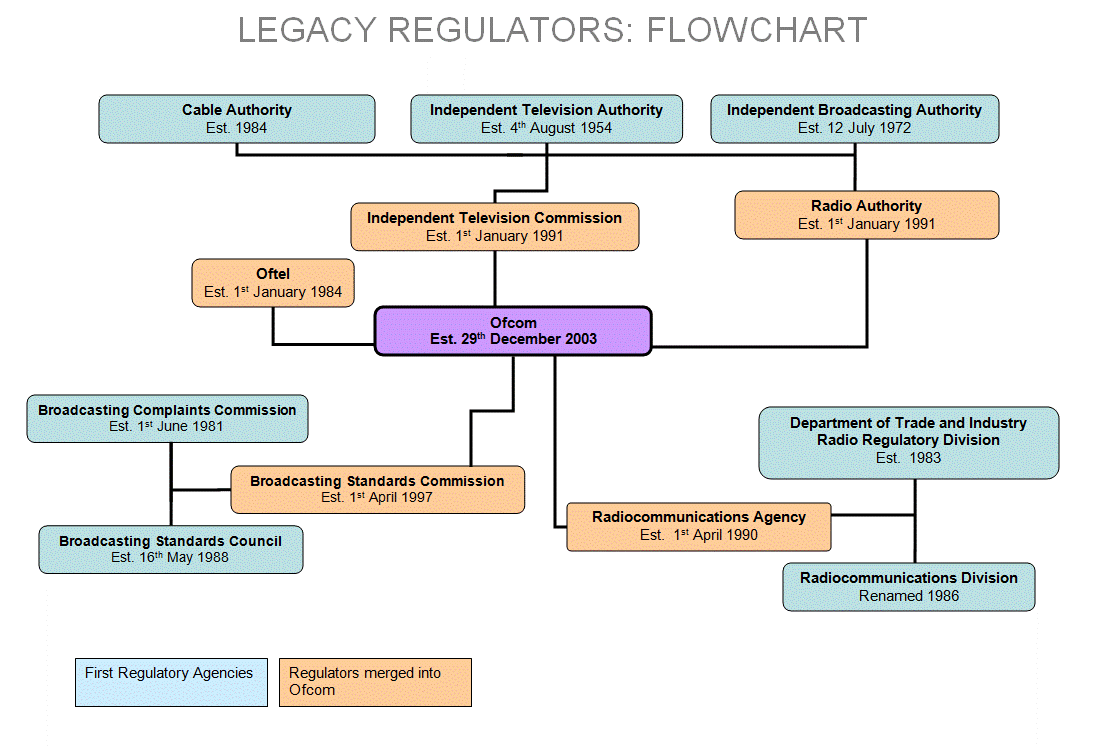
1.3 The Radiocommunications Agency is responsible for the effective management of the civil radio spectrum in the United Kingdom. Regulation is necessary to ensure that those who use radio equipment can do so without causing, or suffering from, undue interference.

1.4 The regulations governing the use of maritime radio are detailed in the International Radio Regulations, set by the International Telecommunication Union (ITU), and the Wireless Telegraphy Act 1949, as amended. It is an offence to install or use any radio equipment on board a UK registered ship, craft, hovercraft, lightship, oil rig or any other ship predominantly moored in UK waters without a radio licence. This includes vessels registered in the Channel Islands and the Isle of Man. A radio licence is required even if the transmitting equipment is not in constant use, or if it is used only for distress purposes.

2.0 What the licence covers

2.1 For licensing purposes, a ship portable radio is defined as a handheld portable VHF or VHF/DSC radio transceiver which is not designed to be permanently installed on a vessel and may be used on a number of different vessels.

2.2 The Ship Portable Radio Licence allows the licensee to have "available for use" one portable maritime radio. Together with the relevant Maritime Radio Operators' Certificate of Competence and Authority to Operate, it allows the use of international maritime radio channels. Within UK territorial waters it also authorises use of the UK Marina channels M (157.850 MHz) and M2 (161.425 MHz).

2.3 The Ship Portable Radio Licence will additionally cover the use of one Personal Locator Beacon (PLB) and/or one Emergency Position Indicating Radio Beacon (EPIRB) operating on 121.5 MHz, 406 MHz or 406 / 121.5 MHz. These units must be specified on the licence, 406 MHz / 121.5 MHz beacons must be correctly registered with HM Coastguard. Please see Section 13 for information and registration details.

2.4 Applicants should note that the use of VHF/DSC Portable maritime radio equipment under the cover of a Ship Portable Radio Licence is only permitted in UK territorial waters.

2.5 The Ship Portable Radio Licence will comprise a licence document and a licence terms booklet. The licence will be valid for a period of one year unless surrendered by the licensee or revoked by the Secretary of State for Trade and Industry. Once a licence has been issued, reminders will automatically be sent prior to the expiry date as a courtesy to the licensee.

2.6 None of the equipment covered by this licence is permitted to be used on land.

2.7 All equipment covered by this licence must perform in accordance with the relevant performance requirements, as detailed in Section 3.0 below.

3.0 Radio equipment conformance requirements

3.1 Equipment built to merchant shipping standards: Any radio, radar or navigation equipment type approved under the European Marine Equipment Directive has been entirely acceptable for use on all UK vessels since 1 Jan 1999 and will continue to be acceptable for the foreseeable future. Such equipment bears the Wheel Mark.

3.2 Equipment conforming to the requirements of the European Radio Equipment and Telecommunications Terminal Equipment (R&TTE) Directive: Since 8 April 2000, all new marine radio and radar equipment (apart from equipment with a Wheel Mark) has had to comply with the R&TTE Directive before being placed on the market. Such equipment may be licensed for use on small craft in the UK, provided it meets the relevant UK Radio Interface Requirement.

3.3 Such equipment must bear the CE mark, the identification number of a notified body (where one has been consulted by the manufacturer as part of the conformity assessment procedure), and where appropriate, the Alert Symbol (which signifies that there may be restrictions or that this equipment may not necessarily be put into service in all EU states).

The equipment must be accompanied by:

  1. A copy of the Declaration of Conformance to the requirements of the R&TTE Directive (or a simplified Statement of Compliance and information on where the formal Declaration of Conformance may be found).
  2. Information on its intended use, including the countries of the EU in which it is intended the equipment is to be used.

Equipment, which additionally meets the requirements of any of the European Standards (ETS or EN) or International Standards (IEC) listed over, is recommended.

3.4 Equipment previously approved under national type approval arrangements: It has remained permissible to sell equipment type approved prior to 8 April 2000 and some may have still been on the market when the R&TTE Directive came into force on 8 April 2001. This equipment will have been type approved to one or more of the standards listed overleaf and customers are advised to confirm this with the supplier. Nationally type approved equipment may continue to be licensed and installed on vessels but, since 8 April 2001, further supplies of such equipment may not be transferred from manufacturers or importers to retailers.

3.5 UK Radio Interface Requirements applicable to maritime radio equipment for small craft under the R&TTE Directive: Radio Interface Requirements are high level descriptions of how the spectrum should be used. They typically consist of the requirements related to intentional transmissions in allocated frequency bands. They do not prescribe technical interpretations of the essential requirements of the R&TTE Directive. (Some of the Radio Interface Requirements may be in draft form and are in the process of being published). The documents and a comprehensive list are available on the Agency web site: www.radio.gov.uk

3.6 In addition, it is the licensee's responsibility to ensure that all maritime radio equipment to be covered by the licence meets the relevant UK Radio Interface Requirement (RIR). The UK's RIRs provide a high level description of spectrum use (frequency range, channel spacing, output power, technology to be used where appropriate), licensing regime, etc. Details of the relevant UK RIRs can be obtained from the Radiocommunications Agency, telephone 020 7211 0211.

3.7 RA personnel carry out regular inspections to ensure that only equipment that operates in conformity with relevant technical parameters is used on board UK registered vessels.

4.0 T-Reference numbers

4.1 As portable radio units are not necessarily for use on one vessel only, they are issued with a unique "T" reference number instead of a ship callsign.

5.0 Maritime Mobile Service Identity (MMSI) numbers

5.1 In March 2001 new VHF/DSC portable radios were introduced onto the UK maritime radio market. The Agency in response, reserved a unique block of Maritime Mobile Service Identity (MMSI) numbers beginning with 2359, for this equipment.

5.2 Portable VHF/DSC radios must on no account be programmed with vessel MMSI numbers. HM Coastguard needs to be able to differentiate between the types of equipment sending a DSC alert, as it is possible for the DSC alert from a transportable radio to come from any vessel. The resulting search on the database for vessel details may provide incorrect information that could jeopardise a Search and Rescue operation.

5.3 The UK administration does not issue MMSI numbers to Personal Locator Beacons (PLBs) or Emergency Position Indicating Radio Beacons (EPIRBS) alone.

5.4 The Agency does not notify the ITU of portable MMSI numbers issued by the UK. They are made available to the Maritime and Coastguard Agency (MCA) to assist with search and rescue operations.

6.0 Payment of licence fees

6.1 The licence is valid for a period of one year. A separate fee is payable for each Portable radio licensed (See Section 2.3).

6.2 Before expiry of the licence the licensee, as a courtesy, will receive reminders. If the licence is allowed to lapse a fresh application is required. Warning: it is an offence to use or install maritime radio equipment other than in accordance with the terms of a licence issued by the Secretary of State for Trade and Industry.

6.3 Refunds will only be made where there has been an overpayment or a duplicate payment. Fees may be varied from time-to-time and are set by the Secretary of State for Trade and Industry, with the approval of Parliament.

6.4 The current list of payment methods and fees can be found in Section D of the Ship Portable Radio Licence application form.

7.0 Other licensing information

7.1 Registration

The Radiocommunications Agency is not able to licence radio equipment for use on vessels that are:

  1. registered in countries other than the UK, Isle of Man and Channel Islands or;
  2. not registered in the UK and owned by non-UK nationals.

7.2 Where a vessel needs to be registered to comply with the Merchant Shipping (Registration) Act 1993, details may be obtained from:

The Registrar General
Maritime and Coastguard Agency

Room 2/09A
Spring Place
105 Commercial Road
Southampton SO15 1EG

Tel: 023 8032 9100
Fax: 023 8032 9252


7.3 All changes to the Ship Portable Radio Licence details, e.g. change of; owner's address, radio equipment etc. must be notified to the Radio Licensing Centre in writing, preferably using form RA393, this can also be supplied by fax. There is no charge for registering amendments.

7.4 If a bulk application has been made for a number of licences, each licence will be mailed separately.

7.5 Company applications

Whilst the Agency is able to accept applications where a company is named as the licensee a named contact must also be specified, and will be the first point of contact with the Agency. If the "company" box is ticked the applicant is declaring that the licensee is a limited company and a company registration number must be supplied. If the company is not a limited company the partnership box must be ticked.

8.0 Enquiries

8.1 Enquiries about your application should be made to:

Radio Licensing Centre
P.O. Box 1495
Bristol BS99 3QS

Tel: 0870 243 4433
Fax: 0117 921 8444

Minicom: 0117 921 9550 (For hearing impaired customers ONLY, special equipment is required to use this service).

Website: www.radiolicencecentre.co.uk
E-mail: radio.licensing.centre@royalmail.com

Hours of business: Monday-Friday 9am-5pm, answerphone is available outside these hours.

In order to comply with the requirements of the Criminal Procedure and Investigations Act (CPI) 1996, all telephone calls to the Radio Licensing Centre are recorded. If you would prefer to write, please send correspondence to the above address.

8.2 Licensees are allocated a unique reference number. This is printed on all stationery, except the amendment sheets. This number should be quoted when making a telephone enquiry and entered clearly on all written correspondence with the Radio Licensing Centre.


Part B: General Maritime Information

9.0 International maritime VHF frequencies table

The frequencies detailed below are the only international maritime VHF frequencies that may be used.

Channel
designators
Notes Transmitting frequencies
(MHz)
Inter ship Port Operation
and ship movement
Public
Correspondence
Ship Stations Coast Stations Single
frequency
Two
frequency
60   156.025 160.625     X X
01   156.050 160.650     X X
61   156.075 160.675     X X
02   156.100 160.700      X X
62   156.125 160.725     X X
03   156.150 160.750     X X
63   156.175 160.775     X X
04   156.200 160.800     X X
64   156.225 160.825     X X
05   156.250 160.850     X X
65   156.275 160.875     X X
06 (1) 156.300   X      
66   156.325 160.925     X X
07   156.350 160.950     X X
67   156.375 156.375 X X    
08   156.400   X      
68   156.425 156.425   X    
09   156.450 156.450 X X    
69   156.475 156.475 X X    
10   156.500 156.500 X X    
70   156.525 156.525 Exclusively for Digital Selective Calling for Distress,
Safety and Calling
11   156.550 156.550   X    
71   156.575 156.575   X    
12   156.600 156.600   X    
72   156.625   X      
13 (5) 156.650 156.650 X X    
73   156.675 156.675 X X    
14   156.700 156.700   X    
             74   156.725 156.725   X    
15 (2) 156.750 156.750 X X    
75 (4) 156.775     X    


Channel
designators
Notes Transmitting frequencies
(MHz)
Inter ship Port Operation
and ship movement
Public
Correspondence
Ship Stations Coast Stations Single
frequency
Two
frequency
16    156.800 156.800 Distress,Safety and Calling
76 (4) 156.825     X    
17 (2) 156.850 156.850 X X    
77    156.875   X      
18   156.900 156.900   X X X
78   156.925 161.525     X X
19   156.950 161.550     X X
79   156.975 161.575     X X
20   157.000 161.600     X X
80   157.025 161.625     X X
21   157.050 161.650     X X
81   157.075 161.675     X X
22   157.100 161.700     X X
82   157.125 161.725   X X X
23   157.150 161.750     X X
83   157.175 161.775   X X X
24   157.200 161.800     X X
84   157.225 161.825   X X X
25   157.250 161.850     X X
85   157.275 161.875   X X X
26   157.300 161.900     X X
86   157.325 161.925   X X X
27   157.350 161.950       X X
87  

157.375

         
28   157.400 162.000     X X
88  

157.425


X

   
AIS 1 (3) 161.975 161.975        
AIS 2 (3) 162.025 162.025        

Notes:

  1. The frequency 156.300 MHz (channel 06) may also be used for communications between ship stations and aircraft stations engaged in co-ordinated search and rescue operations. Ship stations shall avoid harmful interference to such communications on channel 06 as well as to communications between aircraft stations, ice-breakers and assisted ships during ice seasons.
  2. Channels 15 and 17 may also be used for on-board communications provided the effective radiated power does not exceed 1W.
  3. These channels (AIS 1 and AIS 2) are designated for an automatic ship identification and surveillance system capable of providing worldwide operation on high seas.
  4. The use of these channels (75 and 76) should be restricted to navigation-related communications only and all precautions should be taken to avoid harmful interference to channel 16, e.g. by limiting the output power to 1W or by means of geographical separation.
  5. Channel 13 has been designated on a worldwide basis as a bridge to bridge safety communication channel especially where a danger of collision exists.


10.0 Personal Locator Beacons (PLBs)

10.1 A Personal Locator Beacon (PLB) is a self-contained battery operated radio transmitter, the purpose of which is to facilitate search and rescue operations. PLBs are intended for marine use only and must not be used on land.

10.2 There are two types of PLB in use in the United Kingdom; small simple beacons that operate on the aeronautical distress frequency 121.5 MHz and a more sophisticated model operating on 406 MHz and 121.5 MHz. The latter has a unique identification code, which identifies the individual to whom it has been registered.

10.3 It is vital that all 406 MHz PLBs are registered with the Maritime and Coastguard Agency (MCA). The details provide the rescue co-ordination centres with the information needed to co-ordinate a rescue. Failure to register a PLB will seriously degrade its usefulness to the search and rescue services in the event of an emergency and could even put lives at risk.

10.4 406 / 121.5 MHz EPIRBs/PLBs

The details provided in Section C of the Ship Portable Radio Licence application form will be sent to the MCA EPIRB Registry. After having applied for a Ship Portable Radio Licence, should you acquire, or transfer a 406 / 121.5 MHz PLB to another owner and/or vessel, the MCA EPIRB Registry must be notified using the form in the centre of these guidance notes. In addition, the Radio Licensing Centre must be advised in writing.

11.0 Operators' qualifications

11.1 Whilst it is not necessary to hold a Certificate of Competence in order to obtain a Ship Portable Radio Licence, a maritime radio may be operated only by or under the direct personal supervision of a holder of the appropriate Certificate of Competence and Authority to Operate. This is to maintain operational standards and ensure knowledge of current distress, emergency and safety procedures. The certificate holder is required to produce these documents when requested to do so by a person authorised by the Secretary of State for Trade and Industry.

11.2 The minimum Certificate of Competence that is required for use of a ship portable radio is the Short Range Certificate. This certificate covers use of both standard VHF and VHF/DSC equipment under the Global Maritime Distress and Safety System in sea area A1.

11.3 The training and examinations for these certificates are carried out by:

The Royal Yachting Association
RYA House

Romsey Road
Eastleigh
Hampshire SO5 4YA

Tel: 023 8062 7400

Further details can also be obtained from the MCA, telephone 023 8032 9100

12.0 Contacts for further information

General maritime licensing policy enquiries, including ships, Coastal Station Radio (CSR) application forms, navigational aids and RADAR licence processing contact the Agency's Aeronautical and Maritime Section on:

Tel: 020 7211 0215/7
E-mail:
ams@ra.gsi.gov.uk

Ship Portable Radio Licence processing enquiries
The Radio Licensing Centre
PO Box 1495
Bristol BS99 3QS

Tel: 0870 243 4433
Fax: 0117 921 8444
Email: radio.licensing.centre@royalmail.com

Website: www.radiolicencecentre.co.uk

For information on the use of Amateur & CB Radio "onboard vessels", contact the Amateur & CB Section on:

Tel: 020 7211 0160
E-mail:
amateurcb@ra.gsi.gov.uk

For general information on Marine Radio Operator's Certificates and the GMDSS, contact the Maritime and Coastguard Agency (MCA) on:

Tel: 0870 600 6505
Website: www.mcagency.org.uk

For details of the Short-Range Certificate (GMDSS, VHF), including where training and courses are available contact the Royal Yachting Association on:

Tel: 0845 345 0400
Website: www.rya.org.uk

For details about registration of PLBs and EPIRBs, contact the EPIRB Registry on:
Tel: 01326 211 569

For further information about the ITU, visit their website at: www.itu.int

The Agency produces information sheets and publications on most aspects of its work.

They are available from the Agency Library on 020 7211 0502/05, or e-mailing library@ra.gsi.gov.uk or can be downloaded from the Agency's website at www.radio.gov.uk It is also possible to subscribe to the Library (free of charge) and receive updates and new releases; details are available from the above contact options.


Please note: This form should be printed out and sent via 'surface mail' to the address given below. Please do not attempt to re-send this form via E-mail as we cannot at present handle electronic submissions.

Please print entire document.

Please use BLOCK CAPITALS throughout

REGISTRATION FORM FOR A 406 MHz EPIRB/PLB COVERED BY A SHIP PORTABLE LICENCE

COSPAS/SARSAT No:
(Please leave blank)

To be completed by EPIRB/PLB owner:

Radio type
(please tick box)
VHF portable or VHF/DSC portable
MMSI number
(if known)
T Reference number
(if known)
 
Device 1
Device 2
Specify beacon
(please tick box):

EPIRB
PLB

EPIRB
PLB
Beacon manufacturer's name:
Beacon type:
(from label on the beacon)
Beacon serial no:
(from label on the beacon)
Hex Id (15 characters)
(from the label on the beacon)

Device 1

Device 2

Licensees Details

Name
Address


Telephone/contact number(s)


24 hour emergency telephone contact number(s)
Alternative contact details


IMPORTANT: The owner should contact the EPIRB Registry if no acknowledgement is received within 2 weeks.


line.gif (972 bytes)


Return to Application for a Ship Radio Licence

  Top button

line.gif (972 bytes)

RA385gn
SEPTEMBER 2001
home.gif (433 bytes)