![]() |
The Radio Users Guide to the Law |
Purpose
The purpose of this leaflet is to explain the regulations which govern the civil use of radio equipment in the United Kingdom. Please note that we can do no more than summarise here the main points of the law. If you are in any doubt about your legal position, you should consult your legal adviser and the Agency may be able to provide further advice. Some useful addresses are given at the end of this leaflet.
Who are we?
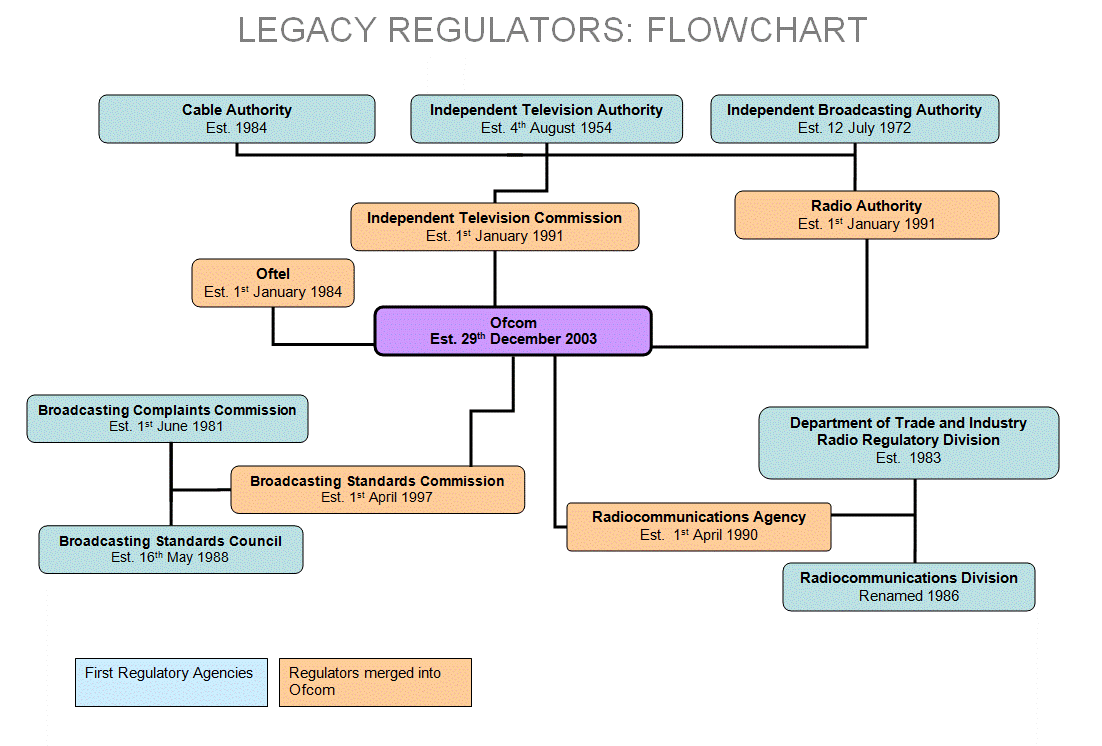
The Radiocommunications Agency is part of the Department of Trade and Industry and has the job of regulating the use of radio. Enforcement of the law is carried out through the Agency's network of local offices.
Why regulate radio?
The use of radio continues to expand rapidly. This applies to business, broadcasting and leisure activities. The use of radio is carefully planned to give as high a standard of service as possible. Unauthorised use of radio can cause harmful interference to legitimate users. Safety of life may be put at risk if, for example, the radios used by emergency services suffer interference. The successful running of a business can be affected by radio interference. Listeners can be prevented from enjoying their favourite radio station by interference.
This is why the Agency takes action to prevent interference and why the penalties that may be imposed for unlawful use of radio can be heavy.
The international position
Radio does not stop at frontiers. That is why the use of radio is regulated on a worldwide basis, by the Radio Regulations agreed at meetings of the International Telecommunications Union. The Radio Regulations are legally binding in international law on Member States, including the UK.
UK legislation
The main legislation is the Wireless Telegraphy Acts 1949, 1967 and 1998 (WT Acts 1949, 1967 and 1998), and the Telecommunications Act 1984 (T Act 1984). This legislation empowers the Secretary of State to:
| issue and charge for licences for the installation and use of radio; | |
| make and enforce regulations on the requirements to be met by users, manufacturers and importers of radio apparatus and of equipment which could cause radio interference; | |
| restrict manufacture, sale, import and possession of specified radio apparatus. |
Responsibility for the above rests with the Secretary of State for Trade and Industry and Radiocommunications Agency acts on his behalf.
Independent television and radio stations and restricted radio and TV services also need a Broadcasting Act licence from the Independent Television Commission or the Radio Authority.
TV reception licences are the responsibility of the BBC.
How licensing works
Section 1 of the WT Act 1949 forbids the installation or use of wireless telegraphy equipment (radio) in the UK mainland including Northern Ireland and territorial waters, the Isle of Man and the Channel Islands, unless:
| an appropriate licence has been obtained from the Secretary of State, or | |
| there are in force Regulations exempting it from licensing. |
Applications for licences should be made as follows:
Citizens' Band (CB) and Amateur Radio
Application forms can be obtained by writing or phoning:
Radio Licensing Centre
PO Box 884
Bristol BS99 5LFTel: 0117 925 8333
Minicom: 0117 921 9550
Ship Radio
Radio Licensing Centre
PO Box 1495
Bristol BS99 3QSTel: 0870 243 4433
Fax: 0117 975 8911
Programme Making and Special Events (including radio microphones)
JFMG Limited
72 Upper Ground
London SE1 9LT
Tel: 020 72613797
Fax: 020 7737 8499
E-mail: info@jfmg.co.uk
The JFMG office is open 0900 to 1800 Monday to Friday except Bank Holidays. Outside those hours a co-ordinator is available for emergency frequency assignments.
Tel: 07050 177335
All other licences
Radiocommunications Agency |
For any applications for the transmission of broadcasting service, before approaching the Agency you must apply to the ITC or Radio Authority for one of their licences. In some cases these bodies will also process the request for a WT Act licence and will hand over both licences to you at the same time.
Licences are usually granted subject to terms, provisions and limitations. These may include:
| use only on a certain frequency | |
| use only with a certain power and certain level of emission | |
| use must not cause undue interference | |
| use only within a certain geographical area | |
| use only of apparatus which meets specified requirements | |
| access for inspection by Agency staff and close down in the event of interference being caused. |
Licences may be varied either to reflect changes which affect all licensees or a class of licensee (e.g. extending the Amateur Radio band) or to deal with individual problems (such as interference). Notice of variation will always be issued and affected individuals will be given a chance to comment.
Licences usually expire automatically on non payment of fees and where there is a frequency assignment attached to a licence it may not be possible to reassign the same frequency if a new licence is subsequently taken out.
Licences may be revoked if a user has demonstrated an unsuitability for the responsibility of holding a licence (e.g. by persistently contravening their licence or causing interference). Again those affected would be given a chance to comment on a revocation.
Licences may also have to be revoked for spectrum management reasons (e.g. to comply with an internationally agreed change of use). Wherever practicable those displaced would be offered access to other radio facilities.
Exemptions from licensing
Deregulation is an important aim for the Agency where this can be done without damage to licensed use. Much radio apparatus is therefore exempted from licensing. In particular:
| apparatus capable only of reception (but not television sets); | |
| cordless telephones and mobile telephone handsets; | |
| metal detectors and model control equipment; and | |
| a wide range of short range devices. |
Generally equipment is only exempt if it meets specified requirements. Some cordless telephones do not meet these requirements and thus are not licence exempt - in fact their possession is not allowed (see below).
Control of interference
The use of radio is also controlled by Regulations and Orders made under the Wireless Telegraphy Acts for the purpose of preventing or reducing the risk of interference.
Orders are used to control the import, sale, manufacture or possession of apparatus which is particularly liable to cause interference. There are currently Orders covering non-approved cordless telephones, CB radio and Videosenders. Other Orders may be introduced from time to time in future. Regulations may also be made in relation to certain specified electrical or electronic apparatus which has the ability to interfere with radio.
These Regulations can set requirements which the specified apparatus must comply with if it is to be used and/or sold, hired, manufactured or imported. Regulations of this sort cover interference from:
| Citizens' Band radio | |
| Electro-Medical Apparatus | |
| Radio Frequency Heating Apparatus | |
| Household Appliances, Portable Tools etc. | |
| Fluorescent Lighting Apparatus | |
| Ignition Apparatus |
In addition, the European Community (EC) Directive on Electromagnetic Compatibility has been implemented in the UK by the Electromagnetic Compatibility Regulations 1992. The Regulations apply to all electronic and electrical apparatus, both commercial and domestic, including radio and television receivers, and cover emissions and immunity. The Regulations do not apply to radio equipment which is subject to the Radio Equipment and Telecommunications Terminal (RTTE) Regulations 2000 which give force to the EC RTTE Directive. These Regulations set out the procedures, including conformity assessment, that must be applied before radio (or telecommunications terminal) equipment can be placed on the market.
Content of transmissions
The Wireless Telegraphy (Content of Transmission) Regulations 1988 make it a specific offence to use obscene or offensive language in transmissions. The Police can directly follow up such offences.
What happens when things go wrong?
Most people are reasonably law-abiding but some users of radio have very little idea of how radio works and they may be tempted not to comply with the licensing regime. The Agency will usually try to help people bring themselves within the law. Where necessary the Agency will not hesitate to prosecute or take other enforcement action under the Wireless Telegraphy legislation to prevent the interference caused by those who operate without a licence or who contravene their licence or an exemption. We can seize apparatus found in unlawful use, and courts can order its forfeiture.
Does it really matter?
Yes; because if you are doing something wrong with radio someone else is probably suffering. The following paragraphs give some idea of who is affected.
Citizens' Band Radio
In terms of numbers of other users affected, unlicensed use
of CB equipment is a major cause of interference. Illegal use
of CB can cause interference to domestic television and radio
reception, hospital radio-paging systems, police, fire brigades
and ambulance services and aircraft landing systems.
Operators of legal CB sets sometimes use transmitter powers or aerials greater than those provided for under the licence conditions. Such use amounts to unlicensed use and prosecutions may be brought. It can cause serious interference to other radio users and prevent responsible users of CB equipment from operating. The playing of music is an offence contrary to the CB licence and offenders are liable to prosecution.
Unlicensed broadcasting stations
Unlicensed pirate radio stations can cause serious and prolonged
interference to a whole range of radio services including safety
of life services.
Private Mobile Radio (PMR)
To enable large numbers of users to operate on relatively
few frequencies, the use of radio by businesses such as taxi firms
has to be carefully controlled. Frequencies are allocated on a
shared basis and licence conditions imposed so as to permit use
by the maximum number of operators; unlicensed use, or use in
contravention of licence conditions, can jeopardise the business
activities of licensed operators and interfere with safety of
life services. We therefore systematically inspect PMR stations.
Enforcement action is taken against those found operating without
a licence or in contravention of their licence conditions.
Marine and aeronautical radio
For those who use mobile radio in connection with maritime
or aeronautical operations, abuse of the radio spectrum is an
obvious hazard to safety of life, as well as to commercial activities.
The use of radio equipment in ships and aircraft requires a licence. Operators of ship radio equipment also require an appropriate certificate of competence to operate. The Agency undertakes campaigns to ensure all operators are aware of these requirements and obtain the necessary licence and certificate. We also inspect many marine business and port operations stations and issue new licences for these and some aeronautical ground stations.
Radio amateurs
Radio amateur licences authorise
use of a range of frequencies allocated to those who use radio
as a hobby rather than for business purposes. Licences are granted
only to applicants who have reached a certain level of competence
in the theoretical and practical use of radio.
Unfortunately there is a minority which seeks to pursue the hobby without the necessary qualifications or licence. Some deliberately cause interference to amateur frequencies, either by jamming them or by transmitting music, obscenities or other forms of abuse.
Short range radio devices
More and more convenience devices now utilise radio in their operation.
Car alarms, wireless door chimes and garage door openers are common examples.
Unfortunately not all of these are manufactured in accordance with the relevant
technical requirements. The use of non-compliant equipment, is an offence and
can lead to interference to authorised
users of radio.
It is an offence contrary to the RTTE Regulations to place on the market non-compliant apparatus.
Who gets prosecuted?
The largest proportion of prosecutions under the Wireless Telegraphy Acts are currently for breaches of Section 1 of WT Act 1949. Such breaches take one of two forms, either the user
| has no licence at all, or | |
| has installed or is using radio equipment outside the terms of the licence or exemption. |
In the case of a breach of a licence the Secretary of State will also have to consider using his powers in Section 1(4) of WT Act 1949 to revoke the licence. In the interests of an interference free service and especially if there is a risk to safety, we may well close down a radio transmitter when it is causing problems. The Agency always provides reasons for such action to the licensee, in order that representations may be made if the closure is considered unjustified.
Where a radio which is used illegally belongs to a company, or is being used for its business, both the individual using the radio and the company and its directors, general manager, secretary or similar responsible officer may have committed an offence. The company officials may have a defence if they can show the offence was committed without their knowledge and that they had not been negligent.
It is also an offence:
| for a person to possess radio equipment with intent to use it in contravention of Section 1 of the WT Act 1949 or know or have reasonable cause to believe that another person will so use it; | |
| to allow premises you own or control to be used for unlicensed broadcasting or to fail to take reasonable steps to prevent them from being so used; or | |
| to be involved in the management of an unlicensed radio station, to advertise on an unlicensed station, to publish programme times of unlicensed broadcasts or generally to facilitate unlicensed broadcasting. |
Non-compliance with interference regulations is dealt with in some cases by serving a notice on the user. A person who knows of the existence of such a notice but uses or permits apparatus to be used in breach of the notice is guilty of an offence under the Act. In the case of certain radio equipment likely to cause interference, such as some CB sets and cordless telephones or videosenders possession or use may be prosecuted without issuing a notice.
Penalties
Transmitting offences under the WT Act
1949
Transmitting offences under the
WT Act 1949, attract a maximum penalty of £5000 and/or imprisonment
for a term not exceeding 6 months if tried in a magistrates court
or, in Scotland, a Sheriff's court, or an unlimited fine and/or
2 years' imprisonment if tried before a jury. A court may order
all or any
| of the apparatus of the station or | |
| apparatus in connection with which the offence was committed, including record collections, vehicles, portable telephones, etc. |
to be forfeited to the Secretary of State.
In addition, anyone convicted of a radio offence could find themselves barred from a career in broadcasting.sting.
Other offences under WT Act 1949
Section 5 of the WT Act 1949 is concerned with the content of messages sent by radio, Section 5(1)(a) is concerned with the sending of a message which, in the knowledge of the sender is false or misleading and is likely to prejudice the efficiency of any safety of life service or endanger safety. Section 5(1)(b)(i) covers the use of WT apparatus to gain information as to the contents of a message whether or not the information is passed on or whether the recipient acts on any information so received. Sub-section 5(1)(b)(ii) deals with the disclosure of such information. Section 13 makes the use of any apparatus for the purpose of interfering with any wireless telegraphy an offence.
Search warrants
A Justice of the Peace, or in Scotland a Sheriff may grant a search warrant under Section 15 of the WT Act 1949, valid for one month, allowing those authorised by the Secretary of State to enter premises etc with or without constables and to examine and test any apparatus found on such premises.
Under Section 79(2) of the T Act 1984, the warrant may authorise the persons authorised by the Secretary of State to seize and detain for the purposes of any proceedings in relation to offences or forfeiture proceedings any apparatus or thing found which appears to those authorised by the Secretary of State to have been used in connection with or to be evidence of the commission of any offence.
Seizure without warrant
Power is given in Section 79(3) of T Act 1984 for constables or those authorised by the Secretary of State, to seize and detain without warrant any apparatus or thing found where they have reasonable grounds to suspect that certain offences have been or are being committed.
Obstruction
Under Section 15(4) of the WT Act 1949 any person who intentionally obstructs an authorised enforcement officer exercising powers under the WT Act 1949 or the T Act 1984 or who fails or refuses without reasonable excuse to give any assistance which those Acts require may be guilty of an offence.
Regulation of Investigatory Powers Act 2000
The enforcement of this Act is the responsibility of the Home Office. Use of radio equipment to listen to radio messages carried on public or private telecommunications systems, including the cellular systems, can be an offence under this Act.
Further information
The Radiocommunications Agency Switchboard/24 hour Telephone Enquiry Point number is 020 7211 0502/0505.
The Agency produces a range of information sheets covering the various licence categories and can advise on the technical standards applicable to radio equipment. For details of these please contact:
The Librarian |
RA 67 (Rev 14)
|