

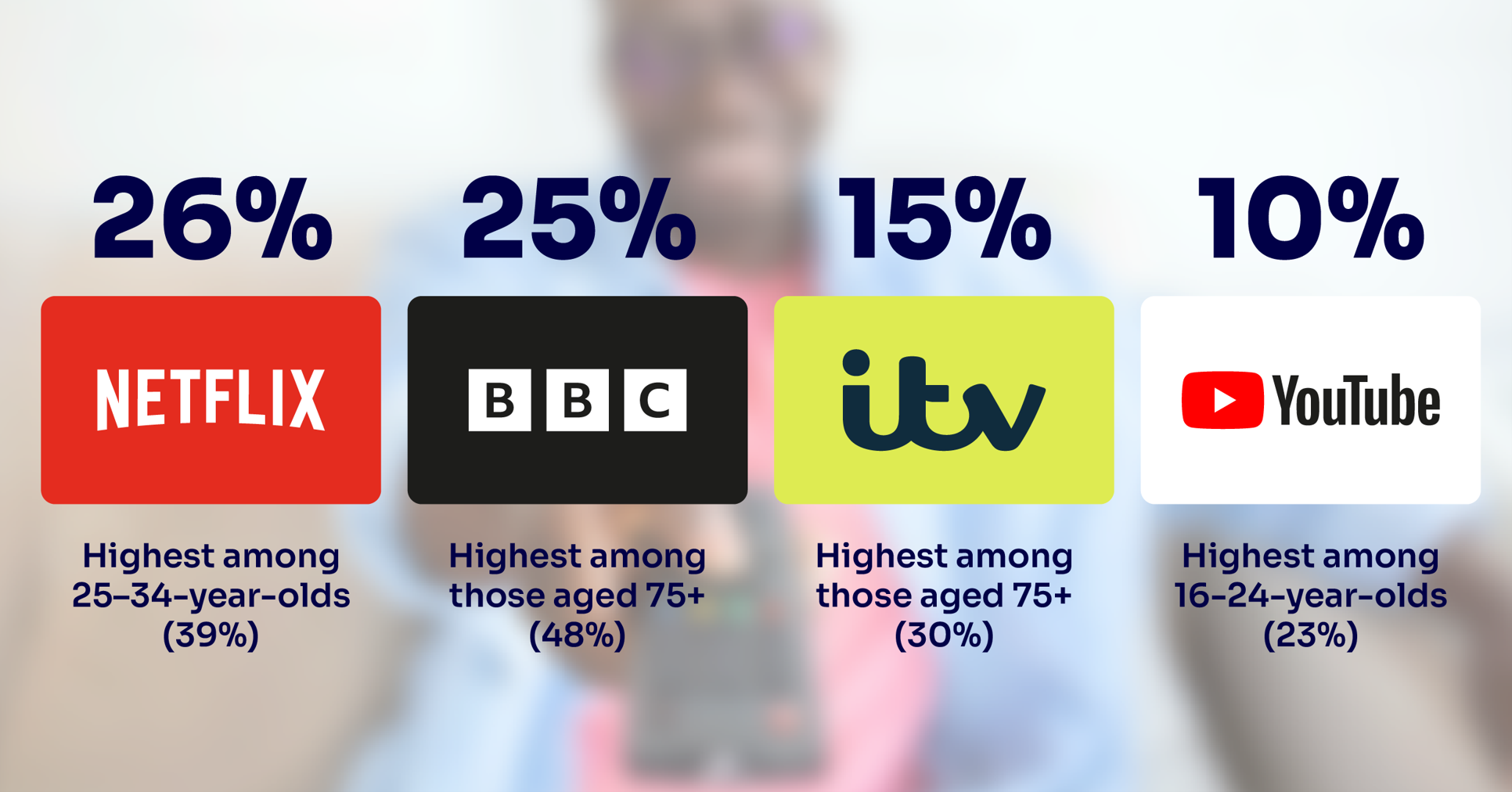
- 26% of viewers say they turn to Netflix first when looking for something to watch, with the BBC neck and neck at 25% and ITV at 15%
- Traditional broadcasters’ on-demand services holding up well in face of fierce competition, with BBC iPlayer and ITVX growing 9% year on year
- Big live events from the World Cup to Celebrity Traitors continue to attract huge audiences
- YouTube viewing on TV sets has doubled since 2022, with older people watching more
A new report from media regulator Ofcom reveals that UK audiences are now just as likely to turn to Netflix as they are the BBC when deciding what to watch, highlighting the ongoing battle for viewers' attention.
Ofcom's annual Media Nations report[1] shows that more than a quarter of viewers (26%) say Netflix is their first choice when looking for something to watch, with the BBC in line at 25%.[2] ITV is now the first choice for 15% of audiences.
The findings underline the growing challenges faced by traditional broadcasters – from fierce competition for viewers’ attention from global streaming platforms and online video services, to ongoing revenue pressures.
Figure 1: Where viewers look first for something to watch
Broadcasters fighting back through growth for on-demand TV
Despite these significant pressures, the UK’s traditional broadcasters are showing signs of resilience. Viewing of broadcaster-owned on-demand services such as BBC iPlayer, ITVX, Channel 4 Streaming and 5 streaming increased by 9% year on year, making them the fastest-growing category of television service. By contrast, subscription streaming services' presence in UK homes has largely plateaued at around 70%, following years of rapid growth during the COVID pandemic.
However, growth in broadcaster on-demand viewing has not been enough to offset the continued decline in audiences for traditional linear television channels. Last year, 70% of people in the UK watched content from traditional broadcasters – including live TV, recorded playback and on-demand services – for at least 15 minutes in an average week.[3] While still a significant reach, this has fallen steadily from 73% in 2024 and 78% in 2022, with declines seen across all age groups, including viewers aged 75 and over.
Public service broadcasters continue to enjoy strong levels of audience satisfaction and remain the leading force in UK-made programming, delivering more than 30,000 hours of first-run UK-originated content in 2025. UK broadcasters also offer over 60,000 hours of UK programming across their on-demand services.
Broadcasters still create national moments
While Netflix occupied the top two positions for the most-watched programmes overall in 2025 with K-Pop Demon Hunters and Adolescence, the BBC has so far claimed eight of the ten most-watched programmes of 2026. [4]
More than half of these top-performing titles were dramas, including The Night Manager and Run Away, demonstrating the enduring appeal of high-quality UK programming.
Major live and event television continues to unite audiences at scale. Celebrity Traitors became the BBC's biggest title of 2025, with the finale attracting an average audience of 14.8 million viewers across BBC One and BBC iPlayer.
Figure 2: Top ten most-watched programmes (highest-performing episode per title), all individuals aged 4+: Q1 2026
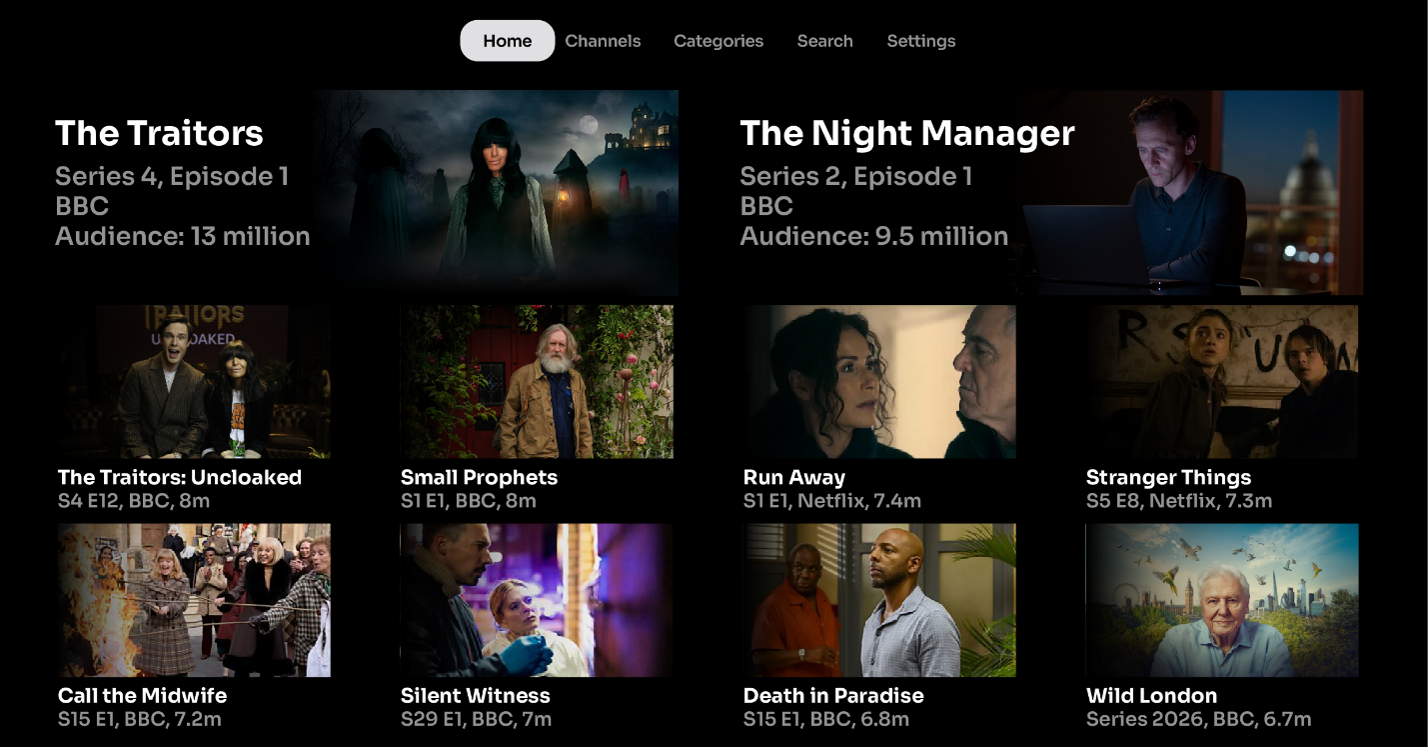
Source: Barb, as-viewed, all individuals aged 4+. TV sets only. Total cumulative average viewing across the whole quarter. The broadcaster figures include live viewing, recorded playback and BVoD.
England's World Cup exit draws massive audience
One of the biggest television moments of 2026 so far came during England's dramatic World Cup semi-final defeat to Argentina on 15 July, when the BBC reported a peak audience of 24 million viewers across all of its platforms. The report also found that 85% of sports viewing in 2025 was watched live, highlighting the continued importance of live television for major national and sporting events.
YouTube's living-room takeover gathers pace
The amount of time people spend watching YouTube on television sets has doubled since 2022, reinforcing the platform's growing role as a living-room viewing destination.
Average daily YouTube viewing on TV sets increased from 9 minutes per person in 2022 to 19 minutes in 2025. Across all devices connected in the home, total YouTube viewing rose to 41 minutes per person per day, up from 33 minutes in 2022.
Figure 3: Where viewers watch YouTube and the changes in the audience
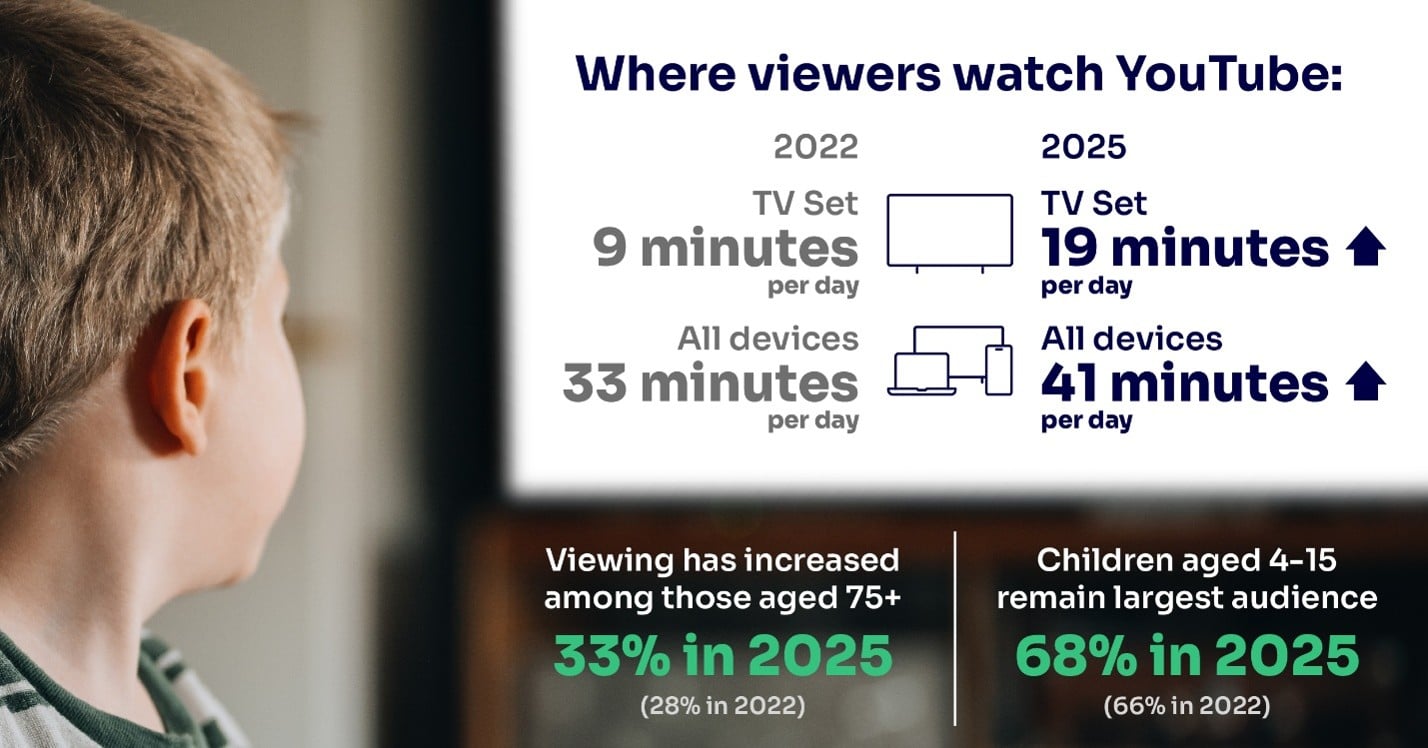
Although YouTube continues to attract younger audiences, older viewers are increasingly turning to the platform. Among people aged 75 and over, weekly reach rose from 28% in 2022 to 33% in 2025.
Children aged 4-15 remain YouTube's largest audience group, despite viewing among 16-24 declining for a second consecutive year. Short-form video continues to dominate viewing habits, with broadcasters increasingly adapting their content strategies to reflect changing audience preferences.
The findings highlight YouTube's transformation from a mobile-first platform into a major competitor for viewers' attention alongside broadcasters and subscription streaming services.
In response to this, public service broadcasters are making YouTube an important part of their distribution strategies. For example, Channel 4 and ITV have partnerships that enable full-length programmes and digital-first content to be distributed on YouTube, alongside tailored commercial arrangements that retain greater control over advertising. Similarly, the BBC has expanded its YouTube strategy through platform-first commissions and a stronger channel presence, particularly aimed at reaching younger audiences.
Audio remains the UK's highest-reaching media sector
The UK's audio sector continues to perform strongly, with 93% of adults listening to some form of audio content every week, and 87% listening to live radio every week, giving it the highest reach of any media sector. [5]
More than a quarter of UK adults now listen to podcasts weekly.[6] News and current affairs are the most popular podcast genres overall, particularly among people aged over 55, while entertainment leads among millennials. Comedy and discussion-based podcasts also continue to attract large audiences.
Kate Davies, Group Director for Strategy and Research at Ofcom, said:
"As audiences increasingly benefit from an incredible choice of content, competition between traditional broadcasters, streaming services, video sharing platforms and other forms of digital media is fierce.
But in face of these challenges, traditional broadcasters are showing resilience with the power to bring millions of us together to watch or listen for big, national moments, as well as growing their digital offerings.
"To thrive and survive in the current media landscape, it’s more important than ever for companies to continue to understand changing audience habits and adapt their strategies to meet people where they are."
Notes to editors
- Ofcom’s Media Nations report tracks evolving consumer behaviours and key trends in the media sector, and to set out how audiences are served in the UK. We draw on a range of evidence, and adopt a cross-platform perspective, including the TV, online video, radio and audio sectors.
- The 1 percentage point difference between 25% for the BBC and 26% for Netflix (response to the question ‘When thinking about what to watch, which one of these TV and video services do you usually turn to first) is not statistically significant and should be treated as the same figure for the purposes of reporting.
- Our total video viewing analysis refers to audiovisual content viewed inside the home, whether on TV sets or other devices connected to a home’s WiFi network. It does not include viewing outside the home or any viewing over a cellular network.
- Figures on in-home video viewing data come from Barb Audiences Ltd (Barb). Streaming catalogue hours data sourced from Ampere Analysis.
- Figures on weekly reach and listening to live radio come from RAJAR. Data on time spent listening to music streaming and podcasts sourced from IPA TouchPoints.
- Separate reports covering Scotland, Northern Ireland and Wales can be found here.
Related content