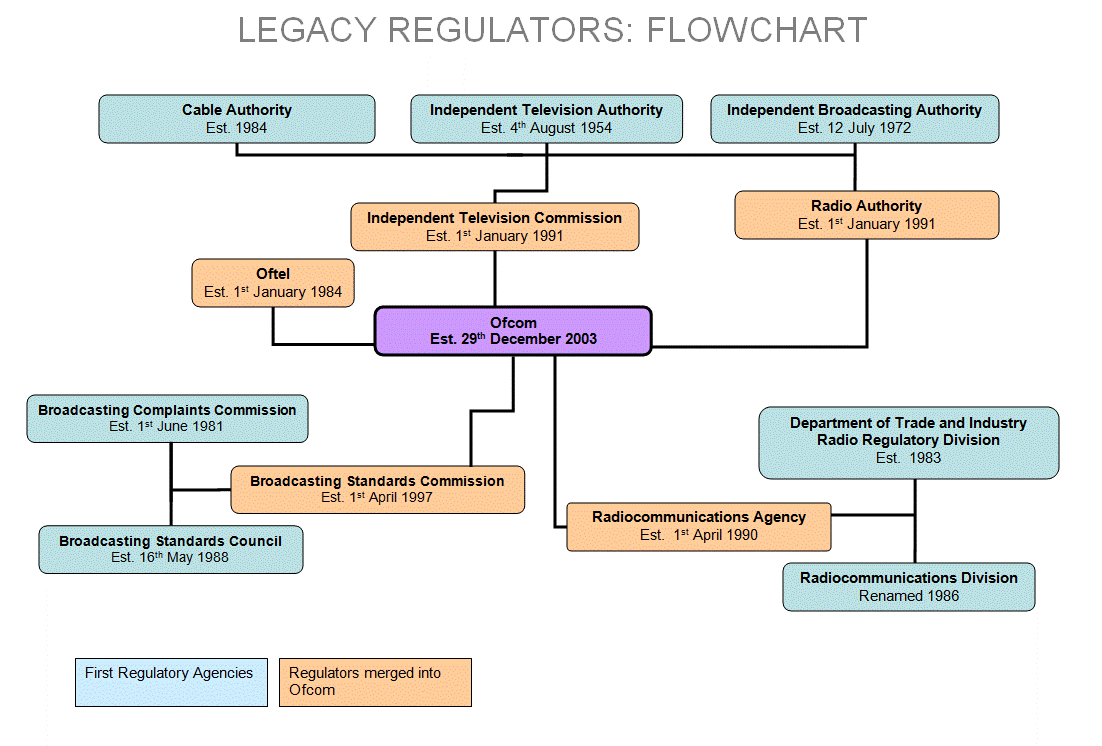
| A brief history of recent UK telecoms and Oftel | ||||||||||||||||||||||||
Before 1969The General Post Office (GPO), a Government Department headed by a Government Minister (the Postmaster General), had a monopoly in UK telecoms and postal services. This included the operation of the network and supply of all equipment. Kingston upon Hull City Council ran the network in the Hull area. 1969October The Post Office Act 1969 established the GPO as a statutory corporation headed by a Chairman appointed by the Government. 1980July Industry Secretary Sir Keith Joseph announced the Governments intention to restructure the GPO and relax the monopoly over terminal equipment and value-added services. November The British Telecommunications Bill sought authority to divide the GPO into two separate organisations Posts and British Telecom. 1981January Professor Michael Beesley submitted his report on liberalisation to the Secretary of State for Industry. October The Telecommunications Bill received royal assent. Apart from formalising the split in the GPO, it also established new responsibilities for the British Standards Institution (BSI) and set up the British Approvals Board for Telecommunications (BABT) a subsidiary of the British Electrotechnical Approvals Board. British Telecom began operating under a licence and independent suppliers of telephones were permitted. 1982January BT began to sell telephones and install plug in master sockets (as opposed to hard-wired installations). February The Mercury consortium received a licence to build and operate an independent network to compete across the full range of telecoms services. June BT telephone suppliers were permitted to sell in competition to BT. July The Government published a White Paper (Cm8610) proposing the sale of 51% of British Telecom and the creation of Oftel as the regulatory body. 1983February The Government accepted the recommendations of a report by Professor Stephen Littlechild to limit British Telecoms main price increases by RPIX%. The formula was set at RPI3% for the first five years of privatisation. April Mercury launched its first telecoms services in the City of London. May Licences were granted to Cellnet and Vodafone to provide national cellular radio networks. July The Telecommunications Bill was reintroduced. The Bill allowed for the selling of BT and setting up of Oftel. November Minister for Information Technology Kenneth Baker set out the duopoly policy limiting the number of long-distance fixed-link operators to two British Telecom and Mercury for seven years. (Kingston upon Hull City Council would continue to supply the service in the Hull area.) He also announced further liberalisation in equipment supply and maintenance. 1984April The Telecommunications Bill received royal assent on 12 April. June British Telecoms and Kingston-upon-Hull City Councils licences were published. July Professor Bryan Carsberg was appointed as Director General of Telecommunications. August Oftel was officially created on 1 August. That month BT became a public limited company. October A joint IBM/British Telecom proposal (known as JOVE) to run a managed data network was refused on the advice of the Director General because of the dominant position such a grouping would have occupied in the market. November 51% of BT shares were sold to the public a total of 3,012 million ordinary shares. The purchase price was 130p and the offer was 3.2 times oversubscribed. 1985January BTs monopoly on the supply and maintenance of the prime (first) telephone ended. The two cellular operators, Cellnet and Vodafone, began commercial service. Later in the year the operators were issued with revised 25-year licences. June The Director General invited applications for the running of national private mobile radio (in the old Band III frequencies) and regional London PMR networks. October The Director General published his determination of the terms for the interconnection of British Telecoms and Mercurys networks. 1986March Band Three Radio Ltd and GEC National One were announced as the successful applicants for trunked national public access mobile radio (PMR in Band III) operators licences. May Mercury began offering basic network services December BTs monopoly on the supply and maintenance of extension wiring and sockets ended. BT, Mercury or Kingston-upon-Hull City Council in Hull still have to install the master socket. The Secretary of State delegated his powers to approve telecoms apparatus and designate standards to the Director General. 1987A strike by BTs engineers at the beginning of the year led to quality of service issues being prominent. March The Director General published his determination on international accounting arrangements for BT and Mercury. June A pilot scheme for approval of some simple telecoms equipment was introduced. Applicants could deal direct with certain test laboratories. The EC published a green paper Towards a Dynamic European Economy on the development of telecoms in the common market. August The Under-Secretary of State for Industry confirmed that Cellnet and Vodafone would provide the UK part of the pan-European digital cellular radio service. Oftel issued a consultative document on BTs contractual liability with its customers. September Sir George Jefferson resigned as Chairman of BT and was replaced by Iain Vallance. October The Director General signed a determination allowing Windsor Television (a broadband cable franchisee) to provide a telephone service in conjunction with Mercury the first such determination. Oftel published a quality of service survey and BT began publishing its own quality of service figures. November The Director General signed a determination allowing Mercury to provide a public call box service in competition with BT. This followed an Oftel survey published in September which showed only 77% of BT public call boxes in working order nationwide. By March 1988 a survey showed that over 87% of BTs call boxes were working. Kingston Upon Hull City Councils licence was revoked and a new dual licence was issued to the Council and Kingston Communications (Hull) plc, the wholly-owned company established by the Council to run its commercial telecoms. 1988January Oftel issued a consultative document on what should replace the RPI3% price cap on BTs main prices (this formula in BTs licence was due to run out on 31 July 1989). May Oftel published the payphone standard. This ended BTs monopoly on the supply of payphones to customers and meant that occupiers of pubs, shops, etc could purchase and/or run their own payphones on their premises. July The Director General reached agreement with BT on a new price cap of RPI4.5% to run from 1 August 1989 to 31 July 1993. The basket was expanded to include operator-assisted calls and any new charged-for services. The Director General referred the problems relating to multiline chatlines and other message services to the Monopolies and Mergers Commission Oftels first reference. Mercury launched its first public call box service at Waterloo Station. August/September There was considerable concern over the quality of service on cellular networks. The Director General began an investigation. September Mercury started a customer guarantee scheme October Six licences for specialised satellite services were granted (one way point-to-multipoint services). December The Macdonald Report on the development of the UKs communications infrastructure was published by the Department of Trade and Industry. 1989January The Director General received a knighthood. Four telepoint (CT2) licences were issued. February Oftel published the MMC report on Chatlines and other message services. April Following Oftels consultative document in 1987, BT introduced a compensation scheme for customers giving them £5 per day after two working days for delayed fault repair or provision of service. Alternatively, for proven loss, business customers could claim up to £5000 and residential customers up to £1000. BT announced there would be a code change in London from 01 to 071/081 in 1990. July Oftel published a consultative document on Numbering for Telephony into the 21st Century. This looked at options such as code recovery and ten-digit dialling. August The Director General recommended to the Secretary of State that suitably qualified installers and maintainers should be able to connect call routing apparatus without the pre-connection inspection by the network operator then required. A BSI scheme to qualify installers and maintainers was introduced in 1990. October Oftel published the first set of monthly statistics on the quality of service on the two cellular networks (run by Cellnet and Vodafone). These were taken from the networks own statistics. The survey was discontinued in 1990 due to incompatibility between the two sets of data. November A new version of the class licence (Branch Systems General Licence) under which the vast majority of people ran their telecoms systems (including residential customers) was issued. This allowed simple resale of spare capacity on private circuits leased from public telecommunications operators. Unsolicited sales calls by fax or telephone were regulated under this version for the first time. A determination was made to bring into force in December the amendments made to BTs operating licence to regulate multiline chatlines and one-to-one live premium rate services, following the MMC reference in 1988. Under the new regulations a code of practice had to be agreed by the Director General a code was agreed in December. Under the code a compensation scheme for unauthorised use and rules on content were introduced. Similar licence conditions were agreed for the licences of Mercury, Kingston, Cellnet and Vodafone. December A price control (of RPI) on private circuit prices was introduced. BT began a compensation scheme for delayed service on private circuits. On Oftels advice the Department of Trade and Industry announced that three personal communications network (PCN) licences would be awarded. The original licensees were Mercury PCN, Microtel and Unitel (all consortia). 1990May The London code changed on 6 May from 01 to 071 and 081. June New mobile operators (such as PCN licensees) were told they would be able to sell direct to customers with safeguards for service providers. Steps began to allow existing mobile operators to market direct in the future. July Oftel took action against four cable TV franchisees over delays in building their networks. This was the first such action. August The code of practice for live one-to-one premium rate services was revoked and new one containing a requirement to record all conversations approved. Oftel specified the first installer allowed to connect call routing apparatus to a public network without a pre-connection inspection by the network operator. October Oftel recognised the concept of logically separate telecoms systems. November The so-called Duopoly Review began with a Department of Trade and Industry consultative document. This looked at the undertaking to introduce no more long-distance fixed-link operators (apart from BT and Mercury) for seven years from November 1983. The review looked at many other aspects of the UK telecoms industry. December On the last day of the year the Broadcasting Act came into force. Among many other provisions, the Independent Television Committee (ITC) took over from the Cable Authority in granting cable TV franchises. 1991January Following the Broadcasting Act 1990 Oftel began monitoring licences for the broadcasting transmission systems of National Transcommunications Ltd (the broadcasting transmission business of the former Independent Broadcasting Authority) and the BBC. The Home Office sold National Transcommunications Ltd later in the year. February BT began offering itemised billing to customers on digital exchanges. March The Duopoly Review white paper Competition and Choice: Telecommunications Policy for the 1990s (Cm1461) was published by the Department of Trade and Industry. This set out government policy in many areas. Decisions announced included ending the duopoly policy and allowing international simple resale to destinations with equivalent freedom to the UK. Decisions and proposals requiring licence modifications included: the setting up of the access deficit contribution (ADC) system, Oftel taking over the UK numbering scheme, introducing number portability, more freedoms for cable operators, and changing the price control formula from RPI4.5% to RPI6.25% with international prices added to the basket and cut by 10%. The Ovum report on numbering in the UK proposed a 10-digit scheme (0 plus ten digits for national dialling) to include the concept of personal numbering. April VAT began to be charged on telephone bills. BT started charging for directory enquiries. The price went into the controlled basket. June Oftel consulted on the future of emergency call handling arrangements and puts forward the idea of setting up a specialist call handling agency. July Following consultation revised proposals for licence modifications to implement the Duopoly Review provisions were agreed with the licensees and the licences modified in September. The three personal communications network licences were issued. The Citizens Charter was published (Cm1599) and recommended more powers for public utility regulators. August A class licence was issued to allow the provision of satellite services (not over the public network). Another new class licence, the Self-Provision Licence, gave more freedoms for private circuits including the abolition of the distance restriction between linked premises and the permitting of separate maintenance of serially-connected equipment. The Director General issued an interconnection determination between Vodafone and Mercury. After discussion with Oftel, BT reduced the maximum deposit asked for to £150 and introduced an appeal procedure. September The Director General announced his agreement to the proposal for a 10-digit numbering scheme. At this time the PhONEday changes were proposed for April 1994. Plans for Oftel to take over the UK numbering scheme were also published. The Director General issued an interconnection determination between Cellnet and Mercury. October Following the suspension of BTs Phonepoint service, only one (now Hutchisons) of the original four telepoint licences remained. December HM Treasury offered for sale up to 1,350 million BT shares. This reduced the Governments ownership from 47.7% to 25.8%. The Director General issued a direction to BT aimed at ending the unfair cross-subsidy of its apparatus supply business which included the sale and rental of telephones and other equipment. 1992January Oftel began reviewing the controls on BTs prices. The RPI6.25% formula was due to run out on 31 July 1993. February 25-year licences were issued to Cognito Group Ltd (reformed as Cognito Ltd later in the year), Hutchison Mobile Data Ltd and Ram Mobile Data Ltd to run mobile data conveyance services and also for the conveyance of data between fixed terminals. They had previously held temporary licences, having been selected by the Department of Trade and Industry in 1989. A further company, Paknet Ltd, was licensed later in the year and Meteor Communications (Europe) Ltd was licensed to run a data service using meteor reflection techniques. March Mercury PCN merged with Unitel, reducing the number of PCN licensees to two. April The code of practice for multiline chatlines was revoked when the compensation fund ran out. These ceased to operate. The introduction in May 1992 of an approval scheme for the metering and billing systems of public operators was announced. The two national public access mobile radio (PMR in Band III) operators, Band Three Radio Ltd and GEC National One merged into one company National Band Three Ltd. A new long-term licence for the merged company was issued. May The remaining telepoint operator, Hutchison, launched its Rabbit service. June The Director General issued a statement proposing a new price control formula of RPI7.5% (from RPI6.25%) from 1 August 1993. The Director General also set out proposals for accounting separation between different BT businesses. On 13 June Sir Bryan Carsberg left Oftel to become Director General of Fair Trading. Bill Wigglesworth, the Deputy Director General, took over until 1 April 1993. The Competition and Services (Utilities) Act came into force. July PhONEday was postponed from April 1994 to April 1995. A new class licence, the Telecommunication Services Licence (TSL), was issued in July and came into force in September. A revised Self-Provision Licence (SPL) also came into force in September. These two replaced the Branch Systems General Licence. The vast majority of people run their systems under either the SPL or TSL. Only those offering services to third parties run their systems under the TSL, all the rest run under the SPL. Eligible cable licensees were offered a licence modification which would liberalise the technical requirements of the systems they were obliged to install. Among the provisions was that cable operators would be able to offer voice telephony in their own right. August BT agreed to the formula of RPI7.5% for the basket of main prices, to run from 1 August 1993 to 31 July 1997. October A driveround survey of quality of service on the cellular networks was launched. It was organised by Oftel and funded by the operators, Cellnet and Vodafone. This was discontinued in October 1993 after three quarters results mainly because of funding difficulties. November Oftel announced additional changes on PhONEday in Bristol, Leeds, Leicester, Nottingham and Sheffield which would become major city areas. 1993February Agreement was reached with BT on the future control of BTs private circuit prices. Price rises were to be limited to RPI on three separate baskets: national analogue, national digital and international. The controls would run from 1 August 1993 to 31 July 1997. Ionica L3 Ltd was granted a nationwide public telecommunications operator (PTO) licence to run a telephone service using short-range digital microwave links. This was the first post-Duopoly Review PTO licence. BABT included a new condition in approvals of mobile handsets that alteration of the electronic serial number (ESN) would mean the handset was no longer approved. March BTs licence was modified to include the RPI7.5% formula controlling the cost of the basket of BTs main prices. An amendment requiring BT to publish details of interconnection agreements also come into force. The National Audit Office published its report on Oftel. The UK, France, Germany and the Netherlands signed an agreement to allow one-stop shopping for licences to provide telecoms services by satellite. The first results from the cellular driveround survey were published. April Don Cruickshank took over as Director General of Telecommunications on 1 April. May A feasibility study on the proposals to set up a specialised agency for handling emergency calls showed the benefits would be marginal. The decision not to proceed was finally made in August. June Oftel published a consultative document on interconnection and accounting separation setting out proposals on how BTs businesses should be divided for regulatory accounting purposes. Another Oftel consultative document looked for views on the use of numbers beginning 02 to 09 after the PhONEday change had taken all geographic numbers to 01. July The first batch of broadband cable TV licences were modified to enable operators, among other things, to convey voice telephony in their own right. August The new price control (RI7.5%) period for BTs main prices began. September Mercury One2One began offering a PCN service. Vodafone started offering GSM (Global System for Mobile Communications) digital services. Oftel published a consultative document on calling line identification (CLI) particularly seeking views on privacy aspects. October The end of the cellular driveround survey after three quarters was announced, mainly due to lack of funding. Oftel launched an awareness campaign for PhONEday. Oftel held its first workshop with operators on interconnection issues. December BT introduced its weekend rate. Oftel published the BT/Mercury interconnection determination. Rabbit, the only telepoint system in operation, stopped offering service. 1994January BT introduced the Light User Scheme to replace SupportLine for customers with low use. The Director General reached agreement with BT that for the remainder of the current price control formula (RPI7.5%) price changes would be introduced in such a way as to be equivalent to a single price reduction on 1 November each year. February Following a consultative review in 1993, the Director General proposed several changes in the operation of BTs Signatory Affairs Office (SAO) to encourage future competition in the provision of satellite services. The main objective was to obtain direct access to international satellite consortia for independent operators. March BT abolished peak rate for local and national direct dialled calls all weekday daytime calls (8.00am to 6.00pm) would be charged at standard rate. Oftel set out its three-stage plan to introduce better interconnection arrangements. Sprint, Telstra and WorldCom International received licences to carry out a number of activities including international simple resale. Oftel published the draft Numbering Conventions for consultation. April Orange launched its personal communications network (PCN) services. May Oftels review into market practices in the provision of mobile telephony services was concluded. This followed a wide-ranging complaint from Talkland International (UK) Ltd and others. Among other measures Directions were issued under BTs, Cellnets and Vodafones licences requiring steps to be taken to end any unfair cross-subsidisation of service provider businesses linked to these network operators. The Directions were revoked in October when the Director General was satisfied the operators were complying. Oftel relaxed the rule requiring customers to part prepay for the maintenance contract they must have for any call routing apparatus. June With the publication of the Numbering Conventions, Oftel took over management of the UK Numbering Scheme. July BT introduced opting-in, using a PIN number, for 0898 adult premium rate services. Access deficit contribution waivers were granted to eight companies of payments they would otherwise have made to BT. The eight were: ACC, WorldCom, COLT, MFS, Energis, Telewest, Videotron and Nynex. The Parliamentary Trade and Industry Select Committee (TISC) published its report Optical Fibre Networks. August Parallel running began for the lead up to PhONEday in April 1995. Customers could now dial either 01 or 0 plus the area code for national numbers, and 00 or 010 for international numbers. September Energis launched its service. Cellnet launched its GSM (digital) service. The US Federal Communications Commission (FCC) announced that the UK met the US equivalence test for international simple resale. October The President of the Board of Trade designated the US as equivalent for international simple resale. The Specified Numbering Scheme was determined by the Director General. This completed the process of transferring responsibility for the Numbering Scheme from BT to Oftel. The Scheme was put on the public record, for the first time, at Oftel. November Oftel and the Department of Trade and Industry published responses to the TISC report on optical fibre networks. No fundamental revision of the regulatory regime covering cable and local delivery franchising would be made. BT launched its calling line identification services. December Oftel published A Framework for Effective Competition. This was a wide-ranging consultative document looking at how the regulatory regime needs to evolve. It included four options for changing the interconnection regime and looked at other issues such as capacity charging for interconnection, regulating anti-competitive practices and universal service. An Oftel investigation into allegations of anti-competitive practice in BT Managed Network Services (BTMNS) proved inconclusive the matter would be investigated further. Mercury announced it would be stopping its public call box service progressively during 1995. Licences were issued to AT&T and Concert (a joint venture between BT and MCI). Nineteen further access deficit contribution waivers were granted by the Director General. BABT approved BTs metering systems. 1995January The Telephone Preference Service was launched. Customers could register to avoid some unsolicited telephone sales calls. February Oftel published The UK Telecommunications Industry: Market Information. This gave information on the size of the market, numbers of customers and market shares. March BT agreed to the package of licence modifications introducing accounting separation and standard interconnection charges. Oftel published plans to make public consultations more open and transparent. April After PhONEday 16 April all geographic telephone numbers began 01. The period of parallel running ended. Oftel granted eight further access deficit contribution (ADC) waivers. Oftel referred the issue of number portability the ability of customers to retain their numbers when changing operators to the Monopolies and Mergers Commission (MMC). May Oftel published a MORI survey on telecoms from the residential customers viewpoint. June Oftel published a consultative document on the future of telephone numbers with geographic significance (the 01 and 02 ranges). (Click here to view this document.) Industria Politechnica Meridionale Communications plc (IPMC) were granted a licence to provide a public call box service following their take-over of Mercurys public call box sites. BT introduced per second charging to replace the unit system. July Oftel published a consultative document on the regulation of the interface between the customer and the public network. The Parliamentary Public Accounts Committee announced that the National Audit Office would be carrying out a survey of the regulatory framework for electricity, gas, telecoms and water. Oftel published a major policy statement Effective Competition: Framework for Action following the consultative document published in December 1994. This policy statement considered the path regulation should take towards the goal of a competitive marketplace. Among the recommendations in the document are that: the RPI+2% constraint on online rental price increases (currently imposed on BT) should be lifted, and that BT should be encouraged to introduce a more flexible range of service and tariff offerings to meet the needs of different groups of consumers; Oftel will improve its handling of investigations into complaints of anti-competitive behaviour; new arrangements for universal service provision and funding should be introduced; changes to the service provider regime and a move to incremental costs as the basis for interconnection charges will be further discussed. Full details are contained in the document. Oftel approved new reduced international accounting rates for calls between BT and US telephone operators. August Oftel published Beyond the Telephone, the Television and the PC, a consultative document on the development and regulation of broadband switched mass-market services in the UK. The document set out the issues arising from the convergence of various parts of the communications industry telecommunications, broadcasting and interactive services. A booklet highlighting issues of concern to consumers was published in September. Finland and New Zealand were designated as equivalent for international simple resale (ISR) services. September BT Published the first full accounts produced under the new arrangements requiring it to produce separated regulatory accounts for different parts of its business. Oftel consented to two changes. October Oftel issued a statement on numbering. This followed the consultative exercise on geographic numbering launched in June. There was overall agreement on introducing measures for conserving numbers in the 02 range and Oftel is now taking steps to implement these. Generally people wanted a clear, consistent strategy for numbering and an overall scheme with built-in flexibility. Oftel needs to know more about what information customers want from numbers and to gain a more accurate picture of the level of demand, taking account of new developments and technological trends. Oftel is commissioning a study to find this out. In the meantime, Reading the only code area where more local numbers are needed before an overall strategy can be put in place will become a major city area. Oftel published a consultative document on The Use of Directory Information, with proposals to boost competition in the running of directory enquiry information databases and other directory based services. November In a speech at a major education conference the Director General put forward a mechanism for delivering affordable advanced services to schools in the multioperator telecoms market through universal service. He said Oftel would be consulting on this issue in December. Oftel conducted its first public hearing, chaired by Richard Thomas, Director of Public Policy at Clifford Chance, and attended by over two hundred people. The hearing was on the Director Generals proposed licence condition on anti-competitive behaviour. For the first time Oftel published its internal management plan for 1995/96 and beyond. December The publication of a consultative document on Pricing of Telecommunications Services from 1997 started the process of public discussion on the structure of price controls after July 1997 when the current controls in BTs licence expire. At present only BT is subject to price controls, with a cap of RPI7.5% applied to a basket of main retail services. The principal proposals were to introduce a network charge cap to act as a broad control on the interconnection charges which competing operators pay to BT and to move some services out of the controlled baskets where there is a clear prospect that they will be subject to increasing competition. Only a light price cap would then be applied to them, in line with Oftels deregulatory approach. Another document for consultation was Universal Telecommunications Services. Particular emphasis was given to looking at the telecommunications needs of educational establishments and of people with disabilities, eg hard of hearing or speech impaired. Views were sought on the possibility of a higher level of universal service for schools and, with the prospect of increased costs for delivering universal service, comments were invited on how a funding mechanism could operate. A consumer companion was published to accompany the Universal Service and Pricing documents jointly. In a statement on Fair Trading in Telecommunications, the DG published for consultation his views on how best to achieve fair trading in the telecommunications market. Suggestions included proposed licence amendments for all significant licences and the deletion of a number of conditions in BTs licence. Mercurys licence also came under scrutiny when the publication of A Review of Mercury Communications Limiteds Telecommunications Act Licence started a period of consultation which proposed the removal of certain unnecessary restrictions in the licence. Other documents published in December included a market research document on Telecoms Services: Influences on Customers Choice of Suppliers, a new edition of Market Information giving figures for market shares from 1992/93 to 1994/95, a consultative document on International Direct Dialled Calls and a statement on number portability following a report by the MMC. Statutory advertisments were placed for the modifications of conditions in BTs licence relating to number portability and to the removal of the RPI+2% restriction on BTs line rental charges. BT appointed a Director of Compliance to head a new regulatory and competition compliance department, a move which was welcomed by Oftel. 1996January Oftel published two reports comparing quality of service offered by telecoms operators, one for residential and one for business customers. The Comparable Performance Indicator reports show how eight leading telecoms companies in the UK performed across five areas, eg repairing faults on time. The DG announced proposals for further liberalisation in the provision of public payphones, reviewing rules affecting licensees who wish to offer public call box services. A consultative document setting out Oftels proposals for a revised price cap for National Transcommunications Ltd (NTL), the privatised transmission network operator was published. Oftel published BTs compliance plans relating to the DGs Direction of 22 September 95 requiring BT to eliminate unfair subsidies to the Network Applications part of its Apparatus Supply Business. February Oftel organised an Education Workshop as part of the consultation on Universal Telecommunications Services as well as a consultation meeting for consumers and representatives of the telecommunications industry. The DG published a Determination of Interim Charges which other operators must pay to BT for interconnection services and for access deficit contributions for 1995/96. The final charges will be published in the autumn when the regulatory accounts for 1995/96 are available. A consultative document on the Provision of Services over Telecommunications Networks was published, looking at ways of promoting more competition in the provision of existing and future services. Other documents published in February for consultation were A Review of the Trials Provision in BTs Licence and Duct and Pole Sharing. The DG issued a Direction to BT, putting in place measures to stop anti-competitive practice by its Managed Network Services (MNS) business. BT was ordered to stop unfair subsidy of parts of MNS from its systems business and predatory pricing in the provision of value-added data services. BTs Board agreed to the removal of the RPI+2% constraint limiting any increase in BTs exchange line rental charges and to the abolition of the obligation on other operators to pay access deficit contributions. The DG welcomed BTs agreement to the licence modification, saying it would reduce regulation and allow BT to serve their customers better. Two reports were published at the end of February as a result of benchmarking research commissioned by Oftel, comparing telecoms services received by UK businesses with services received by businesses in other countries the research shows that generally UK businesses are getting a good deal compared to other countries. March Oftel published a NERA report on the methodology used to calculate the long run incremental costs of a modern telecoms company. The second phase of the consultation on Pricing of Telecommunications Services from 1997 was launched. The second consultative document developed ideas put out for public discussion in December 95. Five public hearings on the price control review were announced, scheduled to take place during April and May. Oftels twelfth Annual Report was published, for 1995. Oftels submission to the Office of Fair Trading regarding the pay-TV inquiry was released into the public domain. April A publicity campaign was launched to publicise a code change for Reading. Parallel running began on 8 April, with the new (0118) code scheduled to take over on 1 January 98. The first quarterly update of Market Information (issued November 95) was published. Figures were collected directly from operators, with over 30 fixed link and 4 cellular network operators taking part. The first public hearing on the price control review took place in London, followed by a hearing in Glasgow. The latest Comparable Performance Indicator reports for business and residential customers were published covering the period from October to December 1995. Oftel announced proposals for discontinuing mandatory regulation of installation and maintenance of private switching systems. May Oftel published its Management Plan for 1996/97. Public hearings on the price control review were held in Cardiff, Belfast and Birmingham and the second phase of the consultation ended. An interim statement of Oftels initial conclusions on the National Transcommunications Ltd (NTL) price control review was published. Nynex Cablecomms Ltd became the first to offer number portability to new customers, a move welcomed by Oftel. Fair Trading in Mobile Service Provision, a consultative document, was published, in which the Director General proposed lifting some of the regulatory contraints on the mobile telephone networks, in a move away from detailed regulation. June On June 3rd, the Director General announced proposals for pricing and fair trading, to take effect after BTs current price control period expires in July 1997, and a period of statutory consultation began. The main points of the proposals were: a retail price control of RPI4.5% until 2001 for low to medium spending residential customers (expected to be the last retail price control); price controls on network charges to be determined early in 1997; and more effective rules on anti-competitive behaviour to deal with the greater pricing freedom. A Statement was issued, and a period of statutory consultation began, on Oftels proposals for Promoting Competition in Services over Telecommunications Networks. The Statement focused on the development of a competitive telecommunications market for network operators and independent service providers, with a range of services at affordable prices for consumers. The Department of Trade and Industry announced their decision to liberalise international facilities licensing in the UK, opening up the field to full competition and ending the BT/Mercury duopoly. As a result, Oftel will be examining ways in which new operators can share existing facilities. Oftel supported action taken by the Office of Fair Trading (OFT) to improve the terms used in consumer contracts by the mobile phone industry through. At this time Oftel receives around 4,000 complaints and queries a year about mobile phones, many from customers who are unhappy about contract terms. A report was published on the methodology used to derive the long run incremental costs of a modern telecoms network. The Director General made amendments to Mercury Communication Limiteds licence, drafted in the early 1980s when Mercury was BTs sole competitor. A number of conditions now thought to be inappropriate were deleted, in line with Oftels commitment to withdraw from detailed regulation where market forces allow; and the 28 day advance notice obligation to publish changes in tariffs was modified so that changes need be published only on the day that they become effective. Oftel established a Task Force to look at ways in which the telecoms industry can best play its part in helping schools, colleges and public access points to get affordable access to advanced telecoms services. The DG issued a Statement on Improving Access to the Information Society for Education and Public Access Points, looking at the evolving Information Society. Oftels first Competition Bulletin was published, to make more visible the focus of Oftels work in relation to competition policy and casework. The bulletin, to be published quarterly, invites comment on specific cases of alleged anti-competitive behaviour and on more general fair trading issues. International Accounting rates were published for traffic between the UK and OECD countries, correct as at April 1996. The DG ordered an investigation into allegations that BT had misused customer information by telephoning ex-directory customers of cable companies as part of a Winback campaign to invite the customers to return to BT. Oftel asked BT to respond to a number of questions. July Oftel submitted to BT the final combined proposals on Retail Price Control arrangements from August 1997 and the introduction into BTs licence of a condition prohibiting anti-competitive behaviour. A consumer guide about Oftels work in promoting the interests of customers was published. A consultation document was published on the future pricing of international private leased circuits, following the DTIs announcement on 6 June that the existing BT/Mercury duopoly in international facilities was to end. Oftel announced that they could find no evidence to invalidate BTs explanation that an encoding error was the cause of the complaints surrounding their Winback campaign. Later in July, a further investigation was ordered and an explanation requested from BT after Oftel received a complaint from the Consumers Association saying that BTs customer-facing staff were supplying misleading and incorrect information about the services offered by cable operators. Oftel also requested details from the Cable Communications Association after the CCA informed Oftel that it had received details of further ex-directory cable customers receiving calls from BT staff during and beyond the period of the investigation whose conclusion Oftel announced on 22 July. A Statement on Oftels policy on Equal Access and Indirect Access was published. August BT accepted Oftels proposals on price control and fair trading, after three changes to the licence amendments regarding the fair trading condition proposed on 18 July. Oftel published the results of a joint Oftel/ICSTIS market research survey into premium rate services. One clear message which emerged from the survey was a preference for all premium rate services to be moved onto the distinctive 09 range of numbers. This idea was amongst those put forward in a consultative document published on 5 August setting out Oftels proposals for a new National Numbering Scheme. London, Cardiff, Belfast, Southampton and Portsmouth were confirmed as areas which would need a new code within the next five years. The document put forward proposals for utilising the 8 billion new numbers freed by PhONE day in 1995 and introduced the idea of a new Corporate Numbering Range for large businesses. The consultation period runs until October 18. September Following evidence submitted by the Consumers Association, the Director General issued an Order under section 16 of the Telecommunications Act, requiring BT to tighten controls over the way in which its staff talk to customers about its competitors. Kingston Communications call metering systems were approved by the British Approvals Board for Telecommunications. Oftel announced the end of the designated maintainer regime Oftel will no longer formally approve those who provide maintenance services, or register installers and maintainers to provide connection services, and customers whose telephone systems include private switching systems are no longer required to enter into a contract with an Oftel approved maintainer for their system maintenance. BT offered to convert, free of charge, hardwired telephone connections to modern plug and sockets. Oftel welcomed the move which gives customers the freedom to choose whether to buy a telephone and who to buy it from. Don Cruickshank announced the new price control on the prices charged by National Transcommunications Limited (NTL) for broadcast transmission services to the ITV companies, Channel 4 and S4C: the total annual price charged by NTL will be reduced by £4 million with effect from January 1997, and following that NTL will be required to reduce prices by RPI4% each year. A provisional Order issued to BT on 26 June was confirmed by the Director General. The Order was made when BT proposed promoting Caller Display Equipment in association with its Caller Display Service promotion, following complaints to Oftel about the short time BT had allowed for competitors in the telephone equipment market to prepare stock and promotional material. Oftels Director General told BT to remove the discriminatory elements from a new pricing structure for ISDN2 service which BT had announced in August. He said that BTs response was extremely disappointing. In a move away from detailed regulation, Oftel had encouraged BT to develop imaginative solutions to promote greater take-up of ISDN whilst ensuring that pricing was not anti-competitive. The Director General said in August that he would assess BTs proposed prices, and had asked for comments from customers and other industry players. October Oftel announced amendments to BTs licence to incorporate the new Fair Trading Condition which will come into effect on 31 December 1996 alongside new Retail Price Controls for the next price control period, which begins on 1 August 1997. Oftel published a consultative document on competition issues in terrestrial broadcast transmission. The consultation period ran until 8 November with a further two weeks until 22 November for comments on initial submissions. A consultative document was also published on the role of consumer representation in telecoms, seeking views from consumer organisations, individual customers and others on how the interests of telecoms consumers are represented.The consultation period will run until 14 February. Oftel published comparable performance indicators for both business and residential customers for the period JanuaryJune 1996 to help customers choose between telecoms companies. A provisional order was issued by the Director General of Oftel to BT over BTs joint promotion with BskyB. The Director General considered that the terms of the promotion was discriminatory and therefore breached BTs licence. Don Cruickshank called for strategic cooperation in the cable industry at the European Cable Communications conference in London. Cable & Wireless announced a merger of Mercury Communications with Bell Cablemedia, Nynex and Videotron to create a new company C&W Communications. A Statement was issued on the future regulation of premium rate services. Don Cruickshank, Director General of Telecommunications, began an investigation into new complaints that BT does not behave fairly when talking about its competitors. November BT announced its plans to merge with American telecoms company MCI, in which BT already holds a 20% share. BT announced its plans to merge with American telecoms company MCI, in which BT already holds a 20% share. CableTel announced the launch of a new pricing package for schools to enable them to get on-line access to the Internet and other services. Oftel began consultation on Guidelines for new International Facilities Licences. The Government published proposals for the regulation of conditional access for digital television services. These proposals were made under the European Communities Act and The Telecommunications Act in implementation of the EU Advanced Television Standards Directive 95/47/EC. December Oftel issued a determination that BT should modify its payphones so that Mercury customers could indirectly access Mercury from BT payphones by dialling 133. Oftel published proposals for Network Charges from 1997. The proposals aim to put in place new arrangements which would give BT more pricing freedom within a broad framework of rules. Oftel began a period of consultation on modifications to Mercurys licence, designed to bring the licence into line with licences issued to other non-dominant public telecommunications operators. As part of an industry group, Oftel, along with consumer representatives, network operators and the Data Protection registrar published a code of practice for network operators on calling line identification (CLI) and other related services. A new Advisory Body on Fair Trading in Telecommunications was established. Oftel began a period of consultation on the practical regulation of conditional access services. The Department of Trade and Industry issued 44 new International Facilities Licences. The High Court confirmed that the Fair Trading Condition, which was introduced into BTs licence on 1 October 1996, was lawful. 1997January The Cable industry announced plans to offer special deals for schools to connect to the internet. Oftel determined BTs costs and charges for geographic number portability up to March 1997. The final phase of the UK National Numbering Scheme was announced by Oftel. The plans included changes in area codes for London, Northern Ireland, Cardiff, and Portsmouth and Southampton to be introduced in the year 2000. Also covered were non-geographic services such as Mobile, Paging and Personal numbers and special services such as freephone and local rate services. February Oftel published a package of measures designed to ensure that everyone can gain affordable access to the telephone, including a new BT Lifeline scheme to be introduced later in the year which would give telephone access for emergency and incoming calls only. Oftels Education Task Force published a report calling on the telecoms industry to offer lower prices to schools, following the Cable industrys plans announced in January. March Oftel ordered BT to drop its Winback marketing campaign on the grounds that BT had discriminated unduly in targeting other operators customers and that BT had failed to obtain Oftels consent to the below-cost element of the offer. WHICH magazine published a comparision of different telecoms companies tariffs for residential customers. Oftels thirteenth Annual Report was published, for 1996. Oftel announced plans to put the new Fair Trading Condition into existing telecommunications licenses. Final Guidelines on the regulation of Conditional access services were published by Oftel. April Oftel launched proposals for full telephone number portability between operators. Comparable Performance Indicators for July to December 1996 were published by PE International, not Oftel, for the first time (tel: 01784 434411 for copies). The second issue of the Numbering Conventions were published. These reflected the plans for numbering announced by Oftel in January. May The formation of British Interactive Broadcasting (BIB) a joint venture between BT (32.5%), BSkyB (32.5%), Midland Bank (20%) and Matsushita (15%) was announced. BIB aims to spearhead the drive into interactive digital satellite services via set-top boxes. Oftel published the next stage of consultation on the future regulation of BT's network charges. The document suggested a range of 612% for the X in the RPIX formula controlling the baskets of non-competitive and bottleneck services. The controls would run from 1 October 1997 to 30 September 2001. Oftel also published two reports An Assessment of the 1995/96 Top-Down Model by economic consultants NERA and Evaluation of the Efficiency of BT's Network Operations by Strategic Policy Research Inc and Weber Temin & Co. Results from both these reports were used in the consultative document. On 15 May Oftel published the final charges payable to BT by other operators for standard interconnect services for 1995/96. The charges, determined by Oftel, reflected a 20% reduction in BT's costs in the year from 1994/95 to 1995/96. Oftel published its Management Plan for 1997/98 and beyond. This set out Oftel's aims and forward work programme for the next 18 months. BT sent Oftel a proposed new deal for providing schools with affordable access to the information superhighway. Oftel plans to publish a consultative document on this proposal in early July having discussed the details with BT and Oftel's Education Task Force. In the meantime Oftel rejected an interim proposal from BT because it would, in effect, have excluded all Internet service providers other than BT. June The Independent Television Commission (ITC) announced that British Digital Broadcasting (BDB consisting of Carlton and Granada but no longer BSkyB) had been awarded the digital terrestrial television licences. DTN was the losing bidder. Oftel published the submission it made in early May but had agreed not to publish until the result was known. The Director General commented: "the participation of BSkyB either as a consortium member or as a long term supplier of certain pay TV services raised substantial concerns in the pay TV network and conditional access markets." The Director General made a Final Order banning BT from making re-connection offers unfairly targeted at other companies' customers, in particular those of cable franchises. This followed the provisional order which stopped BT's "Winback" campaign in March. The Department of Trade and Industry announced a government review of utility regulation. July Oftel have taken action under the new Fair Trading Condition in BT's licence to allow development in the chargecard market. Under the current tariff structure BT are running their chargecard business at a loss. Oftel ordered BT to offer its personal numbering service OneNumber, competitively. The Director general said it was in breach of its licence and gave notice of intent to issue an order. Oftel publishes propsals for helping schools afford the Internet. Access to the Internet for Schools Oftel and DTI jointly consult on conditional access Extending the Regulatory Regime for Conditional Access Services Oftel announced measures to ensure BT met UK licence obligations as it becomes an international comapny, details are available from the document Domestic Obligations in a Global Market August a determination was issued confirming that Mercury would no longer be considered a Well-Established Operator on certain international rates and regulatory restraints would be lifted. Plans were announced for the 05 range of numbers to be used for corporate numbering. The choice to use the 05 number range would be voluntary and could benefit businesses, as consumers will be able to identify the business by its unique code. More details are available in the accompanying document Numbering for Corporate Networks. The Director General decided to give BT notice of his intention to issue an order requiring BT to separate Call Minder's mailbox facility from the network inputs, and offer them on the same terms and conditions to its competitiors. This is another step to encourage competition. In September in response to Oftel's rules designed to bring lower call prices for low-spending customers BT announced they were to cut evening national call rates by 10%. The
Director General gave his response to the Governments Review of
Utility Regulation. The main goals of the resonse are to equip
regulation to deal with rapid changes in the communications market and
respond even better to consumer needs. More details can be found in
the full response Review of Utility
Regulation: Submission by the Director General of Telecommunications.
Oftel
confirmed that two recent proposals to take action to encourage competition
with BTs Call minder and OneNumber services by making provisional
orders against BT. BT is currently running the services anti-competitively
and in breach of its licence. Oftel issued BT with a final order to ensure fair competition in the chargecard market. The order has been taken to stop BT subsidising its chargecards from other areas of its business. Oftel published its response to draft legislation by the Government for cracking down on anti-competitive behaviour. The moves come to strenghten competition law in the UK, further details are available from the document A Prohibition Approach to Anti-Competitive Agreements and Abuse of Dominant Position. October Mobile number portability should be available to consumers by all the mobile operators by the end of 1998. A new agreement to put schools on the information superhighway was announced on 7 October. It means that every school in the UK can have internet access with predictable bills, at low levels for all-day usage, more details are available in Oftel's statement, Access to the Superhighway for schools. The proposed approach to the pricing issues of conditional access services for digital television was proposed today in the consultation document, Pricing of Conditional Access Services for Digital Television . Oftel called on telecom operators to share telegraph poles and cabling ducts, more details are available from the statement, Duct and Pole Sharing . In November Oftel named companies who are still failing to provide customers with compariable information about their quality of service. Speaking at the Telecoms Managers Association (TMA) conference, the Director General announced the publication of Buying telecoms services could your business do better? . He said that big opportunities exist for UK businesses to get a better deal for telecoms. Oftel announced an investigation into BT's plans to raise the price it charges other telecoms operators for the use of BTs payphones. Under the terms of two new European Union Directives the Director General of Telecommunications set out a framework for assessing significant market power in the UK Telecoms industry. For more information see Identification of Significant Market Power for the Purposes of the Interconnection Directive (as amended) Consultative Document (11/97) and the Identification of Significant Market Power for the Purposes of the Leased Lines Directive (as amended) More than 350 telecoms companies now have the fair trading condition incorporated into their licences. December Speaking at the FT World Telecommunications Conference in London, the Director General of Telecommunications said that new regulators could learn key lessons from the UK success story. Oftel announced that wider consultation on corporate numbers was necessary in response to operators who expressed a need to carry out more research before they entered the market. Following pressure from Oftel, telephone companies will be offering Outgoing Calls Barred (OCB) service instead of disconnection. This lets customers pay off their debts over an agreed time while still having access to a phone. Access to 999 and 150 services will still be available. A draft final order was issued against BT in relation to their call minder service. The draft final order will prevent BT from running the service in a way that disadvantages competitors. Oftel asked telecommunication companies for their views on planned changes to the telecommunications licences, more details are available from the document A Review of Telecommunication Licence Fees in the UK Oftel
responded to the Government's consultation on plans for a National Grid
saying that it must deliver wide choice of services to schools.
Details are available from the document Connecting the Learning Society:
Oftels response to the Governments consultation paper on
the National Grid for Learning . In a step to further improve accountability the Director General of telecommunications announced a public consultation meeting to discuss Oftel's draft work programme for 1998/99. The meeting will be held on February 10 1998 at the Great Hall, Kings College. 1998January - On 28th Oftel announced plans to help Coventry meet the challenges of the new millennium. This means that from the year 2000 Coventrys code will move from 01203 to 024. This new code offers a ten fold increase in the supply of numbers in the Coventry area. Oftel published Beyond The Telephone, The Television and The PC II Oftels first submission to the Culture Media and Sports Select Committee Inquiry into audio-visual communications and the regulation of broadcasting. February,
Oftel sets out guidelines on how it will go about responding to competition
issues in the UK telecoms market. The document can be found on
the web site : Effective Competition
Review Statement. Oftel issued a statement Improving Accountability: further steps. This is a series of new measures aimed at ensuring Oftel is even more accountable and transparent in the future. New rules were issued on charges to broadcasters for access to digital set top boxes. More details can be found in the document Conditional Access Charges for Digital Television Cellnet were told to stop unfair pricing towards some of its service providers. A provisional order was made against the mobile phone company. Launched on the 16th was a consultation on payphone provision, details of the consultation can be found in the document A Better Deal for Payphone Users. On the 19th, a new initiative as part of Oftels efforts to promote telecoms for all was launched. The consultative document Telecommunications Services for people with disabilities is trying to place clear duties on operators to provide facilities and services for disabled customers which are available as easily as for any other user. March A major review was launched to ensure that Hull gains the full benefits of the information age. The consultative document Delivering the benefits of the information age to customers in Hull . Following on from the document was a public meeting held in Hul | ||||||||||||||||||||||||