RA Logo

The Radiocommunications Agency - its Role in Managing the UK Radio Spectrum

*

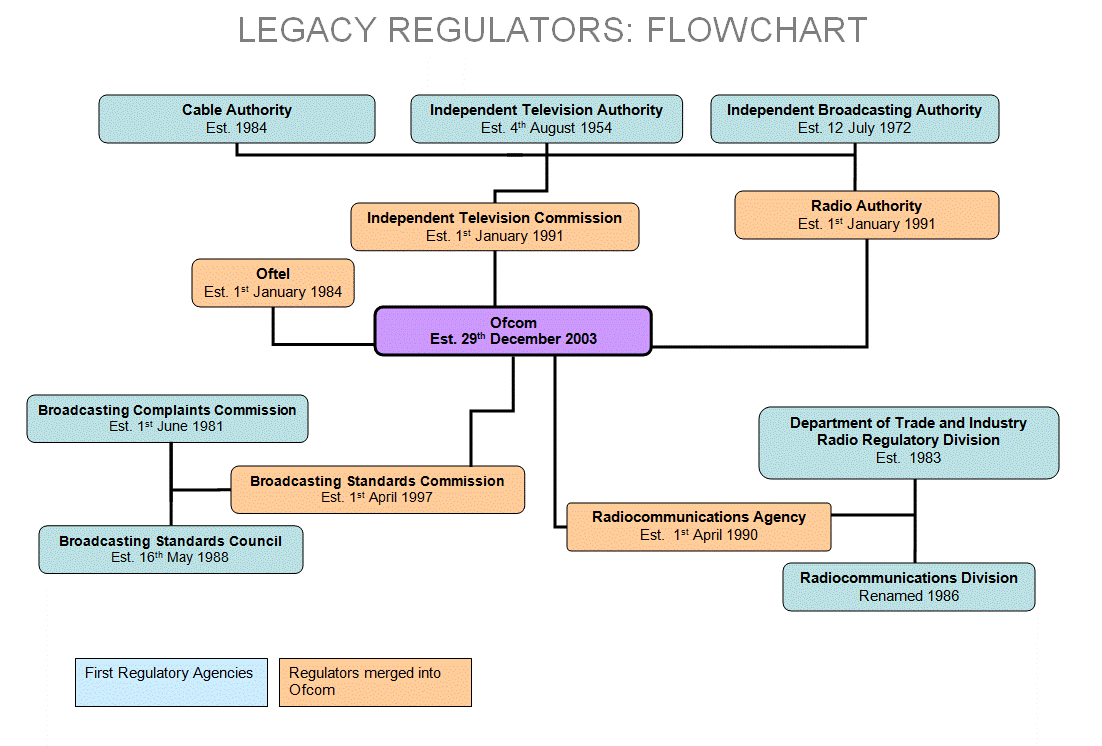
The Radiocommunications Agency (RA) was established as an executive agency of the Department of Trade and Industry on 2 April 1990. This information sheet is a brief introduction to the Agency and its work.

Strategy and Objectives

The Agency is responsible for managing most non-military radio spectrum in the UK and representing the UK in international discussions on radio spectrum. It aims to develop its role at the centre of one of the most dynamic sectors of the economy.

The key aim of the Radiocommunications Agency is:

To be the best spectrum manager in the world, promoting opportunities to access radio spectrum to build a successful and competitive economy and enhance quality of life.

Its broad business objectives may be summarised as follows.

1. To develop and sustain consistent and transparent competitive frameworks

2. To become truly customer focused, and to ensure the best possible delivery of our services (Modernising Government and Civil Service Reform)

3. To focus on driving innovation, building on investment in the science base

*

Our Commitment to You

The Agency is committed to improving the quality of service which it provides, and the highest possible standard of radiocommunications to all its customers. Our annual performance targets reflect the priorities of our customers.

*

What is Radio?

Radio is a small part of the electromagnetic spectrum (see Figure 1 below) that is used for a wide range of business and non-business purposes as described below. For a more technical description, see below.

Figure 1.

The Radio Spectrum

Radio Frequency Spectrum diagram

*

Managing the Radio Spectrum: A Vital National Resource

The knowledge driven economy relies on efficient communications and radio is a uniquely versatile communications medium. The radio spectrum supports an enormous range of services and applications and is in increasing demand by many kinds of users. The spectrum is a finite resource and its effective management by the Agency is crucial to UK success in the Information Age.

Radio is increasingly important to business efficiency and international competitiveness.

Radio makes a considerable, and fast-growing, contribution to the economy. Spectrum-based businesses employ hundreds of thousands of people and are one of the fastest-growing, successful and dynamic sectors of the economy. Radio in its many diverse forms is of vital importance to businesses from High Street taxis and freight transport to broadcasting and multi-national telecommunications. For example, telephone traffic is often carried by radio over links between cities and on international links via satellites; and mobile telephones would be quite impossible without radio. Overall, spectrum-based businesses of all sizes throughout the economy generate billions of pounds for the economy and support hundreds of thousands of jobs.

Quality and safety of life

The radio spectrum is not used solely for business. Radio entertains and informs us; allows us to communicate for business and for pleasure; assists safe travel by land, air and sea; provides the effective communications on which the emergency services and armed forces depend for their operational efficiency and assists scientific research.

Radio plays an increasingly important part in our everyday life.

The radio spectrum is used for a vast range of business, cultural, social and scientific purposes. Television and sound broadcasting spring immediately to mind but mobile telephones, radar, walkie-talkies, amateur and Citizens' Band radio, satellite navigation systems, air traffic control, radioastronomy and many, many other services and applications we take for granted also use radio spectrum.

*

Sharing the Radio Spectrum Resource

Because of the demands for spectrum, it is often necessary for users to share the same frequencies. For example, frequencies used by local broadcast radio stations in the VHF band may be re-used up to about 10 times throughout the UK, whereas in the case of a frequency used for a high power national broadcasting service in the medium-wave band it may only be feasible to re-use it about 3 times throughout the whole of Europe. At very high microwave frequencies, used for instance by point to point links, frequency re-use of 100 times or more may be possible in the UK. With current technology the highest concentration of use tends to occur in the VHF and UHF bands particularly amongst mobile radio users. This concentration means that the spectrum must be used as efficiently as possible by re-using frequencies many times and by users sharing channels rather than having exclusive use of them.

*

Managing Radio Spectrum: The Role of the Agency

Radio waves, used by millions worldwide, do not conveniently stop at political or administrative boundaries. Without adequate planning and management, radio signals from different users and services would interfere with each other and radio could become useless as a means of communication. It is the role of the Agency to manage the radio spectrum so as to ensure that it is used in the most efficient and effective way to the overall benefit of the UK.

The Agency plans and manages spectrum use to ensure as far as possible that the right kind of spectrum is available for those who need it when they need it, and that it is used efficiently and with as little interference as possible. In reaching decisions on the allocation and assignment of frequencies the Agency has to take into account the often competing requirements of radio users.

The Agency does this by:

  1. frequency planning. Allocating different parts of the spectrum to particular services on a strategic basis so that the services do not interfere with each other;
  2. assignment and licensing. Planning the assignments made to individual users within the allocations and licensing systems so that spectrum is used efficiently without interference between users;
  3. keeping the spectrum clean. If harmful interference occurs, investigating and taking action to deal with it.

1. Frequency planning

Careful planning and co-ordination with neighbouring countries are essential. This constrains our use of the spectrum. However, it also provides opportunities for UK businesses and users. There is a growing trend within Europe and on a more global basis to harmonise the use of radio wherever possible. This means agreeing that frequencies are used for similar applications in neighbouring countries and that, where appropriate, European standards and specifications are set for the approval of radio equipment. Harmonisation, particularly within Europe, benefits the UK in that it eases and speeds co-ordination between radio administrations, creates a wider and more open market for our manufacturers and, through increased competition, provides a wider choice of equipment and services. The management of the spectrum must be based on international agreements. The Agency plays a key role, participating in many international negotiations to protect and promote the best interests of the UK.

2. Assignment and licensing

Since radio equipment has the potential to cause interference to other users of the spectrum, users of such equipment must obtain a Wireless Telegraphy Act (WT Act) licence. It is an offence to install and use radio transmission equipment without a licence unless it has been exempted from licensing.

Wherever possible the Agency aims to exempt the use of the radio spectrum from licensing so as to reduce the burden on users. Many short range devices such as metal detectors, radio controls for model aircraft and some types of radio microphones are unlikely to cause interference to other users. Therefore they have been exempted from the requirement for a WT Act licence. Full details of exempt devices can be obtained from the address below.

The Agency makes balanced use of the range of spectrum management tools at its disposal:

* regulation - the imposition of licence terms and conditions to enable users to operate without causing serious interference to each other, for example on the frequencies that may be used, the technical standards to be met by equipment and operating conditions;
* spectrum pricing - licence fees are set by regulation with a view to supporting spectrum management objectives, such as meeting demand for spectrum and the promotion of spectrum efficiency, economic benefits, innovation and competition. Users are, generally speaking, charged more if they have more extensive spectrum coverage or use radio in parts of the country where there is spectrum congestion. This helps ensure hat, where spectrum is in short supply, it is used by those who can use it to best advantage;
* auctions - licences may be auctioned where this is considered to promote optimal use of the spectrum. Generally speaking, licences would be auctioned only for new national or regional services and where there are more potential users than can be accommodated in the spectrum that is available;
* spectrum efficiency grants - subject to the consent of the Treasury, the Agency has power to make grants to promote spectrum efficiency.

3. Keeping the spectrum clean

The Agency takes great care in all aspects of planning and assigning frequencies to users, taking account not only of the type and location of the proposed use but, most importantly, of other existing or planned users of the spectrum. However, despite the Agency's best efforts, interference may still occur to radio transmissions. Sources of interference can include other legitimate radio transmitters which may be malfunctioning, incorrectly installed or improperly operated, unauthorised broadcasters or non-radio equipment, such as radio frequency dryers or computers.

Staff at the Agency's network of local offices offer customers advice about radio services and investigate complaints of interference. If necessary, they use their statutory enforcement powers to remove or reduce interference.

*

Dialogue and Consultation

The Agency continually consults with manufacturers and users of radio to determine their views and requirements, to develop and explain policies to them and to agree standards for radio equipment. Consultation takes place both formally and informally. The Agency aims to be open with customers in seeking their views and explaining the reasons for decisions that affect their use of radio. To further this aim, the Radiocommunications Agency produces an annual publication, Strategy for the Future Use of the Radio Spectrum in the UK, detailing:

* the Agency's view of trends in radiocommunications;
* key policy objectives and how the Agency aims to achieve them;
* strategies for specific services, focusing on fixed, satellite and mobile communications, space research, radio astronomy and broadcasting.

All users of the radio spectrum are invited to comment on this document.

Formal consultation is done in many ways: via committees with representatives from users and industry covering key areas such as broadcasting, fixed and mobile services. There are also several committees dealing with international technical and quality standards, and recommendations on the use of radio which provide feedback to industry and briefing for the UK representation on those international bodies. In addition, when new initiatives or policy issues are under consideration, the Agency often issues consultative documents seeking views on the proposals. The annual licence fee setting process also requires consultation on the proposals. A list of consultative documents produced is included in our information sheet RA 0.

More informal consultations occur at ad-hoc meetings, at seminars, trade exhibitions and the annual Roadshow events.

*

Research and Development

The Agency has an ongoing programme of research and development in radio communication technologies and spectrum management techniques. The National Radio Propagation Committee advises the Agency on its radio propagation research programme and ensures that the results of the research are shared amongst the radio community.

*

RA Resources

The Agency is part of DTI and its staff are civil servants but it is managed as far as possible on business lines. Planning and managing the spectrum requires specialist expertise and nearly half the total number of staff are radio engineering and technical specialists. The remainder fill administrative and managerial roles. Many of the staff are located in the Agency's headquarters, with others at the Radio Technology Compatibility Group which carries out research, development and testing of radio equipment, and the Baldock Radio Monitoring Station which has fixed and mobile facilities for monitoring the radio spectrum. Nearly 200 of the Agency's staff work in a network of local offices taking spectrum management services directly to our customers.

Details of the Agency's expenditure and income are published in the Annual Report and Accounts.

*

Agency Structure

The Agency is arranged in four executives, each headed by a Director dealing with Spectrum Policy, Spectrum Services, Customer Services and Corporate Services and Facilities. Their work is summarised below.

*

Outside Bodies

Three external bodies have links with the Agency.

  1. Radio Spectrum International is the Agency's public-private partnership with CMG plc, a leading European IT company. RSI is a private sector joint venture that supplies the Agency with advanced information systems and also exploits the Agency's intellectual property and know-how by providing consultancy services on a commercial basis to spectrum managers throughout the world.
  2. The Spectrum Management Advisory Group is an independent body under the chairmanship of Dr John Forrest and with members selected from a wide range of backgrounds that provides independent strategic advice on spectrum matters to Ministers and the Agency.
  3. The Agency Steering Board under the chairmanship of Alastair Macdonald CB, Director General Industry at the DTI, and with external members having relevant industrial or commercial experience, advises the Secretary of State on the Agency's Corporate Plan and the extent to which the Agency carries out its functions effectively and efficiently. The Steering Board also has a role in considering complaints that cannot be resolved by the Chief Executive to the satisfaction of the complainant.

*

RA Executives

Spectrum Policy Executive (RA1)
* Strategic spectrum planning
* International representation
* Radio engineering.
* Developing UK Spectrum Strategy.
As part of long-term planning, market demand, RA1 oversees a programme of economic and market demand studies.
* Co-ordinating spectrum use with other government departments, in particular the MoD, through leadership of interdepartmental committees on spectrum strategy, national frequency planning, frequency clearance and radio site clearance.
* Spectrum 'wholesaler', allocating frequencies to specific radio services or applications.
* Representing UK in international discussions on frequency harmonisation, spectrum engineering and technical standards harmonisation. In Europe, this takes place in the CEPT - the 43-member European Conference of Postal and Telecommunications Administrations) - and ETSI - the European Telecommunications Standards Institute - and, at global level, in the ITU - the United Nation's International Telecommunication Union with over 180 member states.
* Co-ordinating international spectrum use, e.g. procedures and policy on international notification, registration and co-ordination of frequency assignments, especially satellite filings. Providing advice on International Radio Regulations.
* Co-ordinating Agency's research programme, which covers many aspects of spectrum management, spectrum sharing, radio propagation and radio system planning. This programme underpins many aspects of RA's work and especially long-term planning of frequency allocations. RA1 leads for the UK internationally and maintains close contacts with the research councils, academic institutions and research bodies.
Spectrum Services Executive (RA2)
* Planning spectrum for individual services
* Licensing and exemption policy
* Spectrum pricing
* Authorising use of the radio spectrum by individual users through licensing or exemption. Spectrum 'retailer'.
* Designing licence terms and conditions, e.g. on radio frequency, technical requirements and operating details, on how our customers may use radio without causing interference to others.
* Developing and implementing spectrum pricing policy.
* Authorising or overseeing use of radio equipment by licensing or licence exemption; and formulating the technical and operating standards for the use of radio equipment.
* Seven Business Units responsible for:
* licensing and pricing policy;
* specialist sectors (aeronautical, marine, amateur, CB, programme making and special events);
* private business radio systems;
* public telecommunications networks;
* fixed links (including terrestrial and satellite services);
* broadcasting (including multimedia and satellite);
* technology sectors (including conformity assessment, short range devices and test and development licensing).
* National and specialist licensing take place at our headquarters. Most local services involving individual frequency assignments are handled by our local offices.
* Some licence classes handled under contract to the Agency by external agents within a licensing policy framework and to service standards set by RA2.
Customer Service Executive (RA3)
* 'Keeping the Spectrum Clean'
* Local services for local customers
* Interference investigation, monitoring and enforcement
Serving customers.
* Education in correct radio use.
* Dealing with interference in accordance with priorities set by Ministers:
* interference affecting emergency services within 24 hours;
* interference affecting businesses within 1 week;
* other complaints within 1 month.

Issuing local licences and inspecting installations to ensure they comply with licence conditions and so are unlikely to interfere with other users.

Monitoring and technical support.
* The Satellite Monitoring Station observes communications and broadcast satellites to resolve interference and conflicts between users. It has two fully steerable large parabolic reflectors for Ku and C bands and a1.8m antenna for L band.
* Mobile Monitoring Teams systematically monitor usage of the private business radio (PBR) bands the UK. Unattended systems monitor PBR channels at selected locations. These can be controlled and read by remote control.
* The NAMAS accredited EMC and interference laboratories deal with complex measurement and interference work across the whole radio spectrum.
* The Radio Technology and Compatibility Group provides technical evaluation of compatibility of radio systems and contributes to international study groups.

The Terrestrial Monitoring Station tracks down sources of harmful interference reported by UK users and overseas administrations. The station is staffed around the clock.

Enforcement and prosecutions
* Agency policy is to try to persuade radio users to operate legally. Those who fail to do so and risk interference to authorised users or who, like unauthorised broadcasters, deliberately flout the law are prosecuted.
Corporate Services and Facilities Executive (RA4)
* Financial, human and physical resource management.
* Communications
* Business processes.
* Recruitment, personnel, training and development, IiP accreditation.
* Finance, purchasing and contracts, planning and budget management, day-to day financial matters and preparing year end accounts.
* Interface between the Agency and Radio Spectrum International Consulting, the joint venture company set up to deliver IT services to the Agency and exploit the UK's spectrum management expertise internationally.
* Business process re-engineering, benchmarking and quality management across the Agency.
* Accommodation issues, building security, records management and Health and Safety.
* Internal and external communication strategies, information and library services, the Agency enquiry point, the Agency's website and publications.

*

What is Radio?

Technically, radio is a small part of the electromagnetic spectrum (see Figure 1), so-called because electromagnetic waves are driven across space at the speed of light by electric and magnetic forces. Gamma rays, x-rays, ultra-violet, visible light and infra-red are also parts of the same spectrum. They all travel at the identical speed but have different properties and uses, depending on their frequency or wavelength 1.

If equipment generating radio frequency energy (a transmitter) is connected to an antenna (or aerial) the energy is radiated in the form of radio waves. Some of the radiated energy can then be collected by another antenna which, when coupled to a radio receiver, enables a link to be made between the transmitter and receiver. Adding information to the radio carrier wave enables messages to be transmitted. These messages may take the form of television programmes, voice messages, data or other forms of radio communication. Radio is an immensely versatile medium.

The way in which radio waves propagate or travel through the atmosphere varies with the frequency or wavelength of the radio signal. In general, the lower the frequency the further the distance that radio waves will travel. As the frequency increases, the waves may be obstructed or deflected by hills and buildings. At extremely high frequencies, rainfall and other weather conditions can significantly limit the effective operating range of radio communications. These propagation characteristics mean that different bands of frequencies are suited to particular types of radio use. For example, for national and international broadcasting the long-wave (approximately 148-283 kHz) and medium-wave (approximately 526-1606 kHz) bands are used. At the higher frequencies such as VHF (Very High Frequency - 30 to 300 MHz) and UHF (Ultra High Frequency - 300 to 3000 MHz), where the effective transmission range is shorter, the bands are more suited to local broadcasting or local coverage for mobile radio systems. At higher frequencies it is possible to allocate wider channels (i.e., more bandwidth) and this allows more information to be transmitted per channel than at lower frequencies. For example, at VHF, because of the greater bandwidth available, high quality stereo music can be transmitted, but a typical channel in the long wave bands will support only a low quality music broadcast.

1 Frequency is the number of times the wave repeats each second and is measured in Hertz (Hz). Commonly used units include kiloHertz (kHz) or thousands of Hertz, MegaHertz (MHz) or millions of Hertz and GigaHertz (GHz) or 1000 millions of Hertz. Wavelength is the length of the radio wave from peak to peak and varies from kilometres in the case of long wave radio to centimetres for microwaves or even millimetres for some radio applications. Frequency and wavelength are related mathematically.

Wavelength x Frequency = Speed of light (about 300,000 kilometres per second)

*

Further Information

For more details on the services provided by the Agency or for information on help to radio users, radio licensing requirements or monitoring facilities, please contact the Agency's 24-Hour Telephone Enquiry Service on 020 7211 0211.

The Agency publishes a range of information leaflets, guidance notes and technical specifications dealing with most aspects of radio use. If you require a publication, please contact:

Information and Library Service
Radiocommunications Agency
Wyndham House
189 Marsh Wall
London
E14 9SX

Telephone: 020 7211 0502/0505
Facsimile: 020 7211 0507

E-mail: library@ra.gsi.gov.uk

Leaflet RA 0, available from the above address, lists current Agency publications.


  Up Image Top

*

RA354 v2
Revised August 2002

RA Home Page