![]() |
Ship Radio Licence Information Sheet |
![]()
This information sheet is intended to illustrate the fact that the use of Maritime radio equipment (which includes VHF) is regulated by the international Radio Regulations as set by the International Telecommunication Union (ITU). It also outlines the role of the Radiocommunications Agency and the importance of its work in implementing these regulations.
Article S18 of the international Radio Regulations requires that:
No transmitting station may be established or operated by a private person or any enterprise without a licence issued in an appropriate form and in conformity with the provisions of these Regulations by or on behalf of the government of the country to which the station in question is subject.
Article S47 of the international Radio Regulations further states that:
The service of every ship radiotelephone station, ship earth station and ship station shall be controlled by an operator holding a certificate issued or recognised by the government to which the station is subject. Provided the station is so controlled, other persons besides the holder of the certificate may use the equipment.
This means that maritime radio equipment available for use on board a vessel that is owned by a UK citizen or UK registered must be:
The ITU was founded in Paris in 1865 as the International Telegraph Union it took its present name in 1934 and became a specialised agency of the United Nations based in Geneva in 1947. The ITU is an intergovernmental organisation, within which the public and private sectors co-operate for the development of telecommunications worldwide. The ITU adopts international regulations and treaties governing all terrestrial and space uses of the frequency spectrum, within which countries adopt their national legislation.
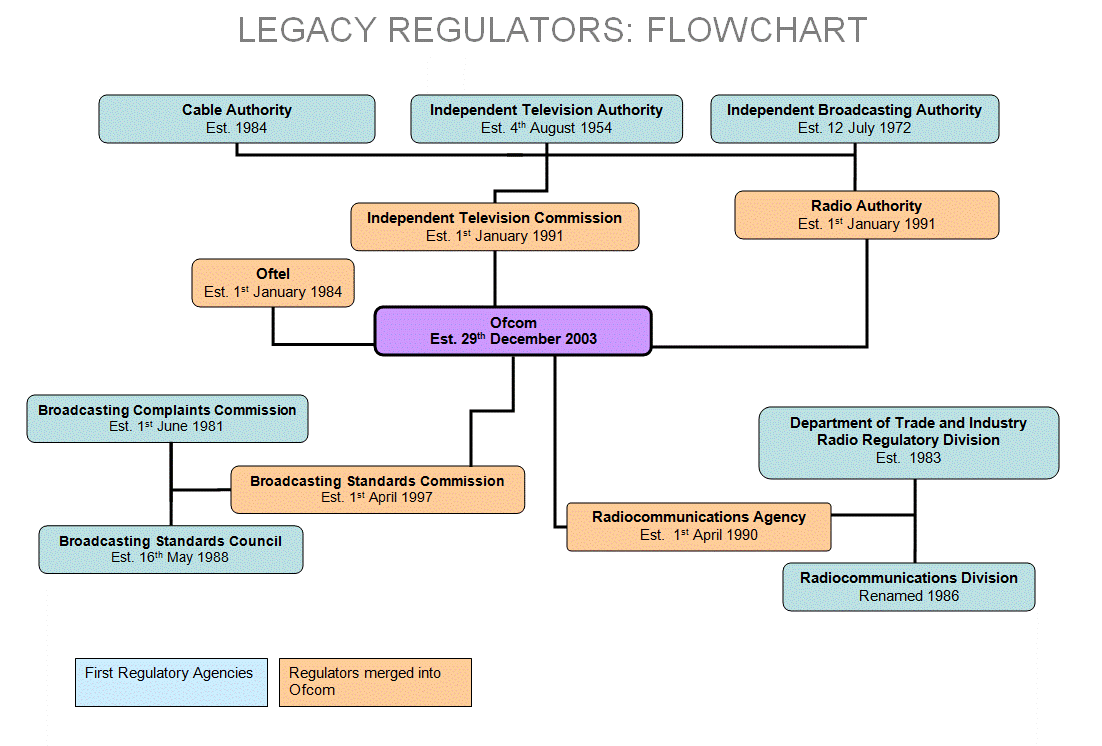
The Radiocommunications Agency (the Agency) is an executive agency of the Department of Trade and Industry and is responsible for the management of most aspects of use of the civil radio spectrum within the United Kingdom (UK). The Agency is also responsible for implementing the international Radio Regulations within the UK.
Radio communications are used by millions of people worldwide and the signals do not stop at national frontiers. Without adequate planning and management, radio users and services would interfere with each other and above a certain level of interference radio becomes useless as a reliable means of communication. Maritime radio exists primarily for the safety of human life and vessels at sea. It is vital that interference is avoided.
The Wireless Telegraphy Act 1949 is the primary UK legislation which enforces the international Radio Regulations and determines the rules for radio use in the UK. The WT Act makes it an offence to have available for use, radio transmission equipment without a licence unless it has been specifically designated as licence exempt. The installation and use of maritime radio transmission equipment, including hand portables, must be covered by a WT Act Licence.
As an Executive Agency of the Department of Trade and Industry the Agency is required to recover its full costs. This is done by charging fees for licences and also by recovering costs from other government departments and major users of the spectrum. Licence fees are reviewed each year and the level of licence fees is set by an order of Parliament.
Licence fees recover the costs the Agency incurs in managing the radio spectrum. The Agency plans and manages the spectrum to ensure that the appropriate kind of spectrum is available to those who need it, that it is used efficiently and with as little interference as possible. The Agency does this by spectrum planning and by control of interference and enforcement (fuller details are available in information sheet RA354: RA - its Role in Managing the UK Radio Spectrum).
In order to plan and co-ordinate the use of the radio spectrum with neighbouring countries, the Agency is a key participant in many international negotiations to protect and promote the best interests of the United Kingdom. Maritime frequency bands are internationally agreed and are set out in the Radio Regulations which are agreed at the World Radio Conferences of the Inter-national Telecommunication Union (ITU). The Radio Regulations have international treaty status and are binding on Member States, including the United Kingdom.
The Agency has a network of regional offices across the United Kingdom where the staff offer customers advice about radio services and investigate complaints of interference. Where necessary the Agency will not hesitate to take enforcement action under the Wireless Telegraphy Act to prevent interference or abuse caused by those who operate without a licence or who contravene the terms and conditions of their licence. Agency staff carry out routine spot checks to ensure that users of maritime radio hold valid WT Act licences and operators certificates.
1. When you apply for a Ship Radio Licence you are not merely complying with the law, there are safety-related reasons why it makes sense:
The call sign
A call sign is issued for your vessel as part of the licensing function. This call sign is a unique identification for your vessel (unlike its name). The call sign is recognised worldwide because the Agency registers it with the ITU along with the details you give about your vessel. Each month and each year when you re-licence the vessel, the details are updated with the ITU.
The Maritime Mobile Service Identification (MMSI) Number
An MMSI number is the equivalent of an electronic call sign and it is required to operate Digital Selective Calling (DSC) radio or satellite communications equipment. Either when licensing your radio for the first time, or at any point afterwards you can request an MMSI number for your equipment. The MMSI is also registered with the ITU by the Agency.
Entry on the Maritime Mobile Access and Retrieval (MARS) database
Access to the MARS database is available to all international administrations for the purpose of co-ordinating search and rescue operations. Article S20 of the Radio Regulations as amended by Resolution 340 WRC-97 (from the 1997 World Radio Conference) instructs national administrations to collect this information. Resolution 340 was introduced in order to supply search and rescue authorities with the information needed to provide the most effective assistance to a ship in distress and to assess the suitability of other vessels that may be in a position to assist.
The ITU has requested that full particulars of Ship (Radio) Stations (where available) registered in the UK are supplied for inclusion on the MARS database. The Ship Fixed Radio Licence application form requests information such as "lifeboats available", "gross tonnage" etc. in order to comply.
HM Coastguard as well as the ITU have requested that the Agency ensures that wherever possible the "24 hour Emergency contact details" and where available "alternative telephone number" are supplied for ALL vessels. The information collected complements the information supplied directly to HMCG via the CG66 form and also acts as a safety net for people who are not aware of or do not use CG66.
HM Coastguard
As well as supplying your details to the MARS database, the information about you and your vessel which is taken on the application form which is relevant to search and rescue operations is sent directly to HM Coastguard in order to help them provide assistance to you in an emergency. It is hoped that in the near future the Coastguard will be able to access this information directly from our records.
2. Other than safety of life this also means:
The call sign
A vessel with a properly registered call sign can be identified easily. It also enables a vessel owner to set up an account with an accounting authority to make use of international telephone services through foreign coast stations.
Interference protection
If you need to use your radio to communicate with another vessel, the Coastguard, a coast station, marina or port operator for whatever purpose part of the Agency's role is to ensure that you can do so without suffering/causing interference from/to other legitimate radio users.
A Ship Portable Radio Licence covers the use of a portable, hand-held marine VHF or VHF/DSC radio with an integral power supply and antenna not covered by a Ship Radio Licence. It can also additionally cover the carrying of either a 406MHz or 121.5MHz personal locator beacon (PLB). This licence is usually issued to someone who intends using a hand-held radio on more than one vessel. It is issued with a T reference as opposed to a vessel call sign and it is usual using the vessel name as an identifier because of this.
As with any marine radio you are required to either hold personally or be supervised by someone that holds the relevant marine radio operators certificate.
This licence and your operators certificate must be kept with or near the radio at all times when operating it. The Agency carries out random checks on vessels from time to time.
As maritime radio exists primarily for the safety of life and vessels at sea, education and the correct training are vital to ensure that it is operated effectively. Operator qualifications have been agreed internationally in order to ensure that users possess the skills necessary to operate their equipment effectively and a knowledge of the procedures for general calling and especially the procedures used in distress or safety situations.
The most common operator's certificate is the Short Range Certificate (SRC) which covers routine, safety, urgency and distress communications using VHF/DSC equipment. Details of courses and examinations for the Short Range Certificate are available from the Royal Yachting Association (RYA). A contact address and telephone number can be found at the end of this information sheet.
The Long Range Certificate (LRC) covers the use of MF, HF, VHF (including DSC operation) as well as satellite communications equipment. The LRC is administered by The Association of Marine Electronic and Radio Colleges (AMERC) and a contact address and telephone number can be found at the end of this information sheet.
Even if you have a radio which is covered by a valid WT Act licence you are not permitted to use it for general transmissions until you have either passed the relevant examination and are in possession of an operator's certificate and authority to operate, or have someone on board who has. This does not mean that the radio cannot be monitored for safety purposes or used to summon assistance in a distress situation. This is because the terms of the licence require that the radio is operated by or under the direct and personal supervision of a holder of a valid marine radio operator's certificate. The Authority to Operate from the Secretary of State also forms part of the operator's certificate. This certificate ensures that users of maritime radio have proven that they understand and are able to use the correct procedures for radio use and will not cause a nuisance to their fellow radio users including other vessels and HM Coastguard.
This also ensures that if you have to use your radio in an emergency situation you will be familiar with the procedures required. In other words if you, your crew, another crew or vessel relies on you to send, respond to or relay their "MAYDAY" you will be able to do so effectively and you could save someone's life.
The R&TTE directive and the UK radio interference requirements and the merchant shipping (marine equipment) regulations 1999
Under the Radio Equipment and Telecommunications Terminal Equipment Regulations 2000, which implements the EU Directive 99/5/EC (the R&TTE Directive), it is a legal requirement that all radio equipment (with certain specific exceptions) meets certain essential requirements. It is the responsibility of any person who places radio equipment on the market or takes it into service to ensure that the requirements of the R&TTE Directive are met, that it is marked with the CE marking, and that a written declaration of conformity has been drawn up for it together with information for the user on the intended use of the equipment (e.g. Maritime radio).
The R&TTE Directive replaced the old type approval regime and came into force on 8 April 2000; prior to this time it was still a legal requirement for maritime radio equipment to be type approved under section 84 of the Telecommunications Act 1984. The Directive also had a one year transition period during which equipment already covered by a type approval continued to be placed on the market and taken into service. No new type approvals have been issued since 7 April 2000. Since 7 April 2001 only equipment that complies with the R&TTE Directive may be placed on the market, though equipment already type approved may continue to be taken into service. Moreover, such equipment already taken into service would satisfy the terms of the licence.
In addition, it is the licensee's responsibility to ensure that all maritime radio equipment to be covered by the ship licence meets the relevant UK Radio Interface Requirement. UK Radio Interface Requirements provide a high level description of spectrum use (frequency range, channel spacing, output power, where appropriate a technology to be used, licensing regime, etc). Details of the relevant UK Radio Interface Requirements can be obtained from the Radiocommunications Agency, telephone 020 7211 0211.
One of the exceptions mentioned above is that of maritime radio equipment within the scope of the Directive 96/98/EC (the "Marine Equipment Directive"). This is implemented by the Merchant Shipping (Marine Equipment) Regulations 1999. This equipment is not within the scope of the R&TTE Directive but must meet the requirements of the Marine Equipment Directive. This equipment will be marked with the ship's wheel marking rather than the CE marking.
In order to comply with the licence terms any channel(s) not covered by the licence should be rendered incapable of transmission.
The fines for unlicensed use of radio are severe so as to reflect the problems that can be caused by illegal use. An unlicensed user of radio, or someone who contravenes the terms of their licence could expect a fine of up to £5,000 or a custodial sentence of up to six months and forfeiture of their radio equipment through a magistrate's court. However they can request trial through the Crown Court where the fine is unlimited and the custodial sentence can be up to two years, again with forfeiture of the equipment involved.
Information about the international Radio Regulations are available from:
International
Telecommunication Union
Place des Nations
CH 1211
Geneva 20
Switzerland
Website: www.itu.int
The Radio Licensing Centre administers ship radio licensing under the authority of the RA. To request application forms and guidance notes you should contact them at the following address:
The Radio Licensing
Centre
PO Box 1495
Bristol BS99 3QS
Tel: 0870 243 4433
Fax: 0117 975 8911
Website: www.radiolicencecentre.co.uk/
Specific enquiries relating to the use of maritime radio equipment should be made to the:
Radiocommunications Agency's Aeronautical & Maritime Section at
Tel: 020 7211 0215/0217
Fax: 020 7211 0228
The Agency produces a range of information sheets and publications concerning most areas of the Agency's work. These publications are available from the Agency's Information and Publicity Team at the following address:
The Information
and Library Service
Radiocommunications Agency
Wyndham House
189 Marsh Wall
London E14 9SX
Tel: 020 7211 0502/0505
Fax: 020 7211 0507
E-mail: library@ra.gsi.gov.uk
Website: www.radio.gov.uk
To obtain information on the Short Range Certificate the RYA can be contacted at the following address:
Royal Yachting
Association
RYA House
Romsey Road
Eastleigh
Hampshire SO50 9YA
Tel: 023 8062 7400
Fax: 023 8062 7143
Website: www.rya.org.uk/
For information on other maritime certificates you should contact the AMERC at the following address:
Association of
Marine Electronic & Radio
Colleges (AMERC)
National Administration Centre
PO Box 4
Ambleside
Cumbria LA22 0BE
Tel: 015394 440218
Fax: 015394 440219
Website: www.amerc.ac.uk/
If you are uncertain about the approval of maritime radio equipment you should contact the MCA at the following address:
Maritime and Coastguard
Agency
Spring Place
105 Commercial Road
Southampton
Hampshire SO15 1EG
Tel: 023 8032 9100
Fax: 023 8032 9252
Website: www.mcagency.org.uk
![]()
| RA 364 (Rev 3) December 2001 |